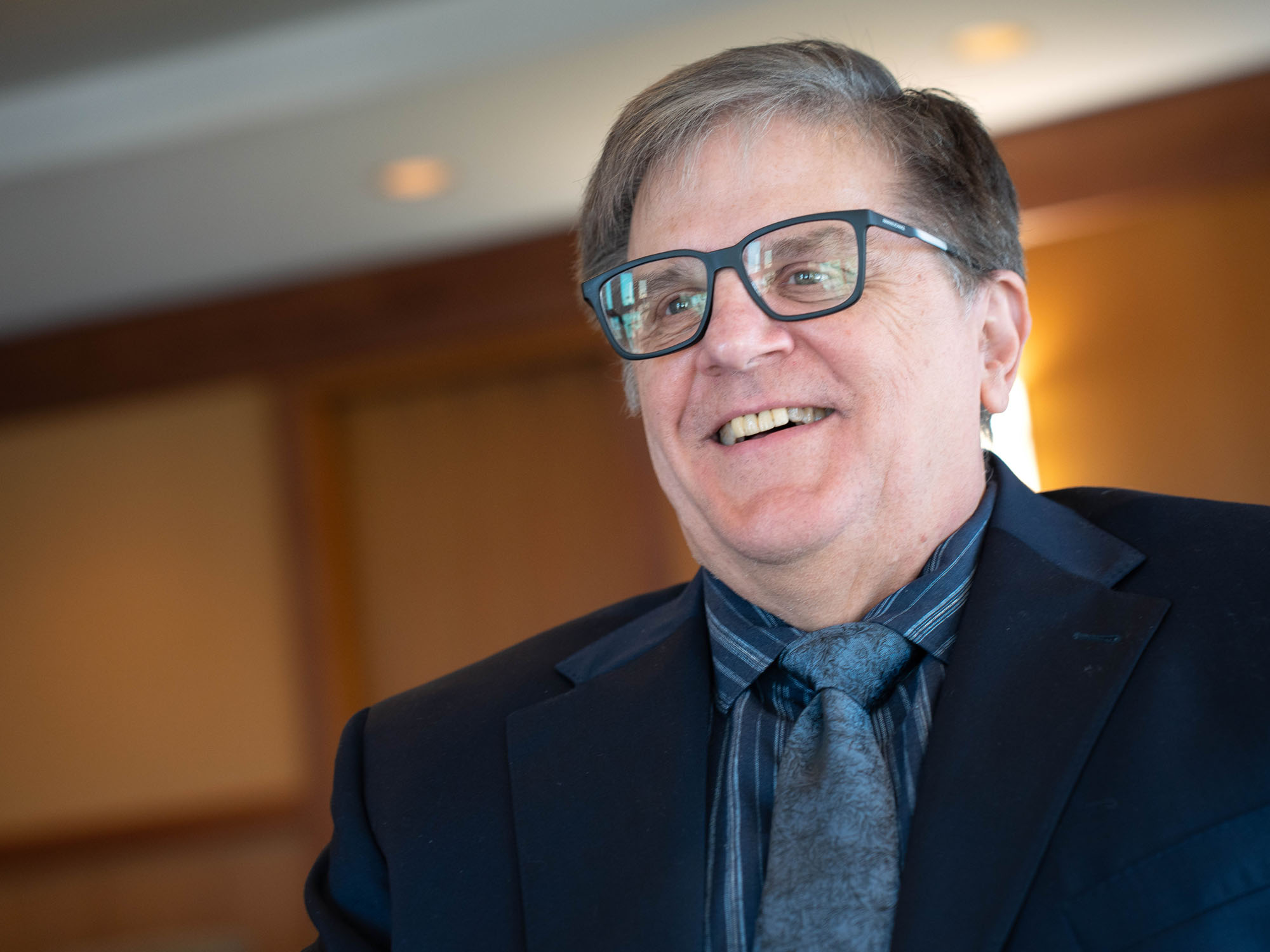
Dr. Dan Gerlowski has held many roles at The University of Baltimore since arriving 40 years ago. During that time, he has been a professor, associate dean and interim dean. Many Merrick School of Business students and alumni know him as an economics professor. Most recently, he has taken over again as interim dean of the business school. One constant, despite the changing positions, is that he has always been focused on one goal—preparing students from every background and experience level for successful careers. Dan recently shared his passions for UBalt, higher education and economics over coffee.
Q: What about UBalt has made you stay here for your nearly 40-year career?
A: The students. Our students back 40 years ago were hard-working, part-time, struggling to balance their time, struggling to get ahead. Very similar to what we see today. Our students are largely part time. There are no dorms for them. They struggle to get ahead, and they want to have the tools to reverse that. We have a phrase that defines us at UBalt: What you do in class today, we hope that you can use it at your job tomorrow. We want to see success. We want our students graduate and lead productive, meaningful lives. And we see students doing that. That's what keeps me and my colleagues at the university.
Q: You’ve spoken about your long-time passion for economics, even getting your Ph.D. in the field and ultimately deciding to pursue academics in the field despite being accepted to several law schools. What is it about economics that appealed to you and how do you pass your knowledge to students?
A: Many legal outcomes are zero sum; there's a winner and there's a loser. That distracted me from going that way. Economics itself is a very abstract thing. If you go and ask people, what the origins of accounting were, some people will say that it began in economics. Finance clearly grew out of economics. Economics is a big, amorphous field—a social science that means different things to different people, and I appreciate and thrive in that expansive approach. At its core, we have fundamental axioms and ideas like opportunity cost that underpin all research and modeling in one way, shape or form. The real challenge lies in where you take those basic ideas and what you do with them to create meaningful impact.
This is my favorite teaching line: I’ll ask, if the Ravens have a good season, what's going to happen to the price of Ravens jerseys? Well, it's going to go up. OK, that's almost good enough. Now, you need a model to put behind that. You need to understand demand and supply, its growth, its limitations, its usefulness, its applicability to answer questions harder than what happens when the Ravens have a good season, and you build off of that. Then you move to advanced demand ideas, things like demand elasticity. There's a foundation for each one of those ideas, and the foundation is you probably knew a lot of this intuitively, so let's work with that intuitive knowledge.

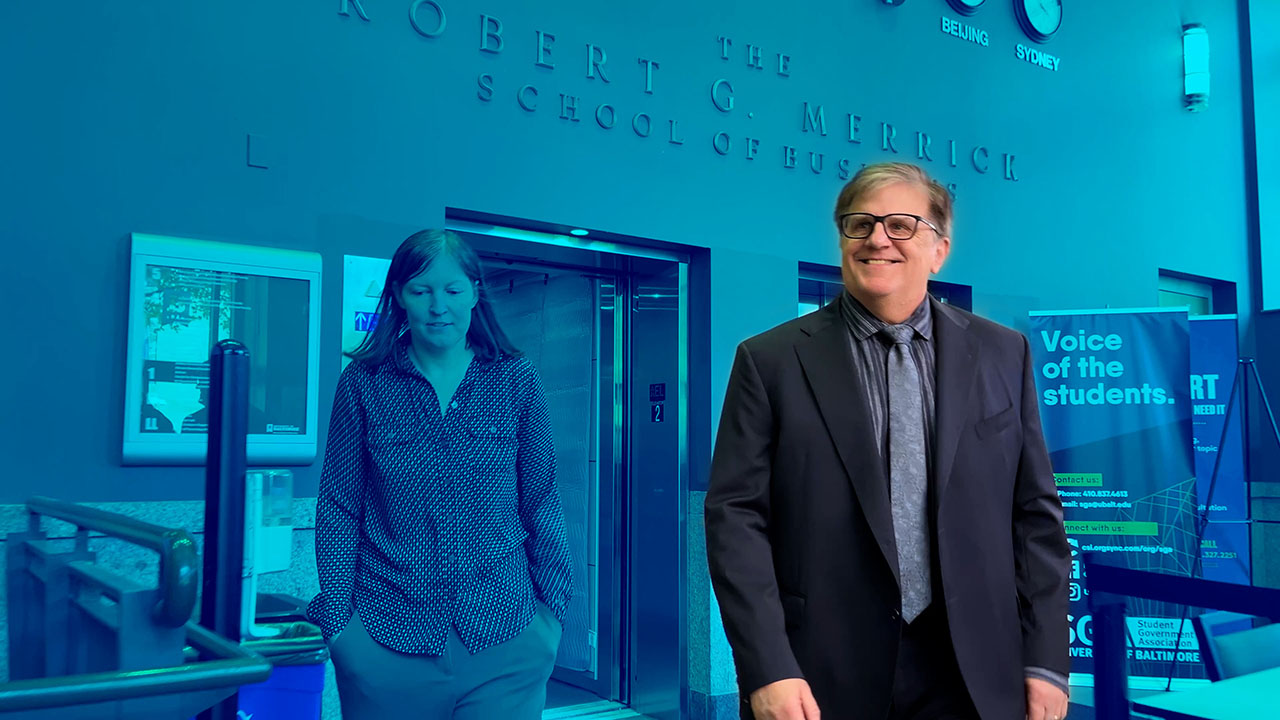
Q: You’ve been part of key turning points in the University’s history during your time here. In the late 1990s, you were part of the School of Business team to bring the MBA fully online. Most recently, you helped oversee the University’s Middle States re-accreditation process, and now, as interim dean ushering UBalt’s business school into its second century, how do you strike a balance between fostering an environment students need now while building a college that’s equipped for the demands of the future?
A: In a lot of ways, the future is coming along faster than we think it is, in particular, artificial intelligence. There's quite a flash point amongst faculty, and society at large, regarding artificial intelligence. In the school, we know that AI is here. We know AI is going to become more and more part of our lives. We know that AI can make tasks easy. We know it can be misleading, and we know that it can lead people astray as well.
We have to bring the best of AI into the classroom. UBalt President Kurt Schmoke said two things about UBalt’s approach to AI: You must teach students how to live with AI, and you need to figure out how to use AI and not infringe upon academic integrity. Those are big challenges. The business school is lucky. We have a very talented faculty in the AI area. I think the entire University wants to build AI into its programs.
You used to be asked on a job interview: Do you know how to use Word? Now, it's going to be: Do you know how to use augmentative AI? And we need to get our students ready for that. We have hints of what that future is going to be. We know that our role in the business, economics and in society is not to build large language models. Our role is to use these tools to solve problems.
Q: You’ve co-authored papers that examine a college education’s value and specifically how a degree increases social and economic mobility. In a time when the value of college is often called into question, what attributes must a college have to maximize return on investment for the student? What’s UBalt’s best attribute?
A: In general, colleges and universities, need to deliver on their mission. If they're not going to deliver on their mission, they're not going to succeed. The Merrick School’s is about helping people advance in their careers. Traditionally, that meant theories and knowledge. Right now, the concepts are important, but the value added is improving the processes that support those concepts in an applied way. If we can train the best generation of candle-makers ever, that's not going to help anybody, right? We need to think about what tools can we put in their tool kits. Our best attribute is one of UBalt’s motto’s “Knowledge That Works.”