

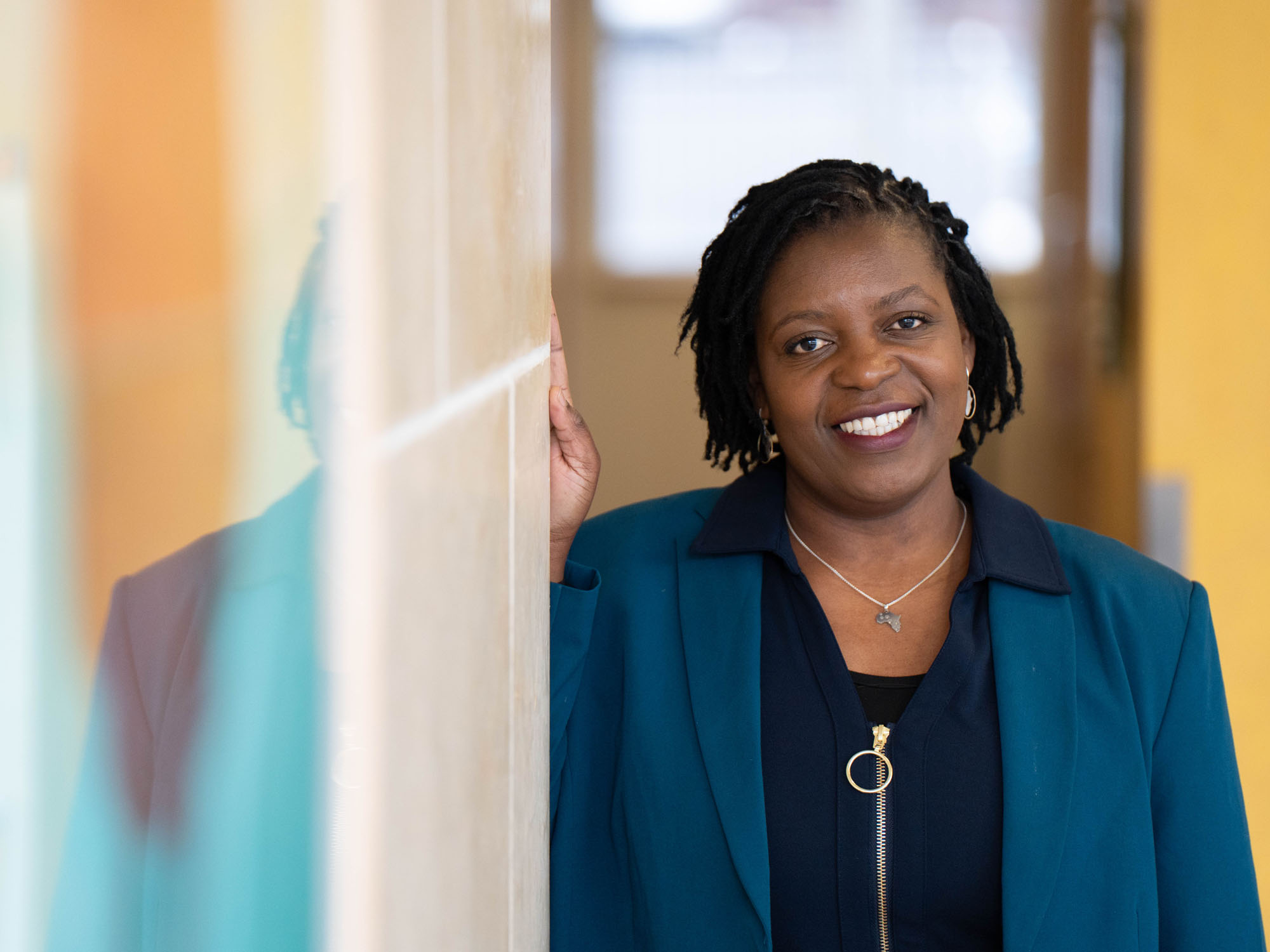
Memory Jakata looked at universities all over the world before committing to The University of Baltimore.
If she was going to leave her home in South Africa to pursue the advanced degree she needed to achieve her long-term career goals, she knew the choice had to be intentional. UBalt, and it’s M.S. in Finance program, offered the balance of rigor, relevance and support she wanted. It checked all her boxes.
“We looked at programs in Poland, the U.K., Australia, and Canada, and I was accepted to all of them,” Memory said. “UBalt stood out because it wasn’t just traditional finance. The program was intentionally built with analytics, and that mattered to me.”
Memory has been working in finance roles for more than 20 years. She doesn’t want to leave the field she’s familiar with but was looking to deepen her impact within it. Many of the programs she considered felt too basic or too familiar. She wanted something that would challenge her, expand her technical skills, and reconnect her to the excitement of learning.
“I needed something fresh, something different, something that would push me and make me excited to do this,” Memory said.
UBalt’s M.S. in Finance is a STEM-designated program that has been retooled in recent years to emphasize quantitative analysis, data-driven decision-making and statistical modeling. The program has been exactly what Memory wanted.
“I’m learning Python, Advanced Statistics, Modeling, Business Intelligence and Visualization to name a few, and that’s incredible to think that I once relied only on hand calculations and basic tools,” she said. “My transcript shows how much I’ve grown, from finance and statistics to data science and machine learning. UBalt professors truly believe in their students. The moment you walk in, they’re committed to helping you push your limits and succeed.”
Nearly all of Memory’s classes are heavily data-focused, and she’s enjoying learning about the different methods of managing it and making decisions from it. She is also getting a front-row seat to the rise of artificial intelligence in the workplace and gaining an understanding of where she fits alongside it, something that was unthinkable when she last graduated.
Memory had the opportunity to apply her newly gained knowledge alongside years of professional experience during a summer internship with The Harbor Bank of Maryland. She secured the role through the Schaefer Center for Public Policy’s Next Gen Leadership for Public Service program.
Memory quickly found herself working at the intersection of research, strategy and community impact.
“I’ve always carried a lot of practical knowledge with me,” Memory said. “But pairing that foundation with what I’ve learned in class helped me approach the work at a different level. The team was supporting tech founders and helping them scale, and I was able to identify a few companies, drill down, and produce market research they hadn’t had the time or capacity to do. I put together a 30-plus-page report with data, analysis, and clear recommendations. It felt meaningful to contribute something so thorough and to realize how much I’ve grown.”
Experiences like her internship, her on-campus job as a graduate administrative assistant with the Division of Student Success and Support Services, and her involvement in student life have further cemented Memory’s choice in UBalt.
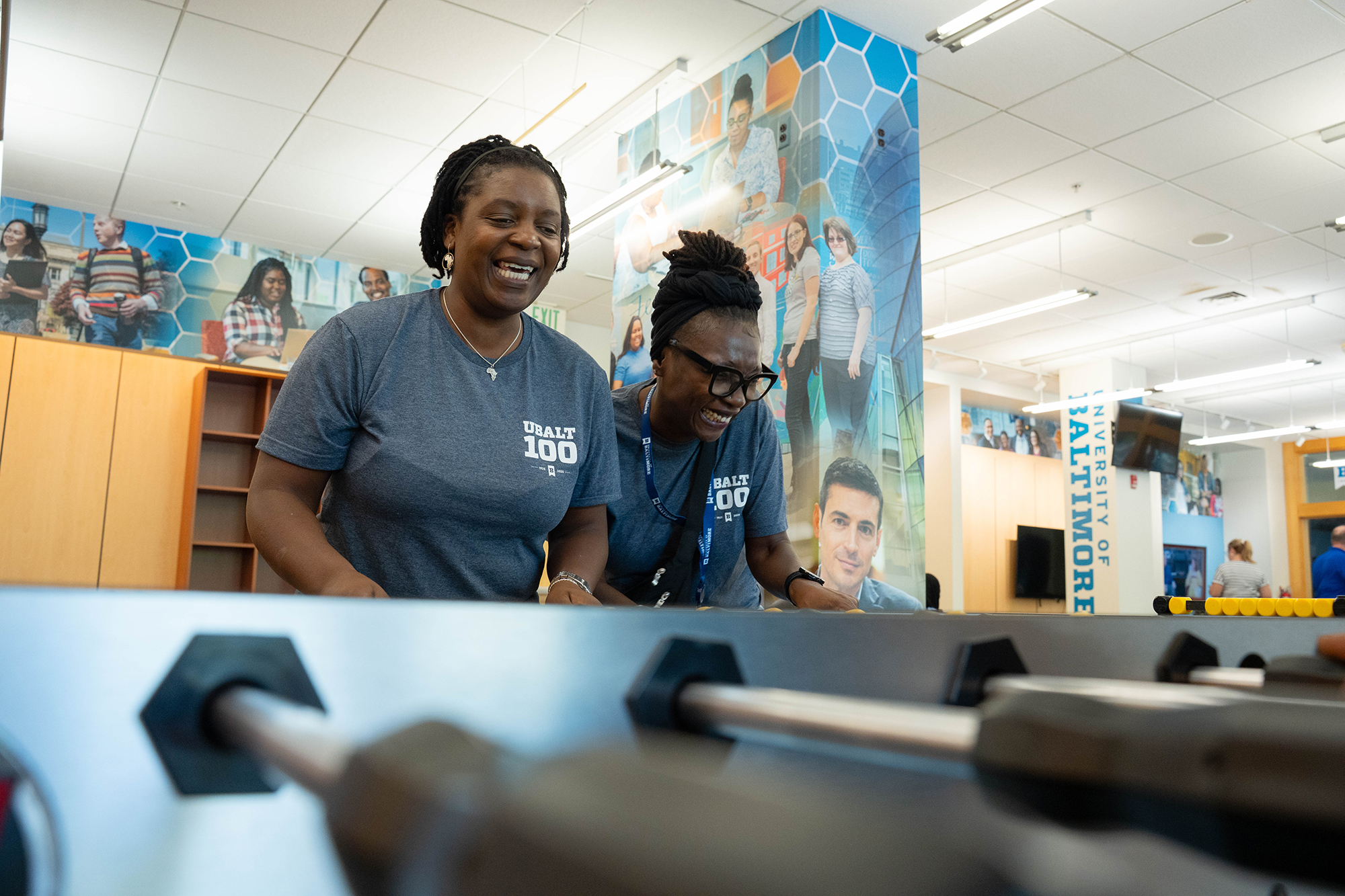
“Building friendships and connecting with colleagues, academically and socially, has made campus feel genuinely welcoming,” she said. “That sense of community has eased my transition and made everyday life feel lighter.”
While Memory’s husband and children are still at home in Africa, she does have a sister nearby in Baltimore. That’s how she was first introduced to UBalt. Her brother-in-law found the program and suggested she investigate it.
“While my other applications were still in progress, we started looking into UBalt, visited the campus, and immediately felt a connection,” Memory said. “There was something about the environment that just felt right.”
It was around that time she met James Shea, a senior admission counselor who focuses specifically on supporting international students.
“It was comforting to realize I could find a place where I wouldn’t just be a number,” Memory said. “I felt seen, supported and genuinely valued.”
Even with that reassurance, Memory still wrestled with doubt about returning to school after a decade away. She also had to weigh the decision carefully as a spouse and parent, knowing it would require significant sacrifice.
She was able to connect with Dr. Mikhail Pevzner, a professor and the graduate business program director, for another view of the program and her potential place in it.
Not only did he assure Memory that she could excel in the program, but he pointed out some courses she could waive because of her professional experience.
Memory noted that, unlike other universities she considered, UBalt consistently checked in with her in a personal and supportive way not simply through automated messages. She never looked back.
“I had real nerves ‘Can I do this?’” she said. “Even now, I sometimes look back and get a shiver thinking about what I’ve been able to accomplish: the grades, the projects, the growth. When I started, I told myself, ‘Forget everything you already know. Go there and be a student regardless of your age or your experience.’ And that mindset has changed everything.”