

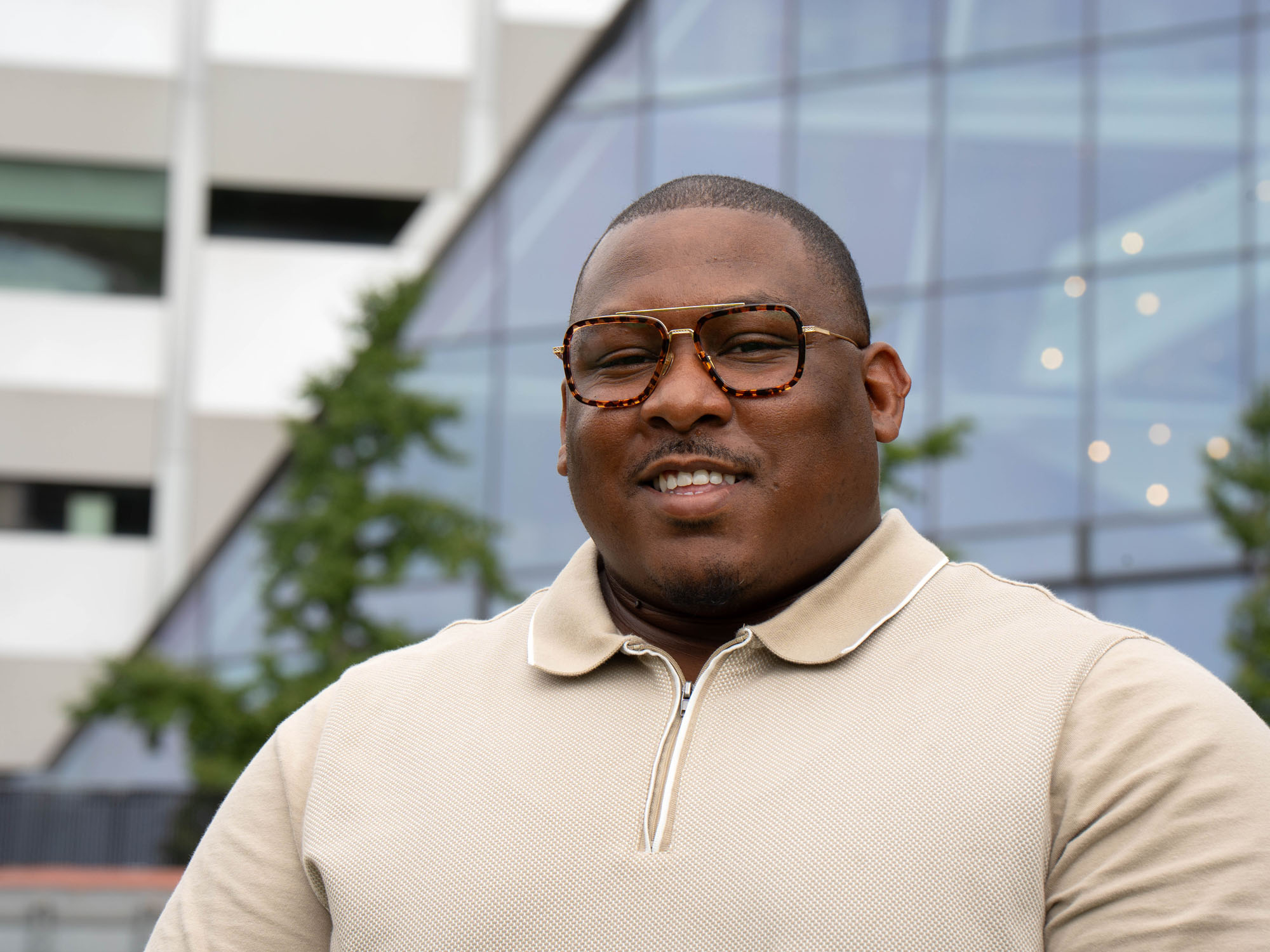
A desire to improve the lives of others is a common thread across the Doctor of Public Administration students at The University of Baltimore.
For Dylan Galloway, that pull came as early as middle school when he first started attending town meetings.
For Jeremy Mose, the spark ignited when he enlisted in the U.S. Army, committing to serve at 17.
For Col. Orlando Lilly, service has always been integrated in his life and career, from his time with the U.S. Navy to his 30-plus years in law enforcement.
Growing into their roles in public service, they have found that embracing opportunities to learn more can only improve their capacity to make an impact. That’s why they were drawn to the Schaefer Center for Public Policy’s Maryland Certified Public Manager program. And that’s why they decided to take their education even further in pursuing their doctoral degrees.
Dylan Galloway started attending town meetings before he could vote. His godmother would drop him off and he would take in the conversations.
The heated debates and infighting he witnessed sat uneasy in his pre-teenage mind, and he wondered what impact he could have in the same shoes.
As he grew older, though, his interests grew broader as he considered his future. Then an unforgettable incident cemented it for him.
Galloway was leaving a college football game in North Carolina when he stepped away from the crowd to call home. Considering his behavior suspicious, city police officers challenged him and then assaulted him.
“While I was on the ground, I thought I never want anyone to feel what I'm going through,” he recalled. “And I made it up in my mind right there that I wanted to go ahead and pursue a career in government.”
Now, Galloway is well into his seventh year as town administrator for Cheverly, a small town of slightly over 6,000, seated in Prince George’s County. Between long hours on the job, he is also pursuing his Doctor of Public Administration (DPA) at UBalt.
Galloway is one of a handful of current DPA students drawn to the program through the Certified Public Manager (CPM) program.
Through a 10-month course of study, the CPM program brings together public service professionals from various levels of government across the state. Through rigorous and relevant curriculum and results-oriented capstone projects, they learn to master the core competencies of public sector management and apply what they learn on the job.
“It is challenging, but if it was easy, everyone would be doing it,” Galloway said.
Galloway discovered the CPM program during a conference of public service professionals where he met Dr. Ann Cotten, executive director of the Schaefer Center and CPM program. Learning the program was a fully sponsored opportunity convinced him to apply.
Already, getting a doctorate had been an idea in the back of his mind. Going through the CPM program helped Galloway realize it was time and UBalt was the place to turn his long-term goal into his next step.
A few years after completing the CPM program in 2024, Galloway started the DPA program.
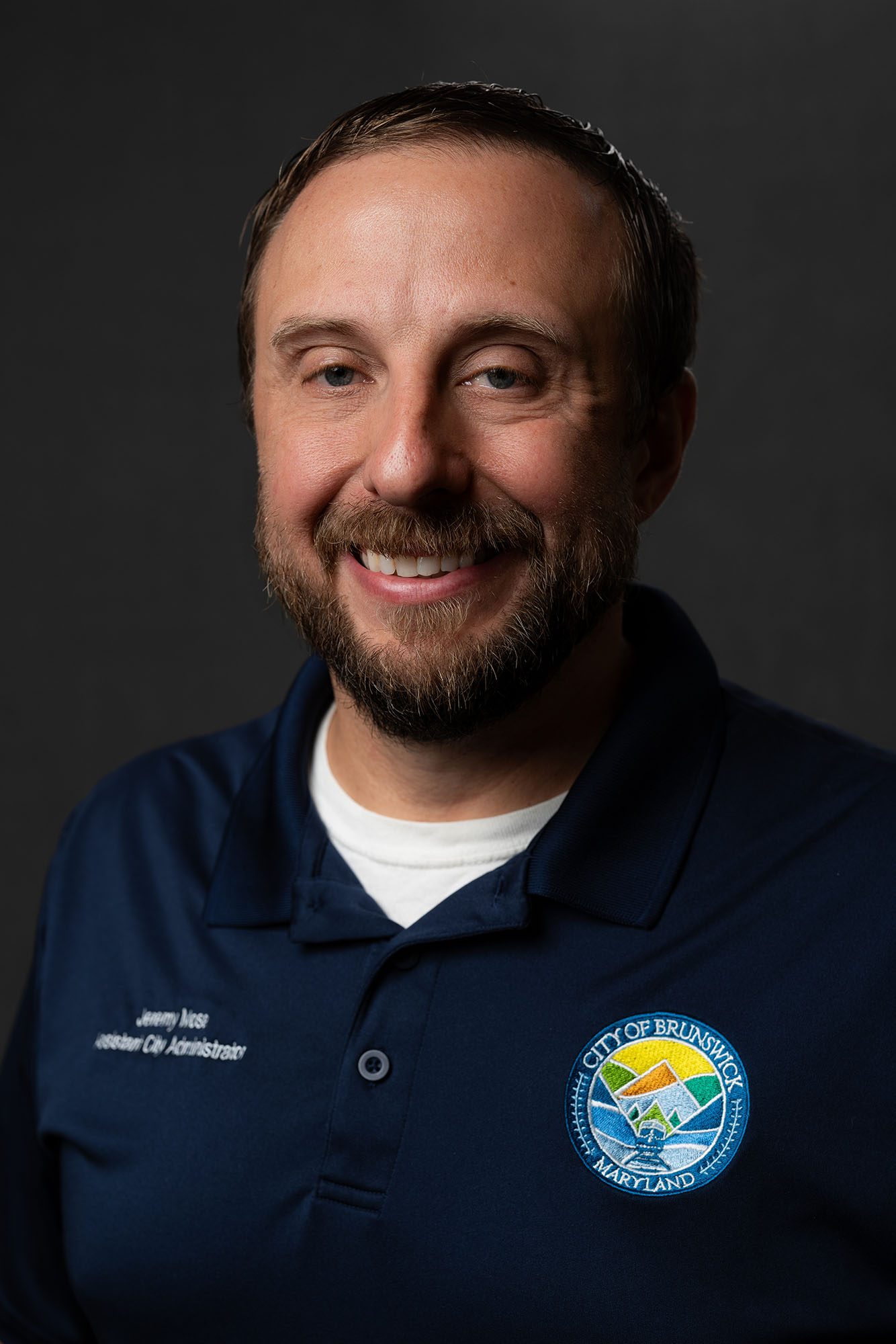
Jeremy Mose, deputy city administrator for Brunswick, Maryland, took a different path to get to the DPA program at the same time as Galloway.
His first brush with service came after enlisting in the U.S. Army Reserves at 17. He spent three years with the Reserves and another three in the National Guard.
After his service, Mose bounced around different jobs before a layoff convinced him to try community college. He got an associate degree in alternative energy technology, which became the first ripple in a movement toward better job opportunities.
Mose loved learning, so he kept enrolling in college programs as he moved up positions in his work, eventually landing in Brunswick.
“I consider myself a lifelong learner now. Like once I started it, I never stopped,” he said.
Mose discovered the Schaefer Center’s CPM program through his city administrator, Julie Martorana, who participated in it first. After learning more about it and because of her encouragement, he decided he wanted to try the program, too. He considered it an important opportunity to better understand the leadership side of public service.
“I didn't jump right into being a manager, or being a supervisor, or being in charge of a large department. I started out as one of the guys that was digging the ditches, and I worked my way up,” he said. … “It doesn't matter if you're starting out just as an apprentice or a new hire, there's always a path for you to move up if you want to, and I think it made me a better leader knowing both sides of things.”
Mose already had a doctorate in mind before he learned about the CPM program, so when he saw UBalt offered the Doctor of Public Administration program, he cemented his plan to do both programs. He started the DPA first and is now doing both programs simultaneously.
Mose initially thought he would do both back-to-back but realized he could get credit through the CPM program for some of his elective courses, saving him time and money on the DPA.
Mose knew the programs were a key learning opportunity to making him a better asset in his work.
“I'm really committed to improving the lives of the residents at the city of Brunswick. That's my whole role, that's why I'm there. I'm a public administrator to improve the lives of the residents,” he said.
As part of the Schaefer Center program, cohort members participate in retreats covering a variety of subjects. Topics include leadership style and personal productivity, strategic and lean management, data-based decision making, public resource management, AI in the public sector, and external management communications and the legislative process.
Participants also have a capstone project that Mose described as solving a real-world problem for your organization. It was what Mose was most looking forward to when he learned about the program.
Mose is exploring how his city can best fact check the use of artificial intelligence tools within public records.
It doesn't matter if you're starting out just as an apprentice or a new hire, there's always a path for you to move up if you want to, and I think it made me a better leader knowing both sides of things.
An AI-based transcription or note-taking service, for example, might be used to keep records of a town meeting. But what if the tools oversimplify the information or make an error, he wondered.
“We save these notes in our files, we put them in Teams and our chats and things like that, and all these things are reachable under a public information request, if someone wanted to gather that information. Without verification that these notes are accurate, they could be getting misleading information or wrong information,” Mose said. “I've been dabbling in AI for a few years now, and it doesn't always give you the best information, so if there's not a checks and balances there, we could be saving stuff to the public record that isn't verified.”
This question has Mose considering what steps his city should be taking to ensure accuracy and clarify AI use, especially as more people are using it.
Mose plans to broaden his research for his doctoral program. He wants to dive more into how different organizational structures implement technology. He’s inspired by his own city’s rollout of Microsoft Teams years ago.
“I've been noticing that with a lot of technology that’s forced upon us, and AI is one of them, too, we're not really implementing this in a structured way,” he said.
Galloway focused his CPM capstone on the career pathways of African American city managers. “City management has been a career for a very long time; however, the very first African American city manager was only appointed in 1970s,” he said. “I wanted to figure out what made people tick in a profession that so few of us were even involved. What were the triggers? What were the motivations? What did they experience?”
He’s still working on narrowing down the focus for his doctoral research but is considering the intersection of music culture and public administration, and misconceptions of police violence.
Whatever his direction, Galloway knows he has incredible support through the program faculty: Dr. Mariglynn Edlins helped him dissect his perspective in his research and is guiding his path as his adviser. Dr. Joseph Adler offered understanding and flexibility when a deadline fell amid a crisis at work. Dr. Al Gourrier weaves his financial expertise into the conversations, giving students practical understanding beyond what a book can provide.
“We've got some of the best professors that are second to none,” Galloway said. … “All the professors that I've encountered have been very understanding of our work and our personal lives as well.”
Galloway also said he’s grateful to his city for their support as he works through the program.
“They're picking up the tab for this. They have a vested interest in me, and they've been a motivation,” he said. “I was reminded in one of my evaluations that, ‘You said that you were going to go and get this when you first got here. We want you to do this.’ So, I’m very appreciative of the town that I work for holding me accountable as well.”
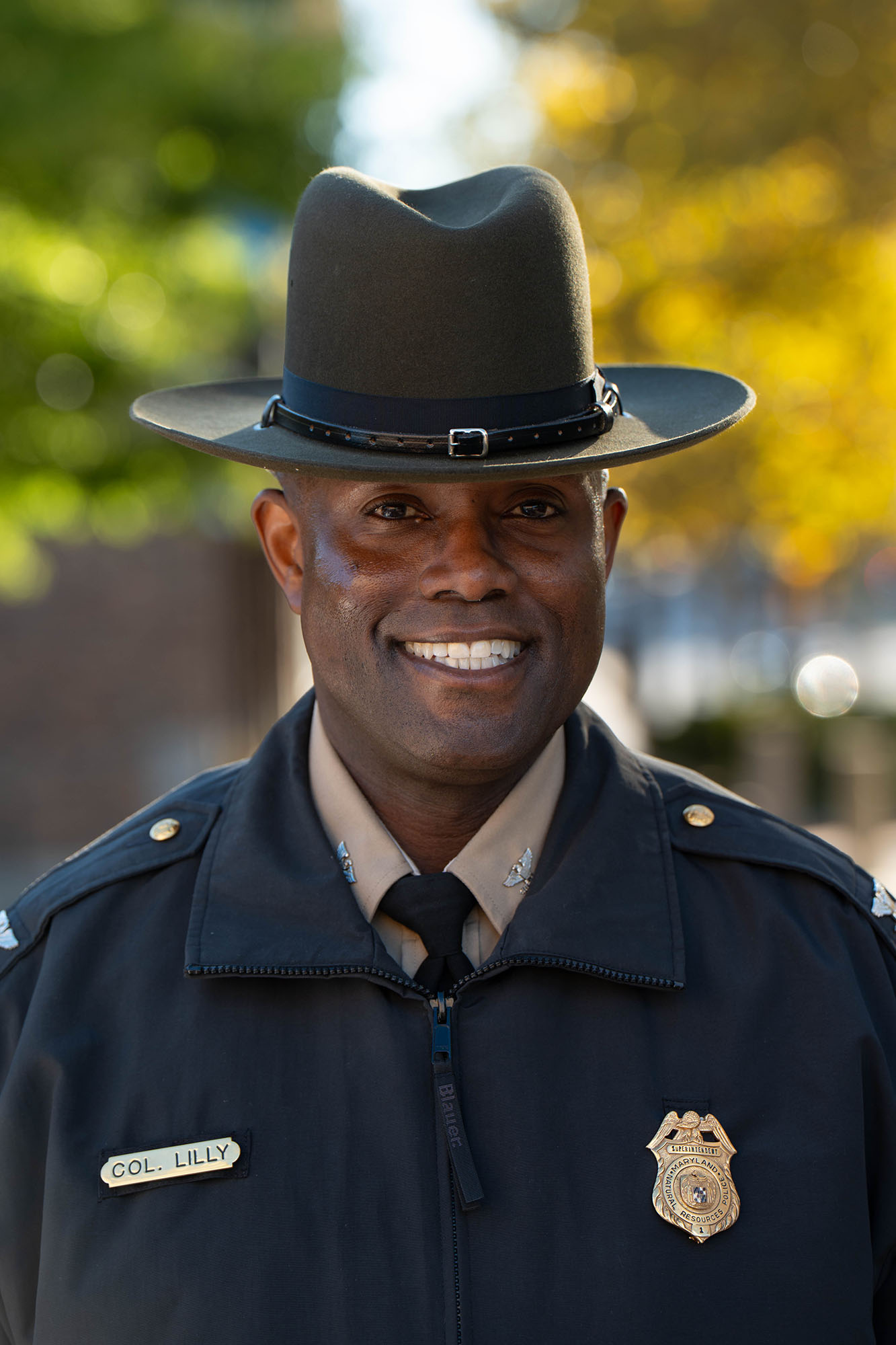
Col. Orlando Lilly of the Maryland Natural Resources Police is pursuing his DPA alongside Galloway and Mose. He also participated in the CPM program, finishing in 2022.
How Lilly came upon UBalt and the CPM program is a story only he can tell.
“I spent 30 years with Baltimore County before getting appointed here by the secretary and the governor, and I had made a decision,” he said. “I made a decision that I was going to retire from Baltimore County Police Department.”
His father became sick and passed away, leaving Lilly thinking about his life and choices. Then he got a call from Stacy Rodgers, a UBalt MPA alum who graduated in 1999 and now serves as acting secretary for the Maryland Department of Human Services.
“She actually played a large role in me staying in Baltimore County, so much so that it impacted the opportunity not only in getting promoted again prior to leaving that agency, but also she had talked to me about the Certified Public Manager Program at that time.”
He followed her recommendation, a decision that he credits for his promotion as the 11th superintendent of the state’s Natural Resources Police and for becoming the first police officer in the state to attend the CPM program.
The latter helped guide his actions in his work.
“The Certified Public Management program actually strengthened my practice while I was there,” he said. “One of the things was it allowed me to reinforce the value of connecting my education with public service.”
Going for a DPA wasn’t on Lilly’s mind like it was for some of his cohort members—at least until he started the CPM program.
Lilly studied criminal justice for his undergraduate studies and organizational management and leadership for his master’s degree. The CPM program left him wishing he had a degree in public administration, though.
“It became one of those things where now I'm starting to understand that I need to understand theory a little bit more, dive deep into that to research the system behind all these practices, and then figure out a way, how do I become not just someone who's in the role?”
Lilly tried a doctoral program once before but dropped out. He knows now that he went for the wrong reasons, for the desire to add Dr. to his name instead of wanting to learn to better himself.
The CPM program helped him understand he was ready. He started UBalt’s DPA program in fall 2026.
Once he started, the lectures and discussions quickly helped him understand he made the right choice.
“I want to be someone who can contribute to the profession in a way, as Dr. Edlins would say, from somebody who's been a life-long journeyman in note-taking to be a note maker, to write my own papers, write my own scholarly articles,” he said.
His CPM capstone project was a first step toward the type of scholarly work Lilly hopes to explore more.
Lilly focused on how law enforcement can move away from a model of punishment to one with a speak-up culture when mistakes are made, “where everybody felt worthy and safe to share their ideas, their concerns, issues, without being minimized, marginalized, or criticized.”
It’s the kind of environment he fuels in his current role.
“If you mess something up, we weren't going to be punitive. We were going to focus on how we develop you so that doesn't happen again,” he added.
While he’s just starting his DPA program, Lilly already knows he wants to research more opportunities to make law enforcement better, where new directions can be integrated for better results and training is encouraged.
The courses are giving him much to consider and right now, he’s soaking in everything he can.
“This process has allowed me to use all of those things that I learned in my organizational leadership material, and then make it applicable in a classroom setting, so I can not just enjoy the experience, but experience the experience.”