

In politics and public service, the parallel topics of transparency and honesty are a regular part of the conversation. While it's often unclear what prompts these discussions—and everyone from rank-and-file voters to top-level government officials has an opinion on it—veracity in public life can take control of the exchange at any time. Usually, this talk can be enlightening. Sometimes, it is reactionary.
For many who observe and contribute to the field of political science, ideas about truths and lies can take a turn into the realm of uncertainty. Complaints about politicians who mislead may be transformed into proposals to penalize what is commonly called "political malpractice"—the willful abuse of the public trust for virtually any reason.
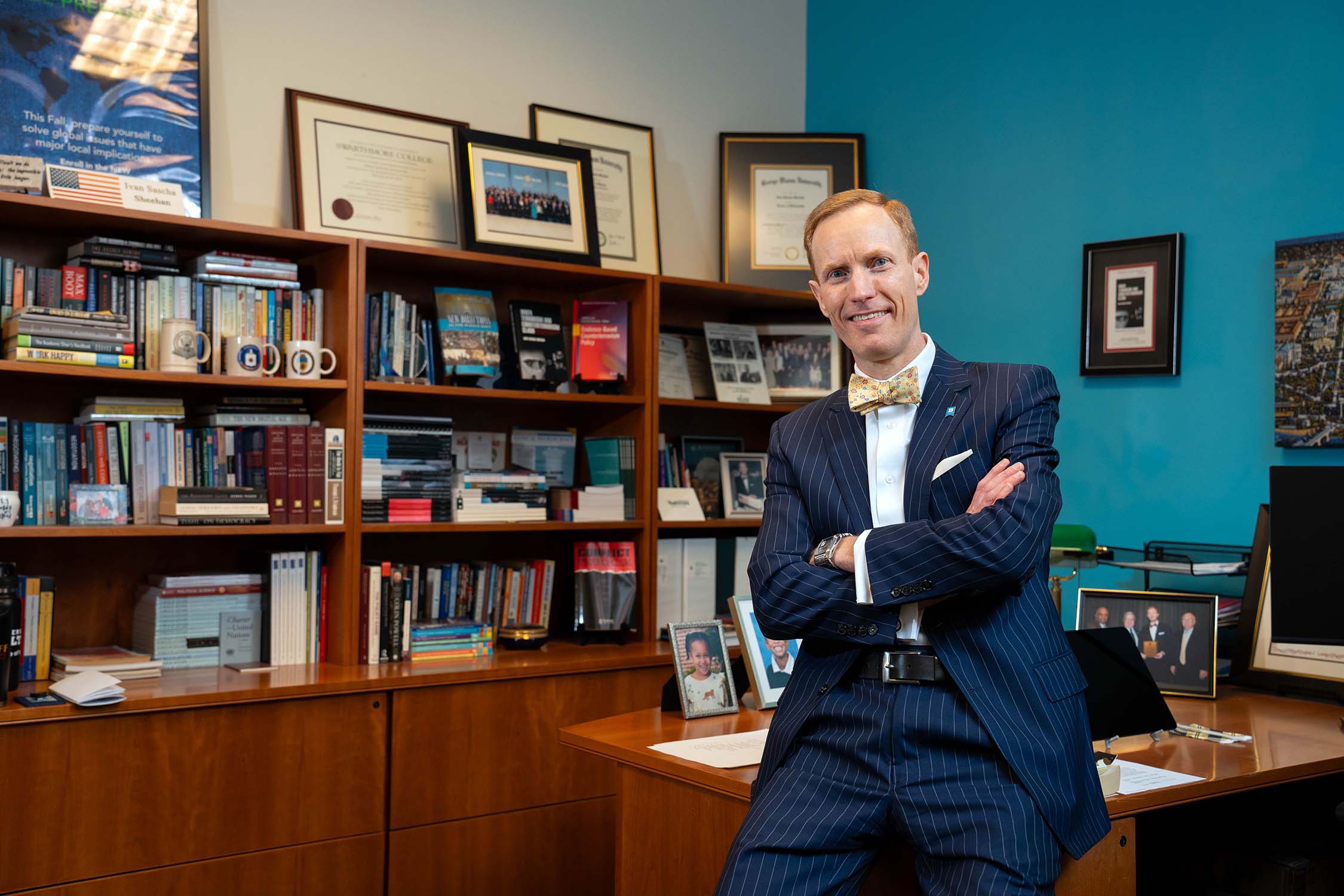
In Wales, a small, democratic country in Great Britain that is part of the United Kingdom, a law has been introduced in parliament that would make it illegal for politicians to lie during Welsh elections. While some see the proposal as an answer to the problem of dishonesty among public officials, others, like Dr. Ivan Sascha Sheehan, interim dean of the College of Public Affairs at The University of Baltimore and an internationally recognized expert on government and politics, predict a dark outcome—especially if such a law took hold in the United States.
"My concern would be that the proposed Wales law, if pursued here, would tee up the criminalization of political speech, which could compromise educators, journalists, pundits, and more. The intent of this law may be to improve the culture of politics, but who defines 'improve' and whose 'culture' is targeted? Trying to outlaw public speech, if it is less than truthful, would weaken, not strengthen, our democracy."
Prof. Sheehan, a frequent commentator on the political happenings of other countries, says candor and integrity should be the goal of any public official speaking on any subject, large or small. When that goal is not met, the answer is simple:
"I believe that the best antidote to objectionable speech—or in this case, 'political malpractice' — is more and ideally better speech," he says. "It's the old 'sunlight is the best disinfectant' argument."
In the U.S., Dr. Sheehan notes, there is growing concern that the foundational value of free speech is in danger. A majority of the Supreme Court, he notes, seems willing to curb freedoms that allow the criticism of certain public figures. While this would go against decades of legal precedent that protect such speech, the issue appears to be increasingly important to some major figures in the law.
Some justices on the Supreme Court "appear to be eagerly awaiting an opportunity to roll back long accepted protections brought about by New York Times Co. v. Sullivan," he says. "That's the landmark Supreme Court case that resulted in the 'actual malice' standard in defamation cases and the wide berth of speech that we all enjoy—whether as writers, thinkers, or consumers of thought," Prof. Sheehan says.
Could an actual ban on lying by public officials work in a society that has enshrined freedom of speech in the public square? Would the solution be worse than the problem itself?
Prof. Sheehan says that's possible—even likely. If free speech is the final arbiter in the American system, and when a lie is told it's up to others to point it out, then the proposed Welsh law would be redundant here to the point of doing harm.
"More speech, and better speech—that's the better way for us to go," Sheehan says.
Learn more about The University of Baltimore's Policy, Politics and International Affairs and Public and International Affairs programs, all part of the College of Public Affairs.