University of Baltimore Alumni Magazine
   

Fall 2005
Table of Contents


ALUMNI

2005 Entrepreneur Conference Tackles IPOs, Honors Frank Adams

It used to be that the sign of success in business was a big, fancy car.

Then it was everything from loud and blazing Web sites to enormous offices.

We live in an era where the measure of success is a difficult thing to discern. At this year’s Merrick School of Business Entrepreneur Conference and Luncheon, experts made it clear that this measure has become so complicated that even taking a profitable company public—formerly a sure sign that things are going great?can be a venture fraught with risk and frustration. But in some cases, they said, it still makes sense.

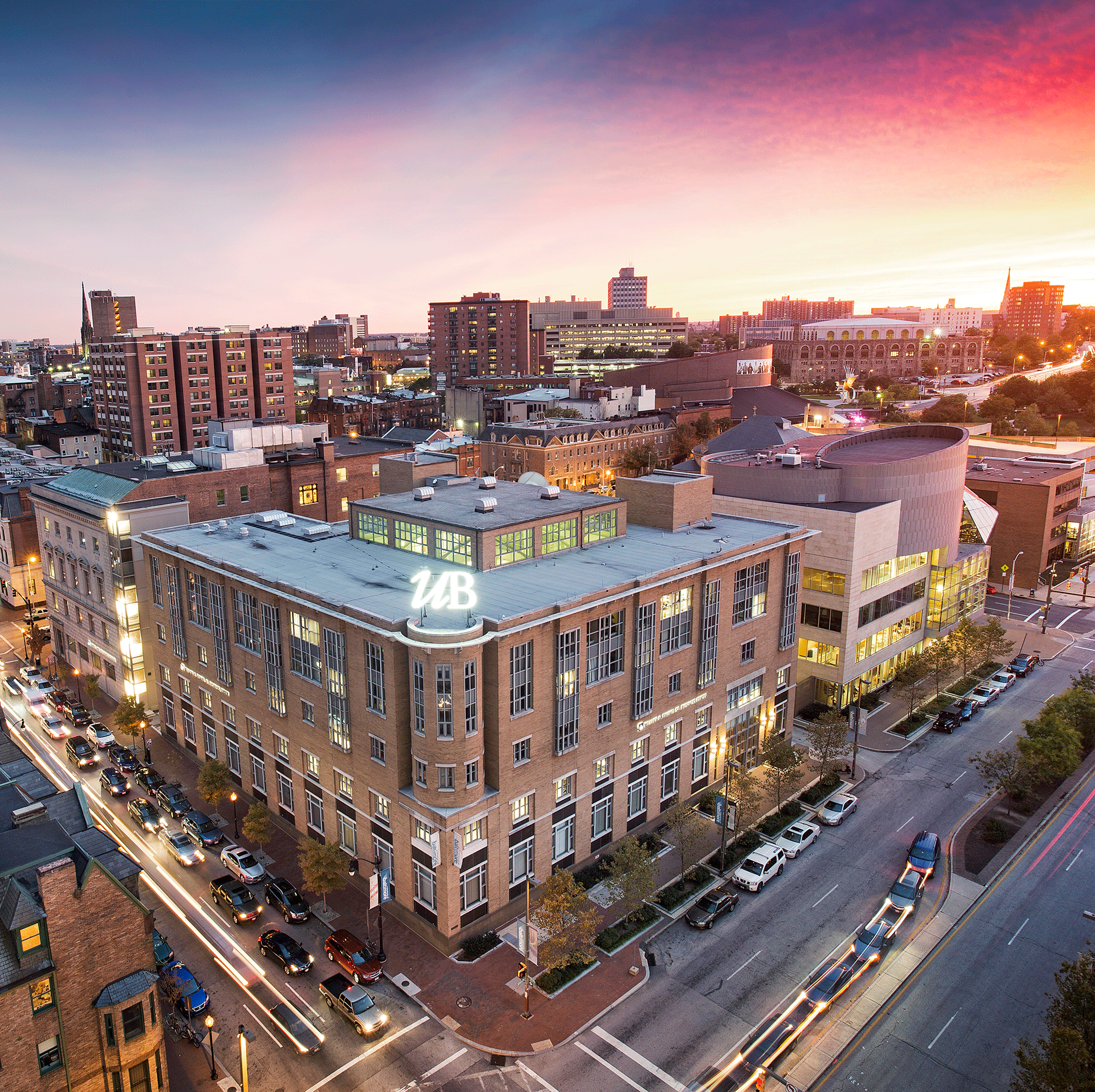
The event, held April 26 in the school’s William H. Thumel Sr. Business Center and in the nearby Lyric Opera House, asked a key question of its attendees: Should I make an initial public offering or not? The answer, in the wake of Enron, Worldcom and dozens of other corporate meltdowns, was decidedly mixed.

Still, the entrepreneurs and corporate mainstays who packed the room expressed optimism that companies can thrive and transform in an era of increased accountability and expectations. Look at the success of Google, they said.

One of those optimists is Frank A. Adams, B.S. ’67, J.D. ’72, who received the 2005 Merrick School of Business Distinguished Entrepreneur Award. Adams, the founder and managing general partner of Grotech Capital Group, a private equity investment firm located in Timonium, Md., reminded his fellow attendees of how much metropolitan Baltimore has grown and changed in the past 25 or 30 years. He expressed confidence that self-starters would continue to drive the kind of long-term strategic investment that has made this metro area among the wealthiest in the country.

Adams began Grotech during the venture capital boom of the 1980s, when pent-up demand for investment dollars was viewed as an economic boon. When that capital fused with the rise of high-tech business in the mid-’90s, especially among the dot-coms, Adams sensibly stayed the course. Now, with e-business firmly ensconced as a more reliable contributor to the nation’s economy, Grotech is positioned to continue partnering with a steady mix of emerging and established businesses. The company currently manages nearly $1 billion in investments.

"Frank Adams brings the irrepressible spirit of the entrepreneur to the table where some of the East Coast’s most important business decisions are made," said business Dean Anne McCarthy. "His accomplishments have been felt far and wide, by companies large and small. He’s the brightest star in the regional investment market, because he understands that, in order for capital investment to work, you have to pay close attention to every aspect of the business plan—the way any smart entrepreneur does."

Robert B. Barnhill Jr., founder, chairman, president and chief executive officer of TESSCO Technologies of Hunt Valley, Md., served as keynote speaker during the luncheon and conference.

Conference panelists included Daniel M. Cornell, vice president of Legg Mason Wood Walker; Charles Cullen, vice president of Grotech; David Chalk, attorney with DLA Piper Rudnick; W. Gar Richlin, chief operating officer of Advertising.com; and Michael R. Buher, audit director for Deloitte & Touche, LLP. The panel considered the pros and cons of making an initial public offering in an era of increased market regulations and heightened expectations among stockholders.

This was the sixth annual Distinguished Entrepreneur Award ceremony. Past winners of the award include James Morgan, B.S. ’61, president of Morgan Financial Group; Richard N. Pridgeon, CERT. ’58, a principal in Nardone, Pridgeon & Co. P.A.; William H. Thumel Jr., B.S. ’69, founder of Accustaff; and Irwin Sternberg, B.S. ’68, founder and president of Stonehenge, Ltd.


All in the Family: Donald Paddy
By Christianna McCausland

You could say that Donald Paddy, B.A. ’79, M.S. ’80, grew up at the University of Baltimore. He first arrived at the University as a student and, only seven short months after graduation, his graduate assistantship at the University led to an offer to become the assistant dean of the business school. He’s been here ever since and currently serves as the vice president of finance and administration. It’s a tradition that’s lasted almost 30 years and is now a family affair.

"It’s not a job; it’s a life," Paddy explains. "I went to school here, met my wife here, we’ve raised our kids through this. I don’t just come to work to do tasks—I enjoy it."

Like so many UB students, Paddy came to the school from community college as a nontraditional student, working while taking classes. At that time, UB was basically housed in one building surrounded by a somewhat questionable neighborhood. Despite the neighborhood and the small facilities, it is the education he received and the support of faculty who understood the plight of nontraditional students that Paddy recalls years later.

"In general, I never met faculty who were so dedicated and willing to help," he says. He remembers a time in his first semester when he was struggling in a course. He began to consider dropping the course—or dropping out of school completely—when a graduating classmate recommended that he speak to the professor about his difficulties.

"I took his advice and went to the professor, who assured me I was going to get through this no matter what. If that colleague in class hadn’t advised me and that professor hadn’t reacted as he did, I don’t know what would have happened. That assured me I’d made the right decision and that I was in the right place. I remember that conversation as if it was yesterday, and we’re going back to 1976."

During Paddy’s tenure, UB has changed into a large, nationally recognized campus with separate law and business school buildings and a flourishing liberal arts program. Gone are the great sports competitions at the Mount Washington campus that Paddy fondly remembers could shut down the whole school. But what remains is the tradition of supporting nontraditional students, which led many of Paddy’s relatives to attend UB as well, including an uncle and four cousins.

"Every one of my relatives, excluding my wife, who has come through UB has been a first-generation college student" he says. "We didn?t come from a very high economic background and the school was affordable, accessible, flexible. It met our needs."

Like Paddy, his relatives had responsibilities outside of school. Some had jobs, others were raising families. "It was a place that opened its arms and said, ’We?re here to help you get your career going.’" Like Paddy, many of his relatives have gone on to great success after earning their UB degrees. The accessibility that made UB such an asset to Paddy and his family remains today. He points to the small average class size and the readiness of professors to work with students as vestiges of the old ways—a tradition that’s benefited from an added boost thanks to the advent of e-mail, which allows instructors to chat with students anytime. As UB continues to grow in influence, both in the local community and in the larger realm of academia, Paddy believes it will always remember its roots, providing a safe and welcoming oasis of urban learning.

"I’d love to see my kids decide to come here—I’d be happy to have them get a UB education—and to see my cousins’ kids all come here," he concludes. "This education is as good as it gets."


The Apprentice Winner Bill Rancic Headlines GEICO Spring Speaker Series

On May 12, 2005, the University of Baltimore GEICO Spring Speaker Series brought Hollywood to the William H. Thumel Sr. Business Center in the form of Bill Rancic, winner of the first season of NBC’s The Apprentice.

Rancic spoke to an auditorium filled to capacity with students, faculty and alumni and shared his unique experiences as both a young entrepreneur and a new employee of famed businessman Donald Trump. After his talk—organized by the Merrick School of Business Alumni Initiative Committee and sponsored by GEICO; the Family Service Foundation; Stout, Causey and Horning; and the Chambers Company—Rancic signed copies of his new book, You’re Hired: How to Succeed in Business and Life from the Winner of The Apprentice, and answered individual questions from audience members.


Merrick School Class of ’55 Celebrates 50th Anniversary

UB’s May 2005 commencement ceremony filled the Lyric Opera House with the University’s newest graduates and their family and friends … and a few very special guests. Six members of the business class of 1955 joined the festivities, at the invitation of Dean Anne McCarthy, to mark the 50th anniversary of their graduation from the Merrick School of Business.

For the first time, the School of Business also hosted a post-ceremony reception, held in the John and Frances Angelos Law Center lobby, honoring its graduates—and giving the two classes opportunity to compare notes.


Save the Date: Student Center Dedication APRIL 17, 2006

What: the dedication ceremony and celebration of the new UB Student Center

When: 11 a.m.

Where: the corner of Maryland and Mt. Royal avenues

Who: Join President Robert L. Bogomolny, UB students, elected officials and other distinguished guests for the festivities.

Details: A daylong celebration will feature student tours, live music, prizes and food and beverages.

For more information, contact

Chris Hart at 410.837.5739 or chart@ubalt.edu.


ALUMNI OF THE YEAR

Feb. 22, 2006

11:30 a.m.–1:30 p.m.

Belvedere Hotel

For more information, contact Alumni Relations at 410.837.6131 or alumni@ubalt.edu.


Athletic Hall of Fame

On May 7, 2005, the University of Baltimore welcomed more than 325 guests—a full house of former athletes and their families—to the Baltimore Marriott Inner Harbor for the second annual UB Athletic Hall of Fame induction ceremony. This year’s inductees included 12 athletes representing six sports as well as the entire 1975 soccer team, a coach and a business manager/trainer.

Save the date: The third annual induction ceremony will be held on May 5, 2006.


Current Issue | Archive | Alumni Association

Back to UB home page