

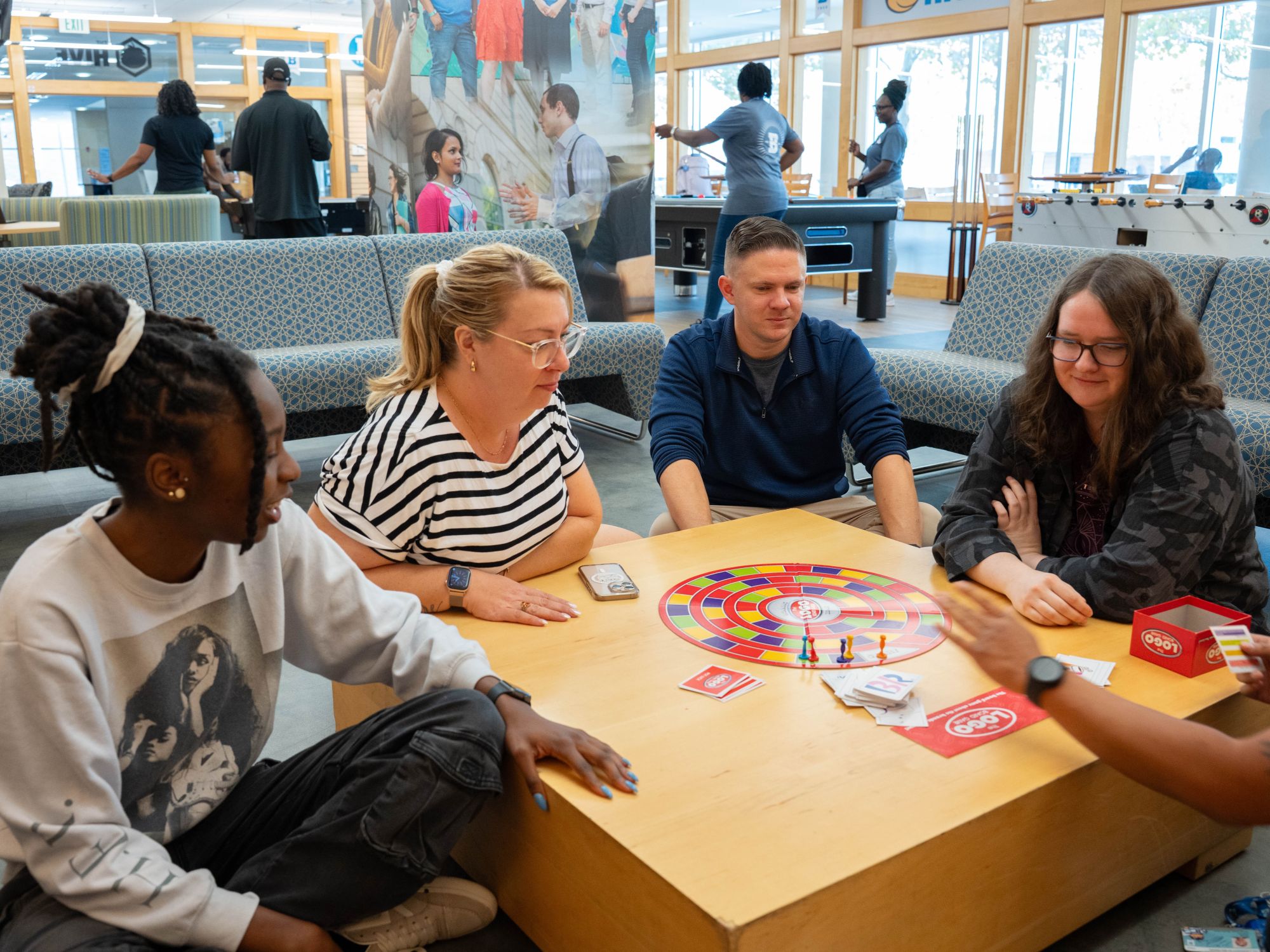
For the last week or so, I've been trying to figure out how to write about the work UBalt's Center for Excellence in Learning, Teaching and Technology has been building since I joined the team three years ago, especially now that our TEF-LEAD Program has finally come together. I've kept hitting a wall; I wanted people to feel something other than "here is one more thing from CELTT," and every version I typed sounded like a press release. I closed my laptop more frustrated than when I opened it, every single time.
This summer, when I'd clock out at the end of the day, I had a few different options to help me decompress. Some nights that meant a walk around Patterson Park. Other nights, a recipe from one of my many cookbooks at home. Most nights, I'd set up a game of Wingspan Pocket, which has quietly become part of my evening routine this summer.
One of those nights, it finally hit me. Somewhere in the game box was the whole story of what CELTT has been trying to build.
Let me back up a bit...
I already loved the original Wingspan board game before Wingspan Pocket came out in July. I own the physical expansions and the digital version on my Nintendo Switch. I have spent whole Saturday afternoons building an engine of birds, and I loved every minute. (Can you tell that I'm a bit of a nerd?) But it asks a lot of you before it gives anything back. Setup, rules refreshers, table space, a real block of time. Wingspan Pocket keeps the exact same mechanic underneath, the same depth, but strips away everything standing between you and actually playing.
Three years ago, when I first started at UBalt, we built CELTT Academy the way you build the deep version of a game. I was excited. I wanted faculty development to feel like an adventure with real structure, and our Teaching and Learning Day in 2023 leaned all the way into that. Looking back, I think I handed people a rulebook when what they had time and energy for was a five minute explanation. I was trying to teach a room full of educators how to play Wingspan when they thought we were playing Uno. I was so invested in the depth of it that I did not stop to ask whether the room had the table time for that much setup.
For a while I read low participation as disinterest, but I was wrong about that. Growth was still happening, but not in a way we could record. It was happening quietly, in office hours and hallway conversations and small experiments faculty were running, stories that never made their way back to CELTT.
That first push with CELTT Academy taught me something the attendance numbers couldn't say outright. We didn't need a bigger adventure. We needed a framework, something flexible enough to meet people wherever they actually were. That's how the Teaching Excellence Framework came to be, born directly out of what CELTT Academy showed us was missing.
When it came time to build the actual process for documenting that growth, we did not do it alone. We found a partner in the University of Central Oklahoma. Their Center for Excellence in Transformative Teaching and Learning had already done this kind of work for their own faculty. With their permission, we adopted their LEAD Cycle structure to make our framework something people could actually engage with.
If I want proof that this kind of growth was always possible, I do not have to look far. Our Teaching Scholars in Residence have been doing exactly this, formally, every single year since the program launched. A TSiR faculty member explores a topic, a question, or a strategy that interests them. They try it in their own classroom or other learning environments. They collect real data and analyze what actually happened. Then, every Teaching and Learning Day, they share what they found with the rest of us.
Learning, Engaging, Assessing, Disseminating.
They were running the LEAD cycle years before I ever put that name on it. Now, we finally have a structure that gives it a name and gives credit where it was always due.
The Teaching Excellence Framework names four areas UBalt has settled on as the heart of great teaching: how we design courses, how we adapt in the classroom, how we support students, and how we keep growing ourselves. TEF-LEAD is how faculty document their growth in those areas, one small badge at a time, in whichever one speaks to them. And just like a good game, those small wins stack into something bigger, and then bigger still. Nobody has to win the whole board on day one.
I think that's really what TEF-LEAD is all about. Years of ideating, play testing, and redesigning, not unlike the process that probably got Wingspan Pocket into my hands this summer, until we landed on something with the same real depth as the original but a much smaller barrier to entry.
I still don't know exactly what this looks like a year from now, but here's what I'm hoping for. A student excited to register for a class because they're inspired by their professor's enthusiasm for and engagement in the TEF-LEAD Program. Two faculty from different schools comparing notes on something that worked in their classroom. Teaching excellence feeling like a favorite board game you pick up and play over and over again.