

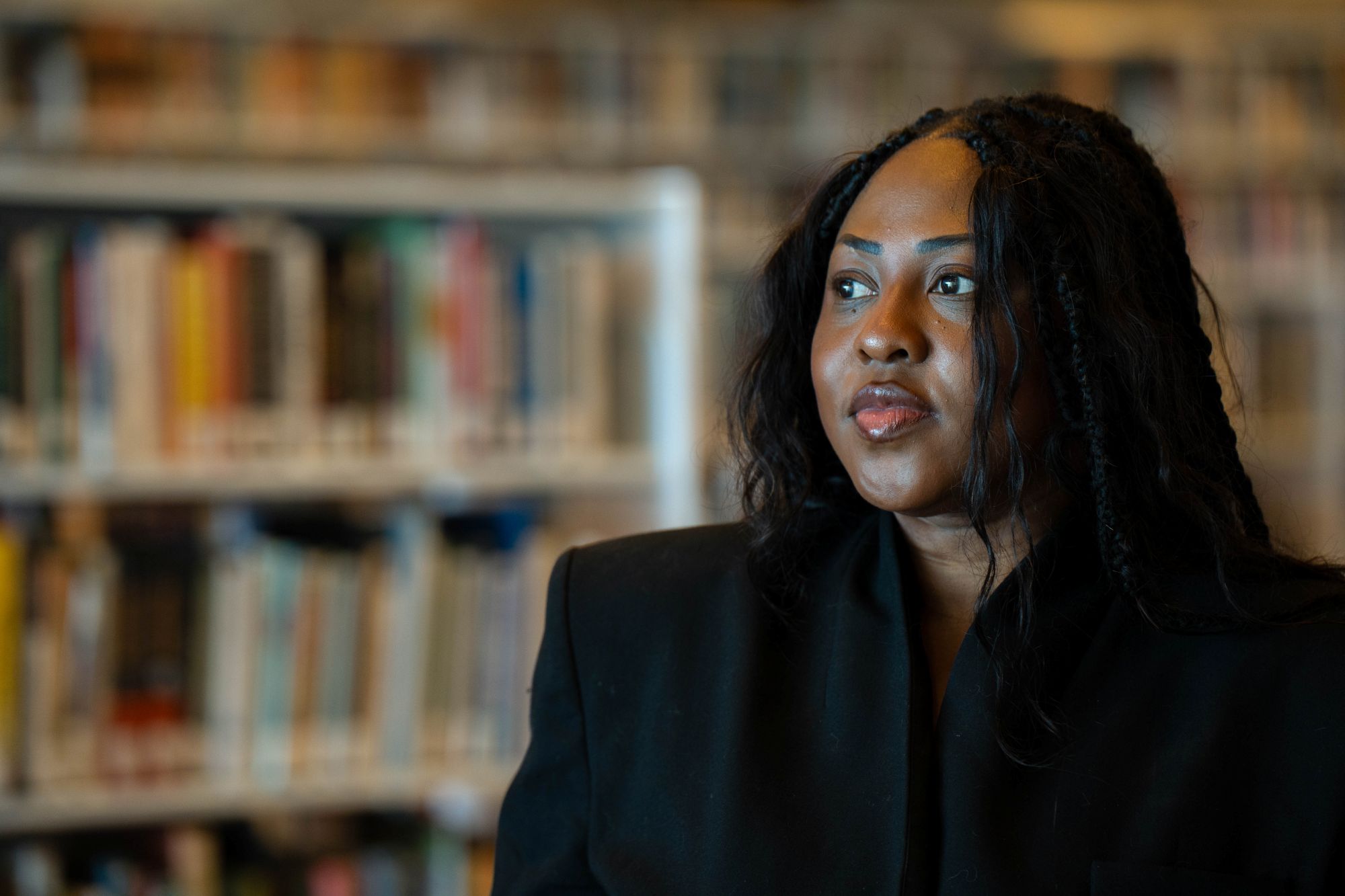
Tiffany Garnett, a current MFA student at The University of Baltimore, had worked in the arts her whole professional life and was looking for a way to get closer to her writing. “I was thinking of how I can write more expansively, more creatively, rather than rigidly.” She’d felt the urge to move to Baltimore, “for over a decade.” And, once she discovered the University’s Creative Writing and Publishing Arts program, she realized “it was the perfect fit.” Now as a creative in Baltimore, donor-funded support from the Expansion of Entrepreneurship Opportunities Fund helped Tiffany take advantage of a unique opportunity.
“While chatting with other artists, we always say it would be great if creatives could take business classes as part of their programs, to have an understanding of how to cultivate their image and audience.”
Before joining the MFA program, Tiffany “had various curatorial projects,” she said. For example, one of her favorite aspects of a large-scale curatorial project she led at the Smithsonian involved a process called “deaccessioning,” where a museum identifies and transfers pieces—usually those that are damaged or no longer in the scope of an institution—out of its permanent collection. “I liked using my art history knowledge in my research, finding where the best institution for an item was, what conservation looked like.”
Over the course of 15 years in the museum space, Tiffany developed a deep professional relationship with her writing. Now, at UBalt, she has been focusing on something more personal—writing memoir.
“Memoir is a way to write about myself through artwork,” Tiffany explained. “Exploring myself and my family through art has been an interesting pivot.” No longer mediating her writing through other works of art but this time through her own, she described her new process as “coming out of my comfort zone. This program is solely dedicated to writing. I am producing something new every week.”
Even though her focus has been on memoir, Tiffany has taken workshops for poetry too. “It really opened my eyes to how I can bring a lot of myself to the form.” Experimenting across genres allowed Tiffany to see herself in new ways. With memoirs, she learned “self-implication,” how her own person factors into her narratives and storytelling. “Figuring out how to bring memoir to poetry” has been a rewarding challenge for her creative writing.
Tiffany’s support from the Expansion of Entrepreneurship Opportunities Fund allowed
her to add one more layer to her writing: business writing. Designated funds allowed
her to enroll in MKTG 645, Marketing Strategy and Analysis. “When the opportunity
first came up to take this class,” she reflected, “I thought it would be perfect.
While chatting with other artists, we always say it would be great if creatives could
take business classes as part of their programs, to have an understanding of how to
cultivate their image and audience.” Through this scholarship support, she and some
of her classmates were able to hone this skill while having it count towards their
degrees!
“There is a lot of community engagement in the arts. I’m excited to bring that knowledge and skill set that I’ve gained to the cultural work I do.”
From New York to Baltimore, one of Tiffany’s visions has always been to showcase more artwork across neighborhoods in both cities’. She previously used her visual arts expertise to navigate this work. “What is crucial to being a creative is knowing how to market yourself, especially in our current climate.” Her experience in Marketing Strategy and Analysis gave her exactly that knowledge. “It is really valuable for me to know how to work with other artists, to build audiences.”
Now, she combines all three elements of her writing—professional, creative and business—to
plan for her future. “You can never have too many spaces to support artists,” she
said. “In New York, I’ve seen how people utilize space to showcase their art. But,
of course, in Baltimore,” she said proudly, “I think there is more space available.”
With the semester underway, Tiffany looks forward to one day creating those new spaces.
“My scholarship was such a great help,” she said. “It enabled me to take this class. It gave me language for things I already knew,
and it built newer levels to things that I thought I already understood.”
Through workshops, fellowships and yes, even marketing courses, Tiffany has grown
tremendously as a writer. She is excited to continue building relationships with artists
and exploring new pathways that connect her writing practice to the cultural work
and opportunities she is currently developing through the program. “There is a lot
of community engagement in the arts. I’m excited to bring that knowledge and skill
set that I’ve gained to the cultural work I do.”