

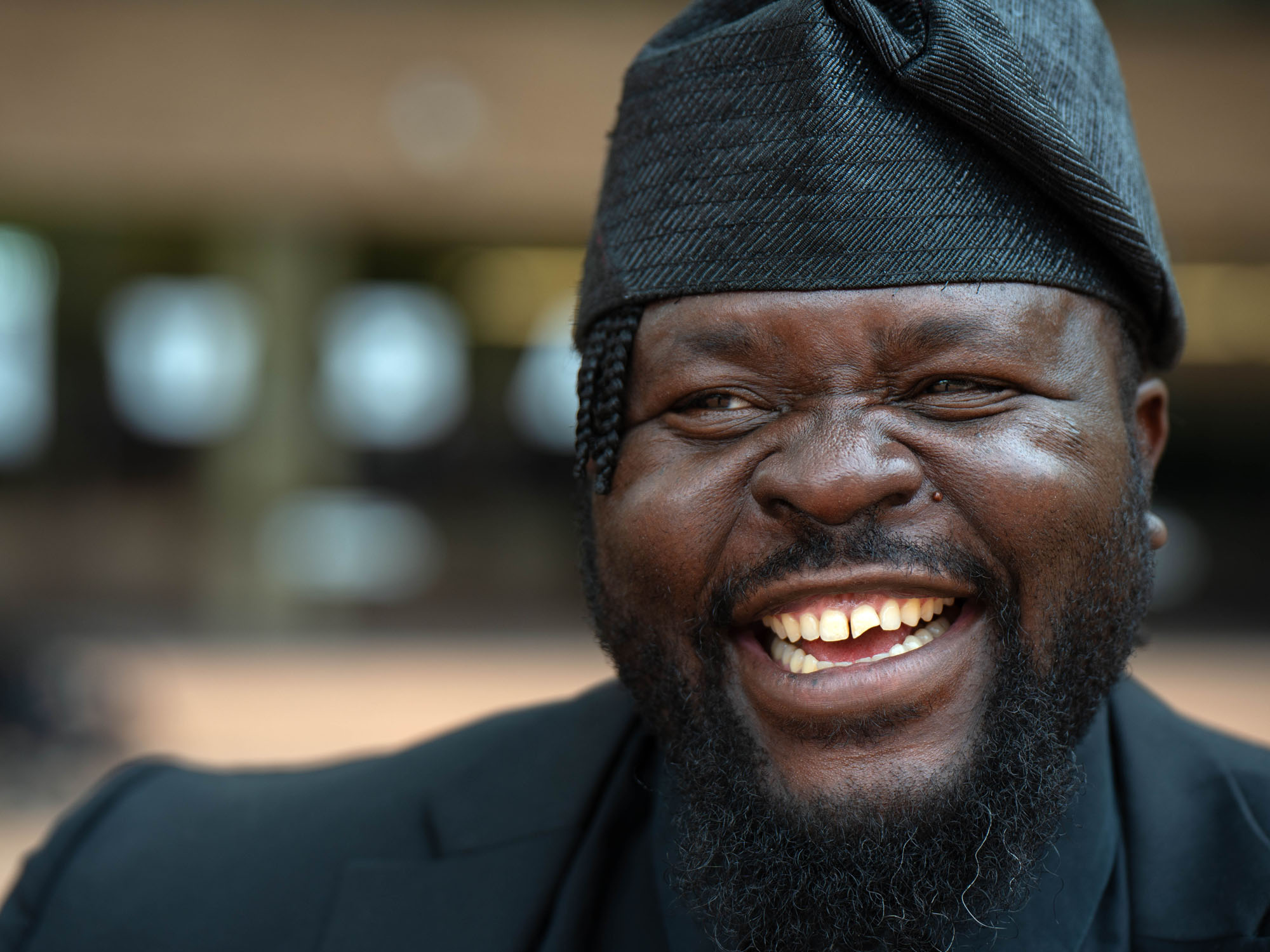
This post was written by Ayanna Davis, B.A. ’24, M.A. in Integrated Design student.
For Christopher Fornchor, understanding people has been a lifelong education.
Now as a graduate student at The University of Baltimore, he’s building on a lifetime of experiences through the M.S. in Negotiations and Conflict Management program, preparing for a future in law.
His career has taken him down several unexpected paths, from healthcare and hospitality to public safety. Yet through each experience, his desire to solve problems and make a difference in the lives of others is constant.
“I am the kind of person that if you give me a problem, I’ll solve it,” Christopher said.
Born in Nigeria, Christopher earned his undergraduate degree in microbiology in 2010 from the Federal University of Agriculture in Makurdi, Benue State.
He began his career working in a hospital laboratory before transitioning into health insurance, where he helped develop plans to better serve underserved communities.
In 2024, he traveled to the United States as a basketball coach, accompanying a young team from Nigeria to an Amateur Athletic Union tournament in Kentucky. After the tournament, he relocated to Baltimore, a city he’s has called home ever since.
His professional journey took another turn when he became a chef at Baltimore Soundstage, eventually serving as head chef and preparing meals for entertainers including Jadakiss, Rakim, Jay Pharoh, Bob Saget and Ja Rule.
Beyond the celebrities and large events, Christopher said his time in the kitchen taught him something unexpected about human nature.
As a child, he admired many of the entertainers he watched on television. Now working alongside some of them, he saw a different side of their lives, including the personal challenges they faced despite their success.
That lesson stayed with him long after he left the kitchen and continues to influence how he approaches people, conflict and his future in law.
Christopher’s decision to pursue law began with a career assessment that identified three potential paths: magistrate, lawyer or pastor.
As he explored those options, he discovered UBalt’s master’s program in Negotiations and Conflict Management. Since enrolling, his coursework has challenged not only how he approaches conflict, but also how he communicates with others.
A group facilitation course introduced him to a distinction he had rarely considered: the difference between debate and dialogue.
Growing up, he learned disagreements meant one person was right and the other was wrong. His studies have encouraged him to consider more perspectives.
“I wish I learned dialogue before debate,” Christopher said.
Outside of the classroom, he is finding opportunities to put his interest in leadership and problem-solving into practice.
As a senator in UBalt’s Student Government Association, he is developing a proposal he calls “Back to the Grassroots,” an initiative intended to introduce younger students to career possibilities though conversations with University students.
He also serves on UBalt’s Traditions Committee, helping relate welcoming experiences and maintain campus traditions.
These opportunities have contributed to his sense of belonging at the University.
“Here, I can actually be myself, express myself, and I’m following my passion,” Christopher said. “Nobody has made me feel that my passion is impossible to reach. Instead, if I mention it, they show me doorways to get there.”
Christopher expects to complete his master’s degree in 2028 and has already begun preparing for the Law School Admission Test.
His ultimate goal is to become a civil judge, a role he believes is essential to addressing conflict while considering the circumstances that make each situation unique.
He is particularly interested in issues affecting aging populations, racial inequities and the ways everyday interactions can escalate into larger conflicts.
“I always use the statement, ‘Our similarities are more than our differences,’ because a lot of people have similar stories, but the differences still matter,” Christopher said.