

As artificial intelligence (AI) and automated decision-making increasingly influence
access to housing, education, employment, and public benefits, University of Baltimore
School of Law Venable Professor of Law Michele Gilman is examining a critical question:
How can the law better protect people most vulnerable to the harms these technologies
can cause?
Professor Gilman, director of the Saul Ewing Advocacy Clinic and co-director of the
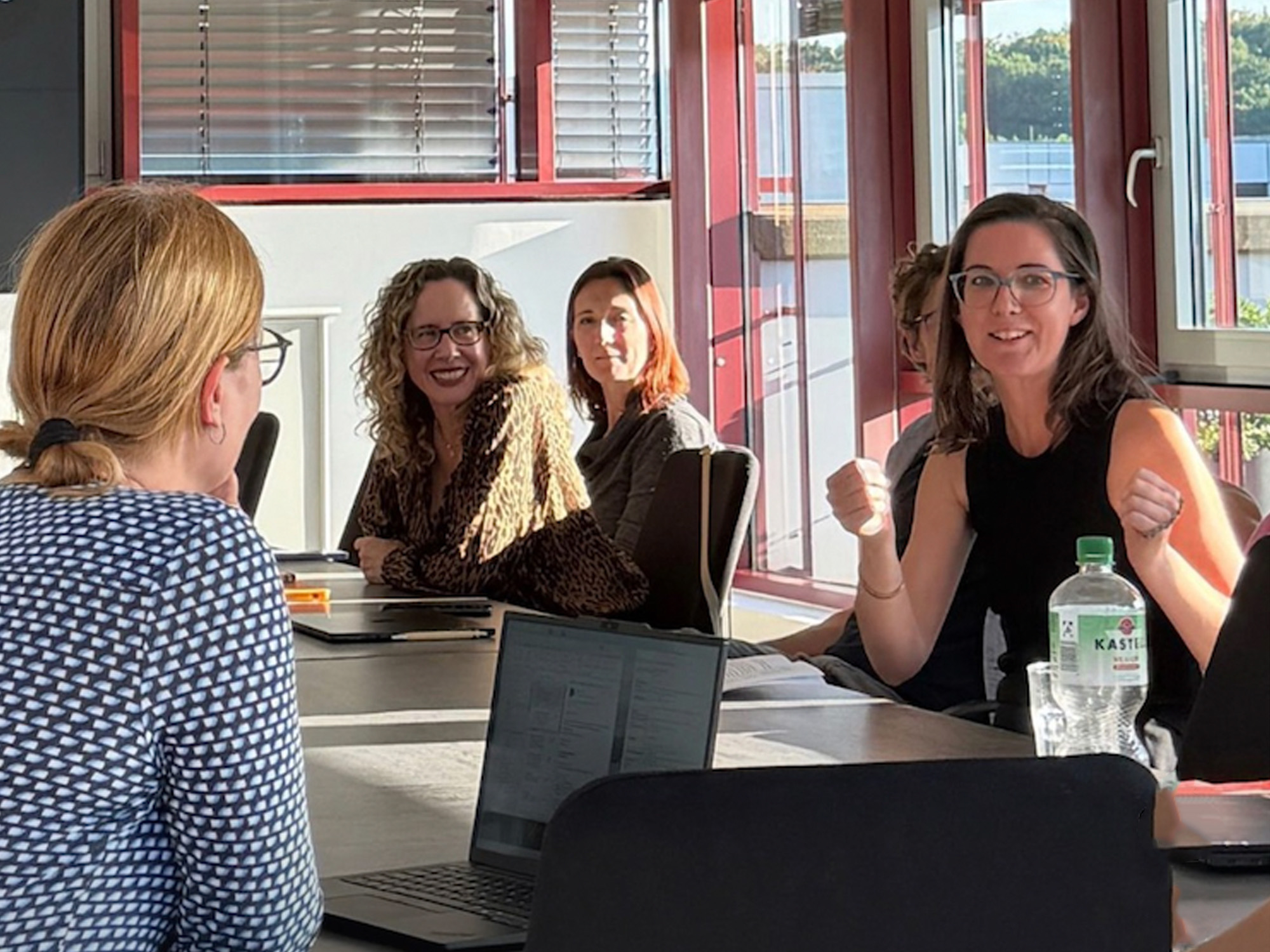
Center on Applied Feminism, recently completed a fellowship at the Center for Advanced
Internet Studies (CAIS) in Bochum, Germany. Her research compared how the United States
and European Union regulate data-driven technologies, with particular attention to
protecting low-income communities from algorithmic harm.
The selective fellowship brought together nine researchers from around the world and
across disciplines, including law, political science, anthropology, and computer science.
The collaborative environment gave Professor Gilman dedicated time to pursue research
building on her longstanding work in poverty law, technology and economic justice.
Her project, The Impact of Technology Regulation on Low-Income Communities: A Comparison Between
the U.S. and the EU, examines how automated systems can create barriers for people already experiencing
economic vulnerability. Algorithms may incorrectly flag individuals for fraud, contribute
to the loss of public benefits, or influence decisions about housing and employment.
"We have a lot of automated gatekeepers, and they penalize people who are already
financially vulnerable and make it harder for them to access opportunities," Professor
Gilman explains. "You might suffer an adverse decision and not even know it's coming
from an automated decision-maker. These tools are often wrapped in the guise of objectivity,
but that doesn't mean the decisions are actually objective."
While the United States often relies on existing laws to address emerging technologies,
the European Union has adopted more comprehensive regulations governing personal data
and artificial intelligence. Professor Gilman wants to understand what the United
States can learn from the European approach.
"In the United States, we're often litigating algorithmic harms using laws that weren't
drafted with these technologies in mind," Professor Gilman says.
Her research went beyond examining legislation and court decisions. While in Europe,
she interviewed lawyers, academics and civil society organizations working in digital
rights and economic justice to understand how these laws operate in practice.
"The laws on the books can be different from how they actually work on the ground,"
Professor Gilman says. "I wanted to look at both the text of the laws and how they're
impacting marginalized people."
The research has direct relevance to Professor Gilman's work at UBalt Law. Through
the Saul Ewing Advocacy Clinic, she sees how technology-related issues increasingly
affect clients and the legal challenges they face. Her findings will inform the clinic's
advocacy, strengthen its work with coalitions and contribute to conversations with
policymakers, including in the Maryland General Assembly.
Professor Gilman's expanded expertise will also benefit students through her teaching
and advising, particularly those pursuing law journal notes and advanced legal writing
projects in technology and law.
"Having this expertise allows me to contribute to conversations about what AI means
for our students, our faculty and the legal profession," Professor Gilman says. "The
more faculty members know about these issues, the better equipped we are to prepare
our students for the future."
Professor Gilman plans to develop her findings into a comparative law article for
publication in an American law journal. She is eager to bring the insights and connections
developed through the fellowship back to the classroom, the clinic and the broader
UBalt Law community.