

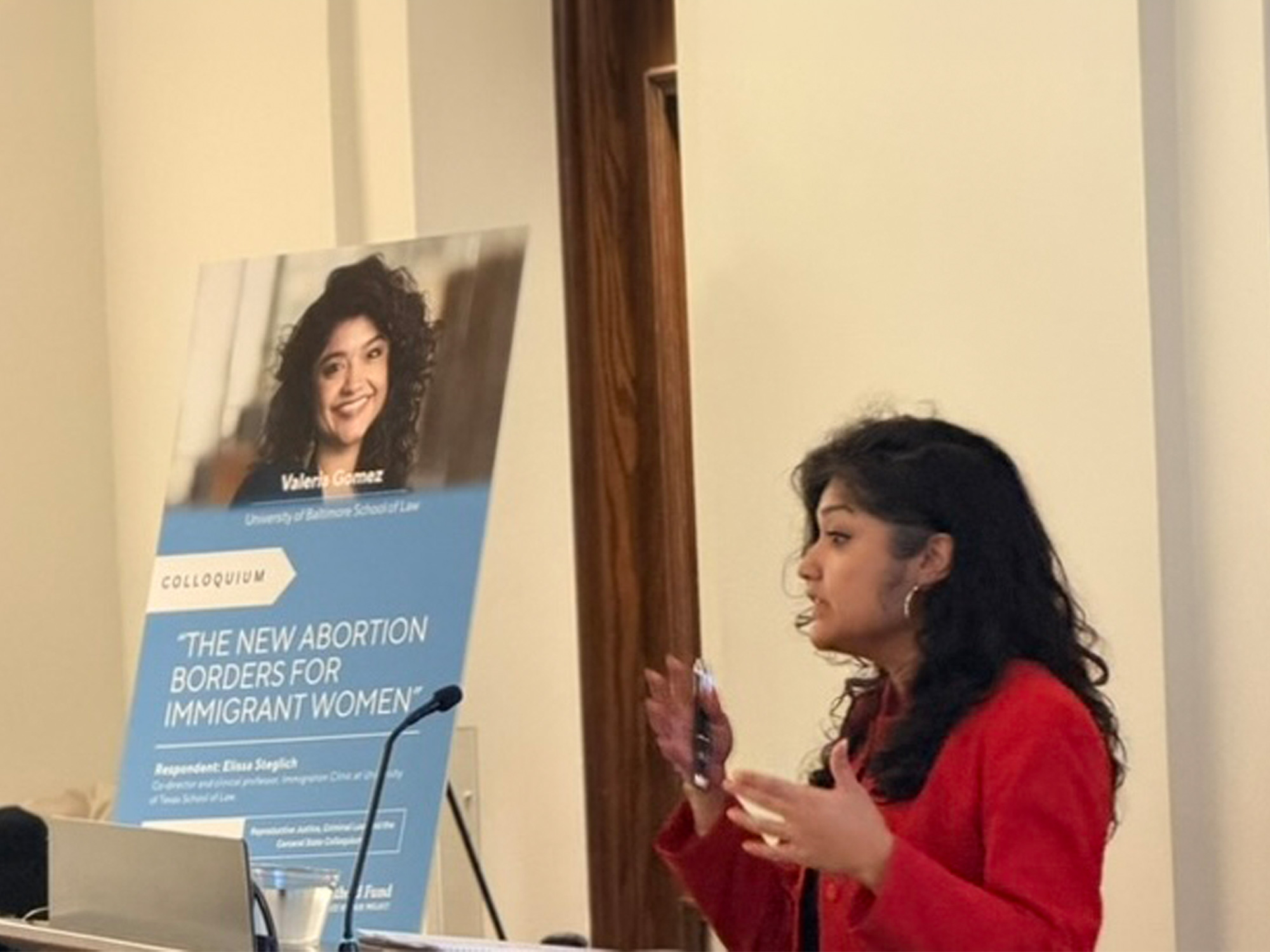
The legal landscape surrounding abortion access has changed dramatically since the U.S. Supreme Court’s 2022 decision in Dobbs v. Jackson Women’s Health Organization. But for immigrant women, access to reproductive health care is shaped by more than state abortion laws. Immigration enforcement, detention policies, and restrictions on movement can create additional barriers. Assistant Professor Valeria Gomez describes them as the “new abortion borders.”
Professor Gomez, director of the School of Law’s Immigrant Rights Clinic, explored
these intersecting legal and policy issues in an invited presentation at the University
of Texas School of Law’s Rapoport Center for Human Rights and Justice. Her talk, “The
New Abortion Borders for Immigrant Women,” was part of the center’s colloquium series,
“Reproductive Justice, Criminal Law, and the Carceral State.”
Professor Gomez’s research examines how immigration law and enforcement practices
can limit reproductive health care access, even within the United States. For immigrant
women, the ability to travel to a state where abortion remains legal may be complicated
by immigration detention, conditions of release that restrict travel, electronic monitoring
and local-federal law enforcement partnerships.
“After Dobbs, whether someone can get an abortion depends largely on where they are and whether
they can travel,” Professor Gomez explains. “For immigrant women, immigration law
and policy control that movement.”
These barriers can compound the challenges faced by anyone seeking reproductive care
in states with abortion restrictions. Professor Gomez notes that immigrant women may
be unable to travel freely, may face detention in remote facilities far from providers,
and may fear that seeking care or encountering law enforcement could lead to detention,
deportation or family separation. The consequences can extend beyond abortion care
to other reproductive health services, including contraception and cancer screenings.
Her research also examines the broader implications of policies governing immigration
enforcement, data sharing and access to health care. Policies that connect information
from public benefits programs to immigration authorities, for example, can discourage
families from seeking care and affect mixed-status households, including U.S. citizen
children.
For Professor Gomez, these issues cannot be understood in isolation. Reproductive
justice, immigration law and the criminal legal system are deeply interconnected.
A pregnancy-related or abortion-related encounter with the criminal legal system can,
in some circumstances, carry immigration consequences that may be more severe than
the criminal sentence itself.
“Lawyers and advocates in each area need to understand the others,” she says. “Abortion
funds and clinics need to know about immigration-related risks, and immigration and
criminal defense lawyers need to know about reproductive exposure.”
The presentation at the Rapoport Center offered an opportunity to bring this research
into conversation with scholars, practitioners and students working across human rights,
immigration and reproductive justice. Professor Gomez says that engagement with colleagues
from different disciplines strengthens her scholarship and helps identify new questions
and directions for future work.
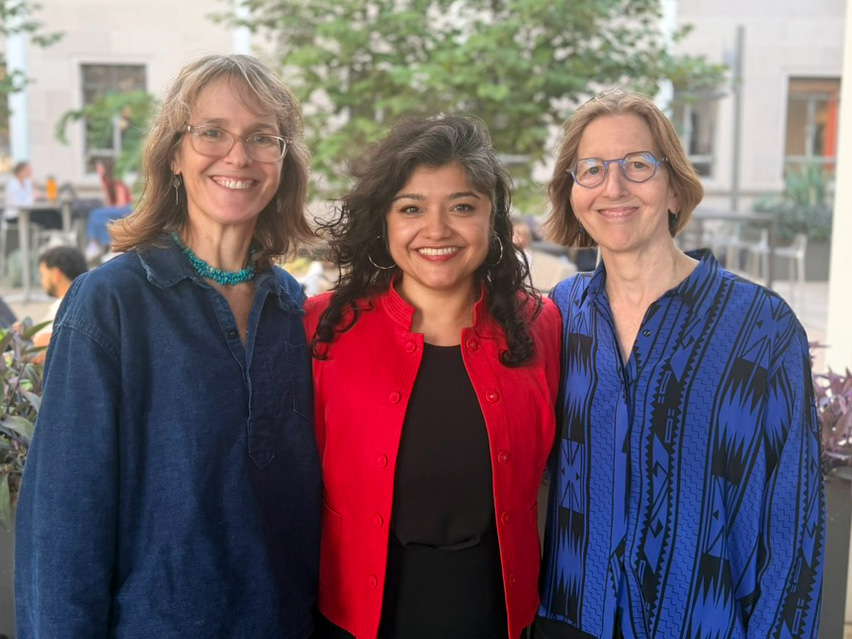 She also brings those perspectives directly into her work at UBalt Law, including
her teaching and clinical policy work. Through these connections, students gain exposure
to complex legal challenges and learn to approach them with careful analysis, collaboration
and an understanding of the people and communities most affected.
“Conversations like these push me beyond the legal perspective and make my scholarship
stronger,” Professor Gomez says. “I bring that back to UBalt Law, in the classroom
and in our clinical policy work, so our students learn to ask the right questions
and to build solutions that are rigorous, collaborative, and grounded in the realities
of the people affected.”
Professor Gomez’s presentation reflects the UBalt Law’s commitment to faculty scholarship
that contributes to important legal and policy conversations, advances understanding
of pressing issues, and connects academic research with the practice of law and the
needs of communities. By bringing their expertise to national forums and engaging
with emerging legal challenges, UBalt Law faculty strengthen the school’s intellectual
community while enriching the educational experience of future lawyers.