

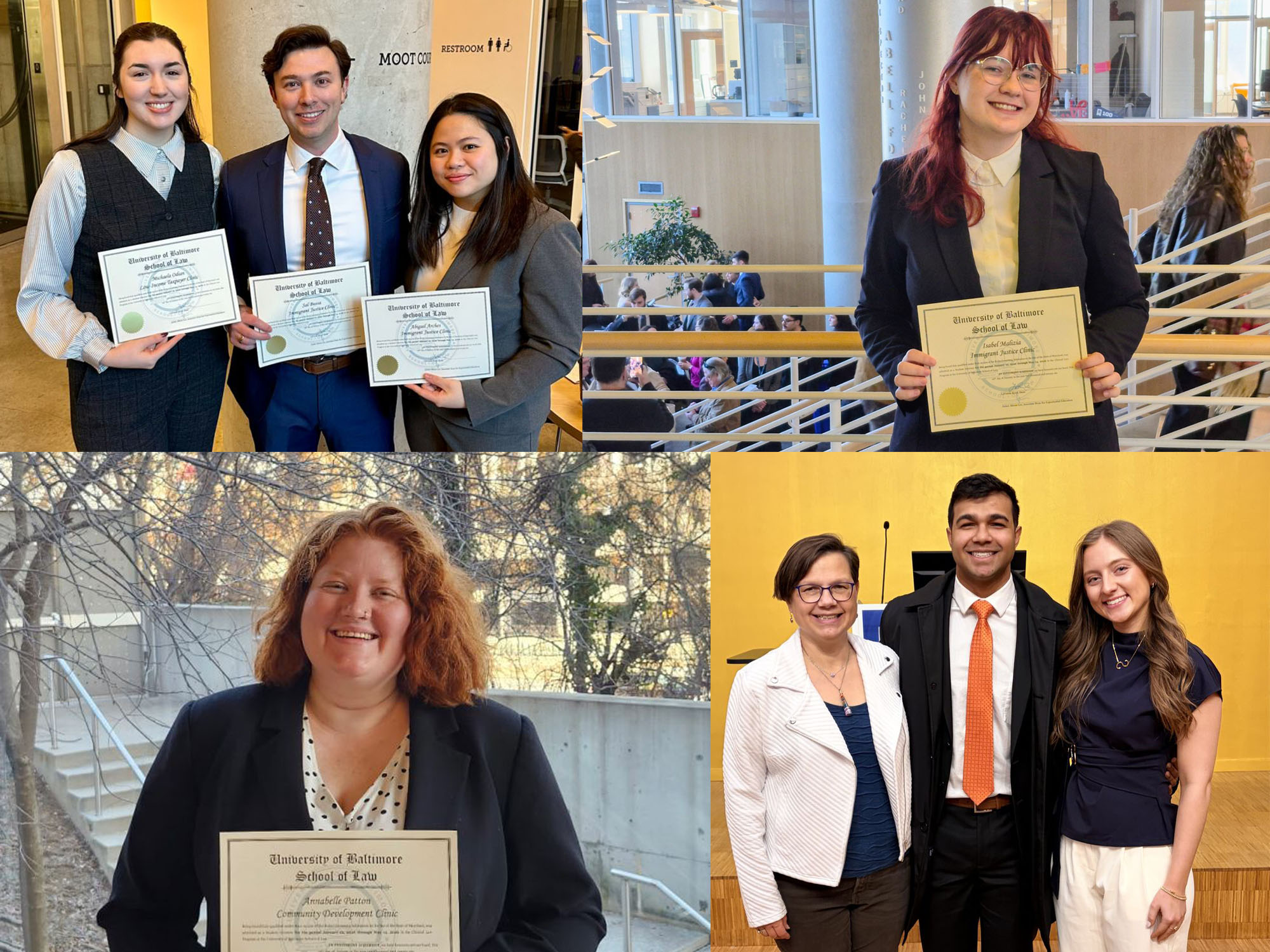
Rows of University of Baltimore School of Law students stood up, arm raised, palm forward and took an oath that marked a special milestone on the way to their degree.
With the Honorable Shirley Watts, Justice of the Supreme Court of Maryland, presiding, this new cohort of student attorneys has been officially sworn in to clinical practice where they can represent clients for the first time in their legal career.
For Annabelle Patton, a third-year law student, this moment has been a long time coming.
“I’ve been waiting for a year and a half to be able to work in this clinic, and so I’m really happy to be able to have this,” she said.
Patton initially envisioned a different career path for herself. She pursued a degree in psychology and chose the education career path, teaching in an elementary school, helping with reading intervention and even educating parents through the health department.
Through her work, she had become increasingly aware of service gaps, and the 2020 pandemic only maximized those inequities. She was ready for a career change and decided law was the best way to help create some of the changes she wanted to see.
With the swearing in, Patton is finally in a position to make an impact.
Through UBalt Law’s clinical program, ranked 4th nationally by U.S. News & World Report, students take the lead with clients to apply everything they’ve learned even before they have their law degree.
“I’ve been able to interview my client with my partner attorney, take the reins on any documentation that they need done, and really dive into the work rather than watching over another attorney’s shoulders,” Patton said. “In a clinic, you really get the experience of what it’s like to be in practice with all of the scaffolding of having a supervising attorney support you.”
Students can request from a wide range of clinics which they want to serve: Civil Advocacy, Criminal Defense and Advocacy, Family Law, Immigrant Justice, Community Development, Veterans Advocacy, Mental Health Law, Mediation for Families, the Innocence Project Clinic, and the Low-Income Taxpayer Clinic.
Michaela “Odi” Odian and Samuel “Sammy” Patnaik are serving with the Low-Income Taxpayer Clinic.
Odian started as a pre-med student, following her family’s example and seeing it as the best way to help others. Work with a Title IX office revealed the impact she could have through law.
Now part of the clinical program, Odian gets to put her passion to practice, cementing her choice to pursue a law degree.
“When I think back to my career possibilities and what I thought I wanted to do, it was always: I want to help people,” she said. “Getting to do this clinic, I’m really seeing the impact of how the legal field can help people. They’re low income and maybe they can’t afford these services that more well off people can, and getting to listen to their stories, get to know them, hear about their lives and how they got to where they were is so rewarding, and I’m just really thankful that I’m in the position to help these people through the clinic and the law school.”
Patnaik, who also serves as vice president for the Business and Tax Law Association, started his journey toward a law degree because he wanted to help people. The clinic only maximizes that opportunity.
“I have already had the opportunity to help dozens of real-world clients. The assistance I have provided is continued motivation to finish the journey I have started,” he said.
He said he looks forward to a heavy workload knowing his professors have prepared him for it.
“I am picking up more leadership positions at UBalt and I am looking forward to implementing my improved time management and soft skills in said positions,” he said.
Isabel Malizia is serving with the Immigrant Justice Clinic, fitting of her longtime desire to fight for justice. Her interest in her clinic started when she took an Immigration Law course with Elizabeth Keyes, associate dean for academic affairs.
“I grew up in a community with a dense immigrant population. I wanted to learn how to help defend undocumented immigrants from deportation and put those skills from class into practice,” she said. “I am looking forward to help putting together U-Visa applications to ensure a safe pathway to citizenship for my clients.”