

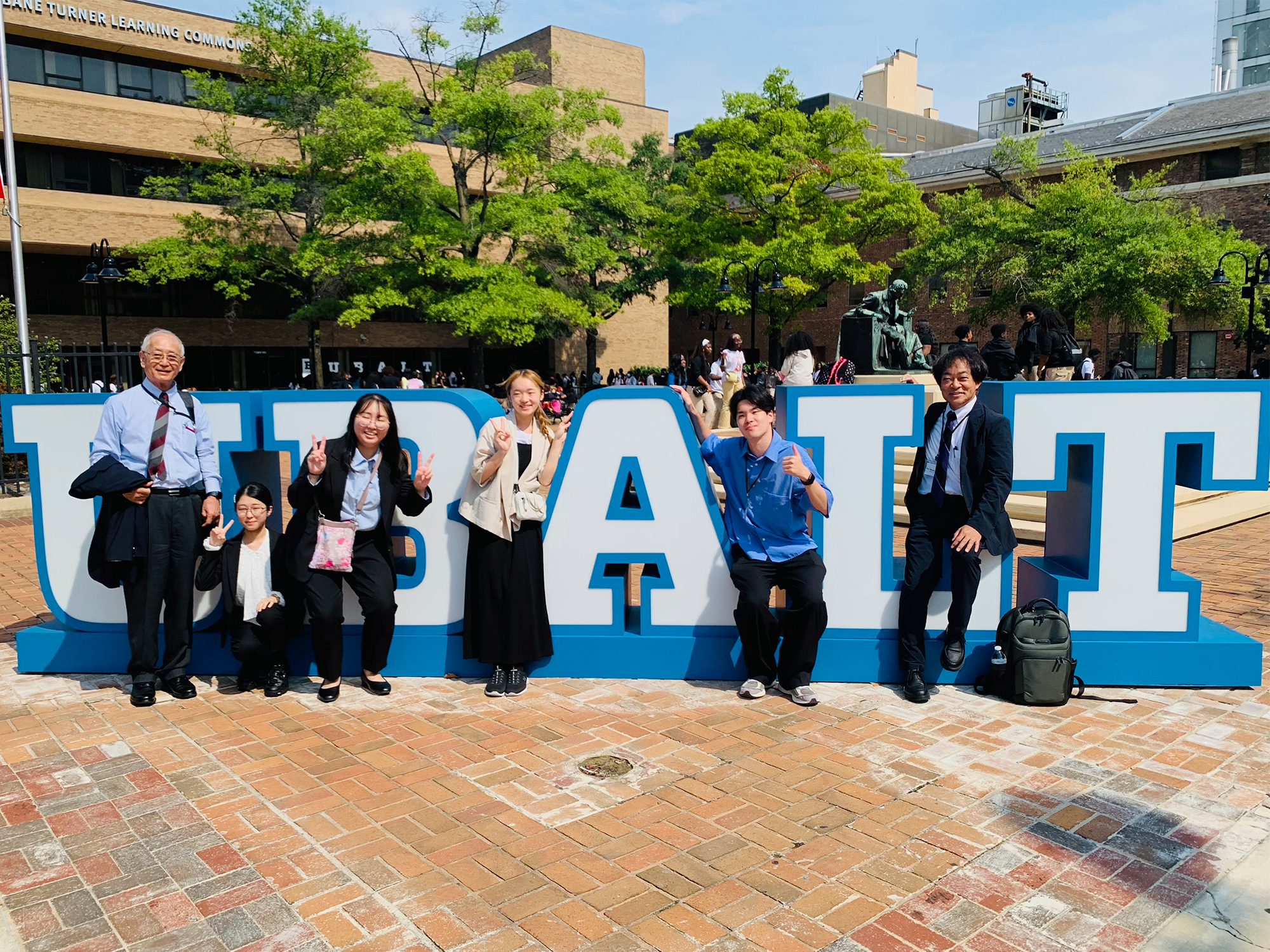
Six students, a professor and a special ambassador from Japan's Ehime University visited The University of Baltimore campus the week of Sept. 14, during which they discussed different ideas and approaches to resolving conflict as well as American immigration policy and more. Students, faculty and administrators from UBalt's College of Public Affairs, as well as other schools and programs from across the institution, interacted with the Japanese contingent during a series of exchanges that took place both on campus and at local cultural institutions including the Walters Art Museum.
"Our partnership with Ehime University is connected to even broader thought leadership and aspirational goals of improving the bilateral relationship between the United States and Japan," said College Public Affairs Interim Dean Ivan Sascha Sheehan. "It was a tremendous effort and it has gone about as well as any of us could have possibly imagined. The delegation has found the experience to be enormously valuable."
Ehime University, based in Matsuyama on the island of Shikoku in Japan, has 150 partnerships with universities worldwide. Their partnership with the University of Baltimore is only their ninth in the United States. The exchange was signed by Ehime University President Hiroshige Nishina and University of Baltimore President Kurt L. Schmoke in October 2025.
Members of the Ehime delegation included:
The group's activities included:
In addition, the visitors sat in on a graduate class, "Understanding and Assessing Conflict," taught by Dr. Clay-Robison. The class is part of the University's M.S. program in Negotiations and Conflict Management.
The Ehime University group declared the visit a complete success, with Amb. Ohde noting, "Throughout this entire week's agenda, you and your colleagues have taken exceptional care of our students, and we are sincerely grateful."
Elishabha Eaton-Whitehurst, deputy chief of community engagement and opportunity for MONSE, noted, "It was a pleasure sharing our collective work around public safety, community engagement, and neighborhood-based approaches in Baltimore, while also learning from their perspectives. The opportunity for this kind of international exchange was incredibly valuable, and we hope our visitors were able to take something meaningful from the conversation as well."
Mao Inoue, who studies regional revitalization and community development in Japan, said, "The idea that education can create new opportunities really inspired me. In Japan we have fewer opportunities to have experiences with people who are different from us."
Learn more about The University of Baltimore's College of Public Affairs.