

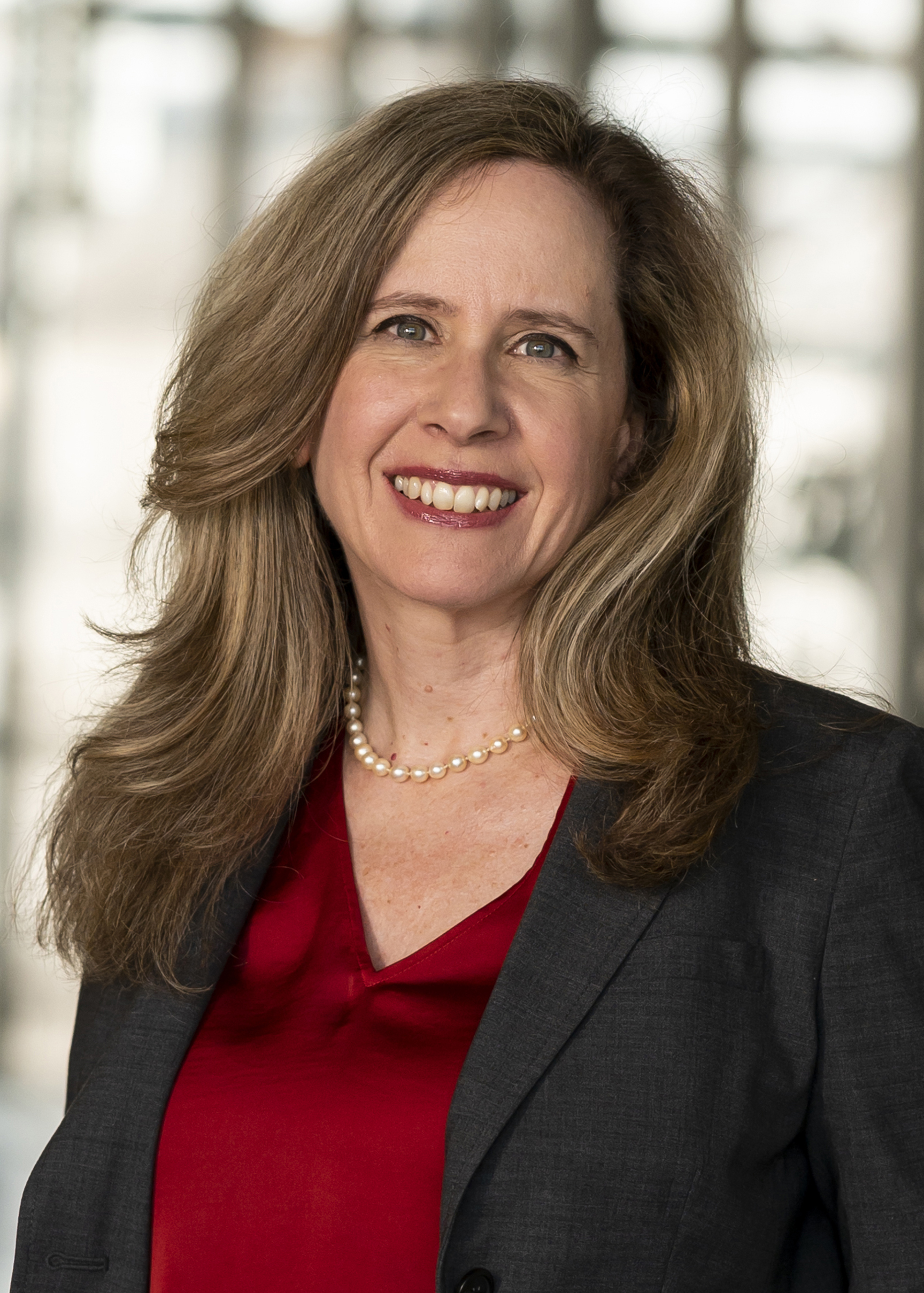
Office Details
Administrative Assistant: Stephanie Lee, 410.837.5705
John and Frances Angelos Law Center, Room 412
Co-Director, Center on Applied Feminism
Director, Saul Ewing Civil Advocacy Clinic
Education
J.D., University of Michigan
B.A., Duke University
Areas of Expertise
Privacy Law
Civil Advocacy
Evidence
Law and Poverty
Administrative Law
Feminist Legal Theory
Biography
Before joining the faculty, Professor Gilman served as a trial attorney in the U.S. Department of Justice’s Civil Rights Division and practiced at Arnold & Porter in Washington, D.C. She previously clerked for Judge Frank A. Kaufman of the U.S. District Court for the District of Maryland and was an editor of the Michigan Law Review.
Professor Gilman’s scholarship centers on poverty, technology, privacy, and feminist legal theory. Her work has appeared in leading journals, including the California Law Review, Vanderbilt Law Review, Washington University Law Review, and Fordham Law Review, among others. She frequently writes and speaks in the media on data privacy issues affecting marginalized communities.
Gilman directs the Saul Ewing Civil Advocacy Clinic, where student-attorneys represent individuals and community organizations in civil litigation and law reform matters. She also teaches Evidence, Administrative Law, and Poverty Law. In 2009, she received the school’s Outstanding Teaching Award. During the 2019–2020 academic year, she was a Faculty Fellow at Data & Society in New York, focusing on data privacy and low-income communities. In 2023–2024, she served as a Visiting Professor at Georgetown Law and Acting Director of the Communications and Technology Law Clinic. She was a Program Chair for the Association of Computing Machinery 2026 Conference on Fairness, Accountability, and Transparency (ACM FAccT). In 2026, she is a fellow at the Center for Advanced Internet Studies in Bochum, Germany.
Professor Gilman has long been active in organizations advocating for low-income Marylanders. She is the past president of the Public Justice Center’s board of directors (2004–2014) and has served on the Maryland Bar’s Section Council on Delivery of Legal Services, the ACLU of Maryland’s Committee on Litigation and Legal Priorities, and the Women's Law Center Judicial Selection Committee. She received the 2010 University System of Maryland Board of Regents’ Award for Public Service.
She is the former co-chair and a current member of the Scholarship Committee of the AALS Clinical Legal Education Section, and has served as an editor of both the Clinical Law Review and the Journal of Legal Education. Gilman is also co-director of the Center on Applied Feminism, which advances the practical application of feminist legal theory. She is a member of the Maryland and District of Columbia bars.
Becoming a Trial Lawyer, with Steven Grossman and Fredric Lederer (Carolina Academic Press 2008).
The Relevance and Prejudice of Poverty Evidence, in Critical Evidence (I. Bennett Capers, Jasmine Harris & Julia Simon-Kerr, eds. forthcoming Cambridge U. Press 2026).
Feminism, Privacy & Law in Cyberspace, in The Oxford Handbook of Feminism and Law in the United States (Martha Chamallas, Deborah Brake & Verna Williams eds., Oxford U. Press, 2022).
Commentary on Wyman v. James, in Feminist Judgments: Reproductive Justice Rewritten (Kimberly Mutcherson, ed., Cambridge U. Press 2020).
The Difference in Being Poor in Red States versus Blue States, in Holes in the Safety Net: Federalism and Poverty (Ezra Rosser, ed., Cambridge U. Press, 2019).
Wyman v. James: Privacy as a Luxury Not for the Poor, in The Poverty Law Canon (Ezra Rosser & Marie Failinger, eds., Univ. of Michigan Press 2016).
Code & Consequences: How Fraud Detection Algorithms Criminalize Welfare, 39 Harvard J. L. & Tech 617 (2026).
The Impact of Proptech and the Datafication of Real Estate on the Human Right to Housing, 9 Geo. L. Tech. Rev. 444 (2025).
Michele Gilman, et al., Participation Versus Scale: Tensions in the Practical Demands on Participatory AI, 29 First Monday (April 2024).
Ten Empowering Strategies for Non-Directive Clinical Supervision, 31 Clinical L. Rev. 211 (2024).
Michele Gilman, Expanding the Public’s Role in Federal AI Governance, 49 ABA Administrative & Regulatory News 16 (Fall 2023).
Democratizing AI: Principles for Meaningful Public Participation, Data & Society Research Report (2023).
Beyond Window Dressing: Public Participation for Marginalized Communities in the Datafied Society, 91 Fordham L. Rev. 503 (2022).
Me, Myself and My Digital Double: Extending Sara Greene’s Stealing (Identity) from the Poor to the Challenges of Identity Verification, 106 Minn. L. Rev. Headnotes 301 (2022).
Expanding Civil Rights to Combat Digital Discrimination on the Basis of Poverty, 75 SMU L. Rev. 571 (2022) (symposium on AI, Algorithms and Inequality).
Periods for Profit and the Rise of Menstrual Surveillance, 41 Colum. J. Gender & Law 100 (2021).
Digital Barriers to Economic Justice in the Wake of COVID-19 (with Mary Madden), Data & Society (April 21, 2021).
Five Privacy Principles (from the GDPR) the United States Should Adopt to Advance Economic Justice, 52 Ariz. State L.J. 368 (2020).
Poverty Lawgorithms: A Poverty Lawyer’s Guide to Fighting the Harms of Automated Decision-Making on Low-Income Communities, Data & Society Research Report (2020).
The Future of Clinical Legal Scholarship, 26 Clinical L. Rev. 189 (2019).
The Surveillance Gap: The Harms of Extreme Privacy and Data Marginalization (with Rebecca Green), 42 NYU Rev. L. & Soc. Change 253 (2018).
Privacy, Poverty and Big Data: A Matrix of Vulnerabilities for Poor Americans (with Mary Madden, Karen Levy & Alice Marwick), 95 Wash. U. L. Rev. 53 (2017).
En-Gendering Economic Inequality, 32.1 Columbia J. of L. & Gender 1 (2016).
A Court for the One Percent: How the Supreme Court Contributes to Economic Inequality, 2014 Utah L. Rev. 389 (2014).
Feminism, Democracy, and the "War on Women," 32 J. of Law & Inequality 1 (2014).
The Return of the Welfare Queen, 22 J. of Gender, Social Policy & the Law 247 (2014) (symposium).
The Poverty Defense, 47 U. Rich. L. Rev. 495 (2013).
The Class Differential in Privacy Law, 77 Brook. L. Rev.1389 (2012).
Quoted, Stephanie Kalina-Metzger, Legal Experts Address the Question of Who Should Pay When AI Goes Wrong, Daily Record, Aug. 18, 2025.
Video interview, The Intersection Between Surveillance and Reproductive Justice: A Conversation with Michele Gilman, Our Bodies, Ourselves, March 1, 2025.
Quoted, Madeleine O’Neill, Baltimore’s Opioid Trial Could Hinge on Highly Paid Expert Witnesses, The Baltimore Banner, Nov. 11, 2024.
Quoted, Hallie Miller, Tenants Ask Court if Unlicensed Landlords, Property Manager are Committing Fraud, The Baltimore Banner, Oct. 21, 2024.
Quoted, Rachel Konieczny, How Maryland Law Schools Approach AI in Curriculum, Research, Daily Record, Aug. 21, 2024.
Quoted, Sam Janesch, Tighter Security for SNAP Benefits Pursued as Maryland Sees $26M in Fraud, Baltimore Sun, June 1, 2024.
Quoted, Dorothy Atkins, “Much More is Coming”: Experts See Wave of AI Related Lawsuits, Law360, April 12, 2024.
Quoted, Dwight Weingarten, Maryland Legislature Considers Online Privacy Bill, Herald Mail, March 4, 2024.
Quoted, Aitana Vargas, Big Data at School, Palabra, Sept. 23, 2023.
Quoted, Joseph Cox, Inside Shadow Dragon, The Tool That Lets Ice Monitor Pregnancy Tracking Sites and Fortnite Players, 404 Media, Sept. 18, 2023.
Quoted, Kristin Poli, The Most Popular Digital Abortion Clinics: Ranked by Data Privacy, Wired, August 21, 2023.
Interview, The Power of AI, Meet the Press Reports, NBC, May 14, 2023.
Quoted, Khari Johnson, Algorithms Allegedly Penalized Black Renters. The U.S. Government is Watching, Wired, Jan. 23, 2023.
Guest, Kim Dacey, Expert Says Recent Rulings from SCOTUS is Changing Course of American Law, WBAL-TV, June 27, 2022.
Quoted, No, the Right to an Abortion is Not Explicitly in Maryland’s Constitution, Verify WUSA-9, May 12, 2022.
Quoted, Maressa Brown, What to Know About Period Trackers and the Information They Share, Parents, May 9, 2022.
Quoted, Jeremy Loudenback, The Foster Care System Turns to Big Data: Promising or Profiling?, The Imprint, Feb. 1, 2022.
Quoted, Bryan Renbaum, Gansler: SCOTUS Likely to Chip Away at Reproductive Rights in Mississippi Case, Maryland Reporter, Nov. 29, 2021.
Guest, What’s Going On? with Rebecca Myles, EU's Flawed Artificial Intelligence Regulation, WBAI Pacifica Radio 99.5, Nov. 10, 2021.