

Italian-American; ca. 1890-1970
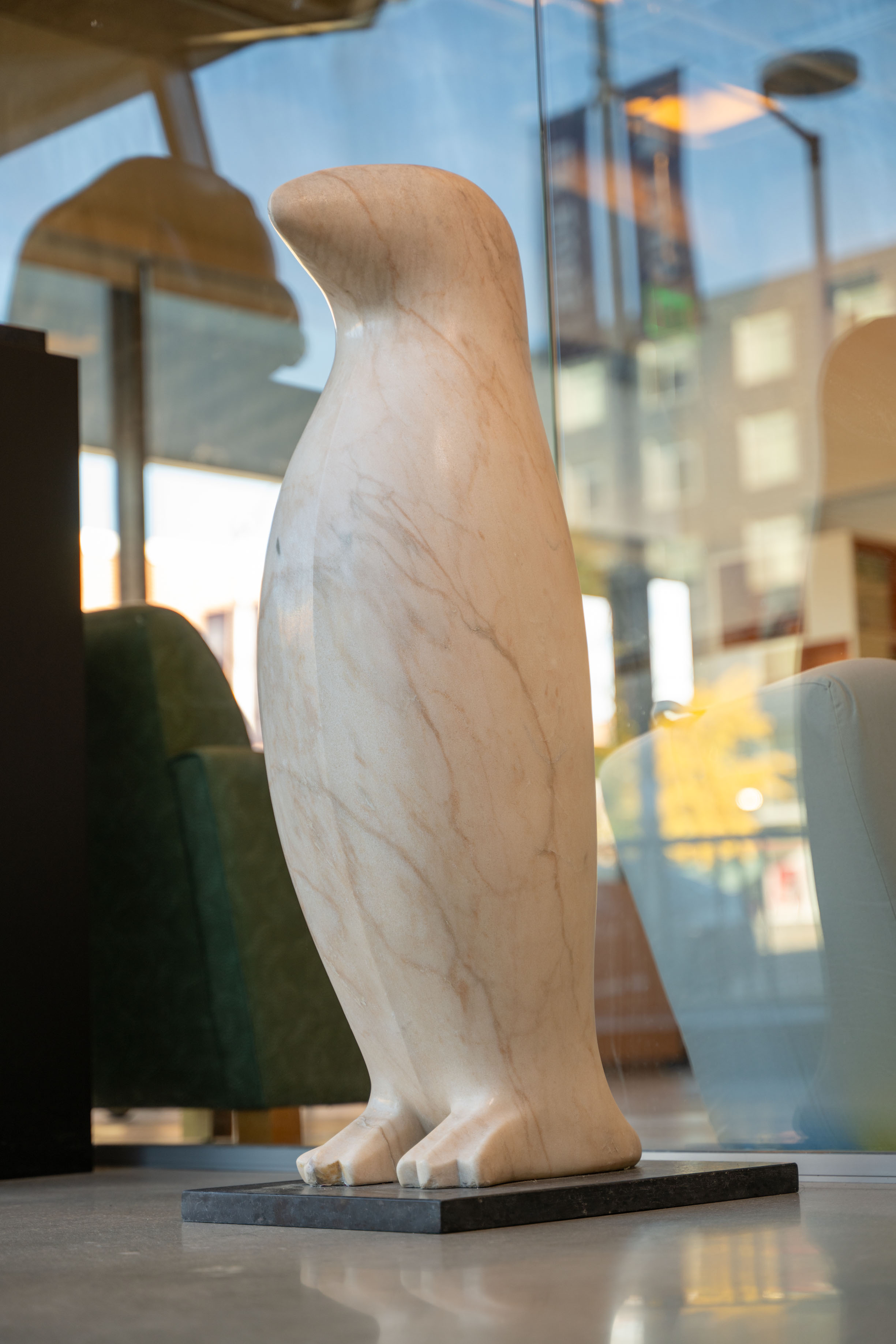 Penguin, n.d.
Material: Marble
Measurements: 41” x 12” x 14.5”
Location: Robert L. Bogomolny Library
Main Floor
Bufano came with his family from San Fele, Italy to New York City in the early 1900s. Known as “Benny”, he studied under renowned sculptors Paul Manship, Herbert Adams and James Earle Fraser, learning the technical basics of sculpture. Bufano met critical acclaim at an early age, winning the first art competition he entered in 1915. The nationwide competition focused on the plight of immigrants, and Bufano’s entry—a group of statues depicting an impoverished family—demonstrated the start of his lifelong role as an advocate for equality and the democratization of art. By 1917 he had settled in San Francisco, where he completed many commissions for public art.
Bufano traveled throughout Europe and Southeast Asia in 1920, where he learned about the emerging Art Deco movement as well as traditional Chinese ceramics and glazing techniques. Upon his return to San Francisco, he developed his own style, which consisted of smooth-textured, simplified forms that usually took the shape of animals. The recurring animal theme was influenced by Bufano’s deep admiration for St. Francis of Assisi, patron saint of animals and the environment. While he primarily worked in stone, he also used ceramics, stainless steel and mosaics, often combining two or more of these materials in one sculpture.
"Penguin" embodies both Bufano’s modernist approach and his love of the animal world. With its softly rounded contours and relaxed stance, "Penguin" captures the animal’s friendly and playful nature. Bufano omitted the birds’ wings, both for stylistic consistency—in this way he achieved more fluid, unbroken lines—and to call attention to the flightlessness of these gentle creatures. In addition to St. Francis of Assisi, the penguin was one of Bufano’s most frequent subjects.