

Cuban; 1927-2001
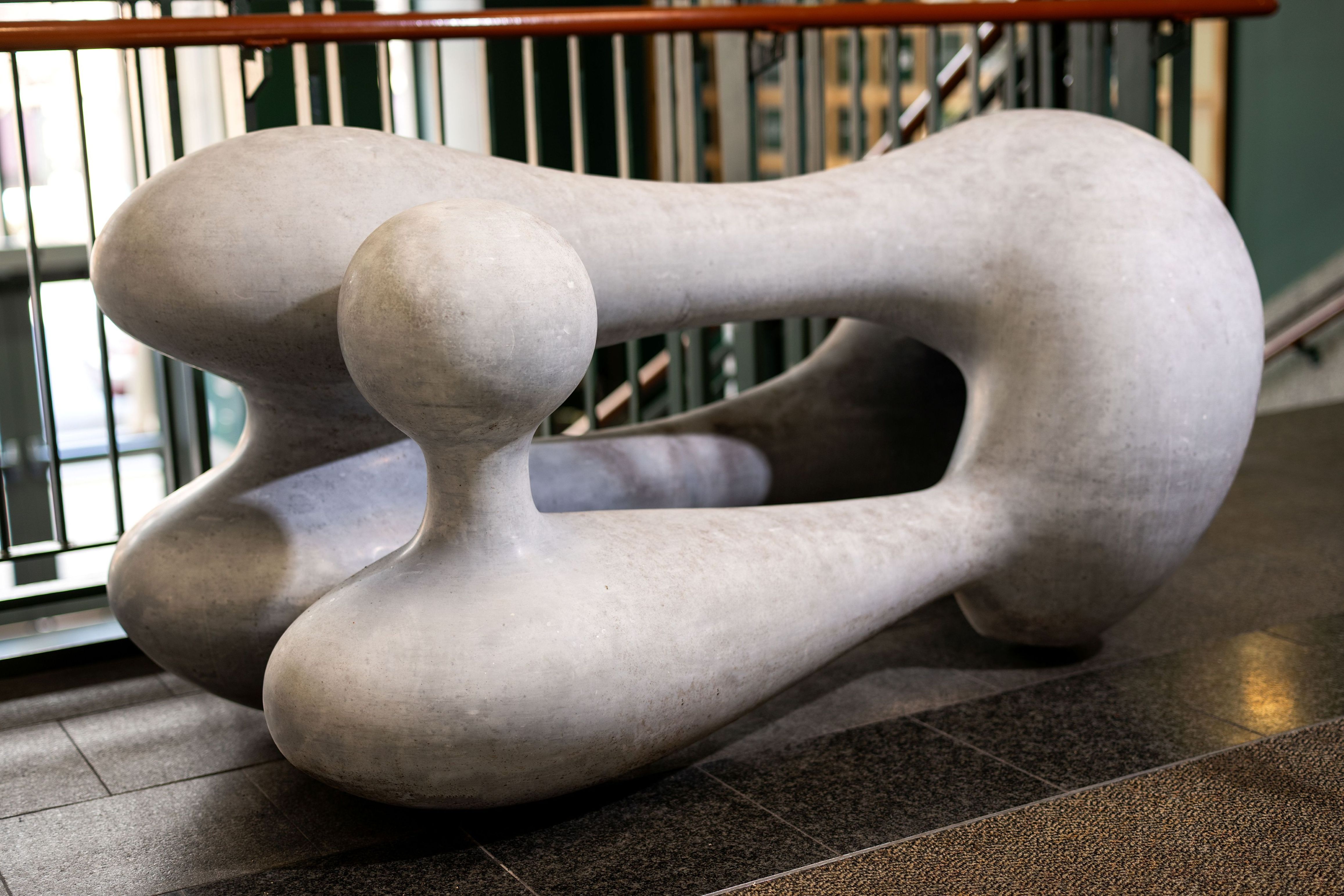
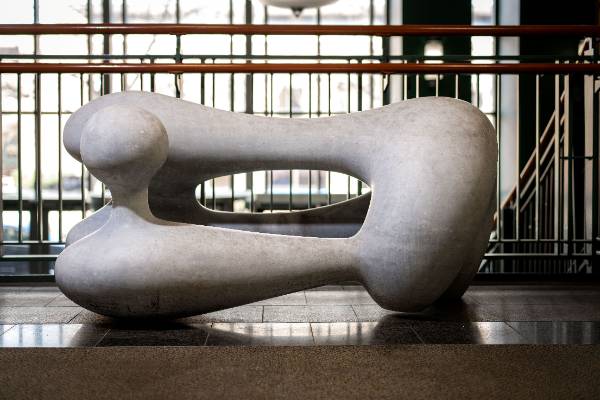 Overture; 1989.
Material: Cararra marble
Measurements: 30” x 60” x 29”
Location: William H. Thumel Sr. Business Center
Overture blurs the boundaries between animate and inanimate, sentient and inert: the general structure resembles a table or stool placed on its side, yet its fluid, biomorphic shapes suggest a living organism. Two parallel strands extend horizontally from one side of the rounded base, connected by a membrane-like section and ending in oval shapes. A third “leg” extends from the bottom of the base. While it too ends in an ellipse, a solid orb sprouts from the upper surface, similar to an eye on a stalk like that of a crab or snail. Overture‘s substantial weight and curving lines evoke both the stillness of objects and vitality of the natural environment.
Cárdenas graduated from San Alejandro Academy of Fine Arts in 1949, studying under renowned sculptor Juan José Sicre. Cárdenas looked to European and American abstract modernists, abandoning traditional techniques and subject matter in favor of a more experimental approach. He had his first solo show in Havana in 1954, which earned him a scholarship from the Cuban government to study in Paris. Shortly after Cárdenas’ arrival in Montparnasse in 1955, he encountered Surrealist leader André Breton, who enthusiastically declared Cárdenas’ work to be a defining part of the movement.
Some twenty years later, while Cárdenas acknowledged his art aligned with Surrealist principles and methodology, he confirmed that he developed his style well before he was aware of the genre. Despite Cárdenas’ aversion to labels, his work flourished within the Surrealist network, and he also drew inspiration from artists outside the group. Henry Moore’s flowing lines and simultaneous embracing of the abstract and the figural, Jean Arp’s organic forms and interest in the subconscious, and the fervent modernity embodied by Constantin Brancusi can all be observed in Cárdenas’ marble pieces. But it would be a mistake to conceive of his oeuvre as merely the influence of other artists. Cárdenas’ mastery of negative space, balanced use of sensual contours, and incorporation of his Afro-Caribbean cultural heritage come together to create a wholly original artistic identity.