

American; b. 1933
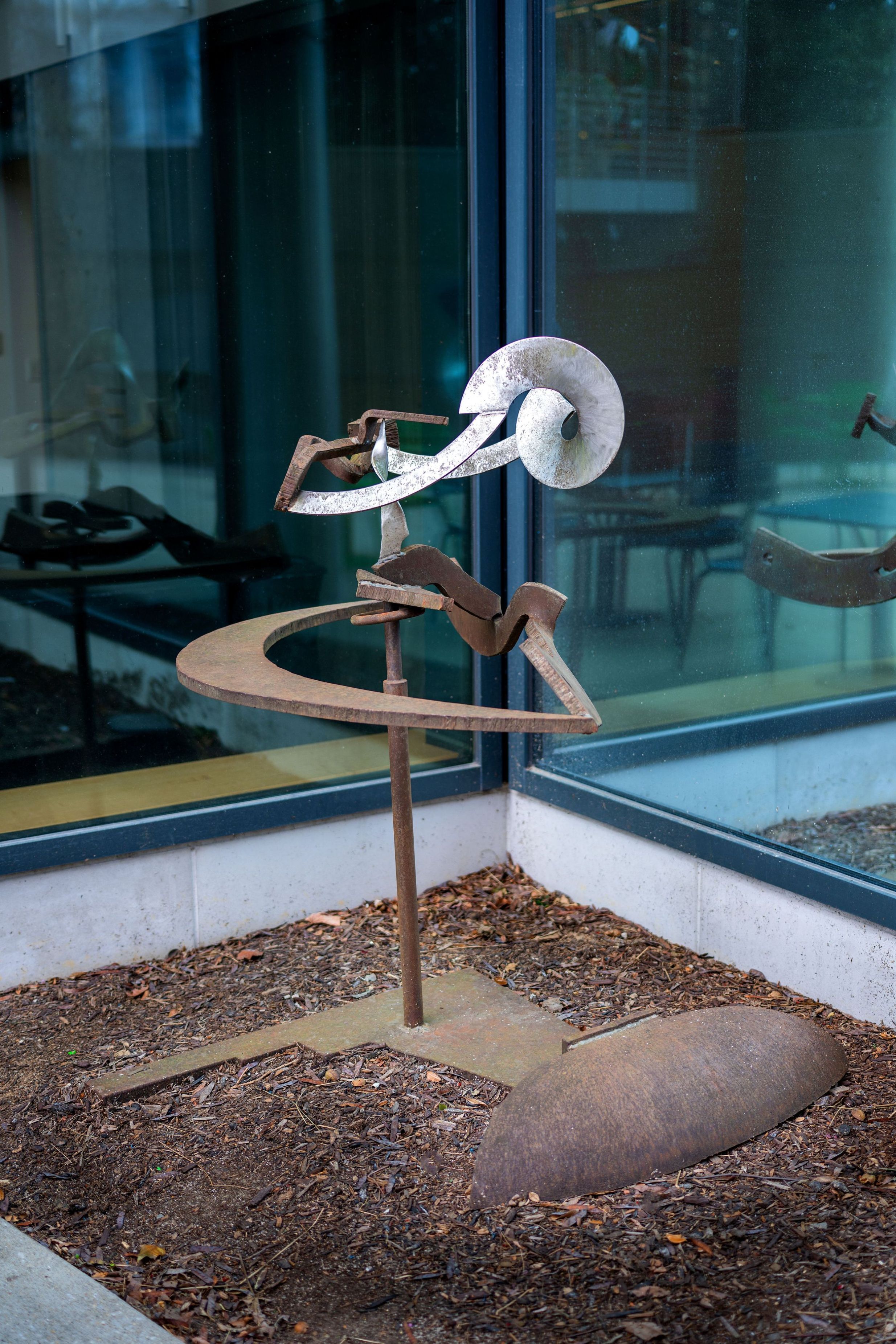
Wishtree, 1990.
Material: Steel
Measurements: 60” x 45” x 48”
Location: Angelos Law Center, 1401 N. Charles St.
Courtyard - Floor .5
Mark di Suvero was born in Shanghai, China, in 1933 to Italian parents. His family
immigrated to the United States in 1941, and di Suvero received a BA in Philosophy
from the University of California, Berkeley in 1957. That same year he moved to New
York City and began making small assemblages in plaster, wax, scrap metal and wood.
Widely considered a pioneer in the use of steel, di Suvero’s practice is deeply rooted
in Abstract Expressionism. Applying principles of engineering and architecture, particularly
geometry and structure, his sculptures often invite viewer engagement. Providing space
to walk through, under, around or even on top of the piece align with di Suvero’s
belief that art should be participatory and encourage viewers to interact with their
environment.
Di Suvero is best known for towering constructions that sometimes soar several stories tall. This is partially due to a near-fatal accident he suffered in 1960, which left him with limited mobility and temporarily unable to sculpt directly with his hands. He learned to weld and began using an industrial crane as an extension of his arms, which allowed him to create monumental steel beam sculptures as easily as painting on canvas (di Suvero often refers to the crane as his “paintbrush”.) Di Suvero’s small and mid-size pieces are typically improvised and less deliberate than his larger structures, but for the most part they utilize the same elements and creative process as his larger works. Instead of drawing or painting a sketch for the finished piece, the artist gathers bits of scrap metal in his studio left over from other projects, selecting them on impulse and assembling them relatively quickly as he sees fit. While a crane isn’t needed for these, the artist does nearly all of the welding and cutting himself.
Wishtree consists of a rectangular base with a jagged staircase-like border on one side, with the other side a raised half-moon shape. A vertical beam planted in the base is surrounded above by sleek, dynamic curves that convey movement and speed. The top of the sculpture is punctuated by a silver spiral out of which thin bands slope gently downwards. Here, as in his other small-scale works, industrial materials lose their heavy, Brutalist undertones to produce an effect of airy openness and motion. The title also contributes to the quality of lightness: Wishtree connotes themes of nature, optimism and hope.
The title also perhaps reflects di Suvero’s yearning for peace and social justice, particularly as they relate to public spaces. He is a lifelong activist for accessible art, not just in the physical sense but also culturally and financially. He co-founded New York City’s first artists’ cooperative in 1962, and 15 years later he established the Athena Foundation, a nonprofit that provided studio space and awarded grants to artists. In 1986 di Suvero founded Socrates Sculpture Park, a 6-acre parcel on the site of an abandoned landfill on the East River in Queens, New York. The space was transformed into a public park, open artists’ studio and exhibition space through the collaborative efforts of artists and community members. To date, Socrates Sculpture Park has hosted the work of over 1200 artists and offers an array of free public programs, including cultural festivals, art education initiatives and performances. These three organizations demonstrate di Suvero’s commitment to supporting the arts and reducing barriers to entry into the art world – both for aspiring creative professionals and the general public.