

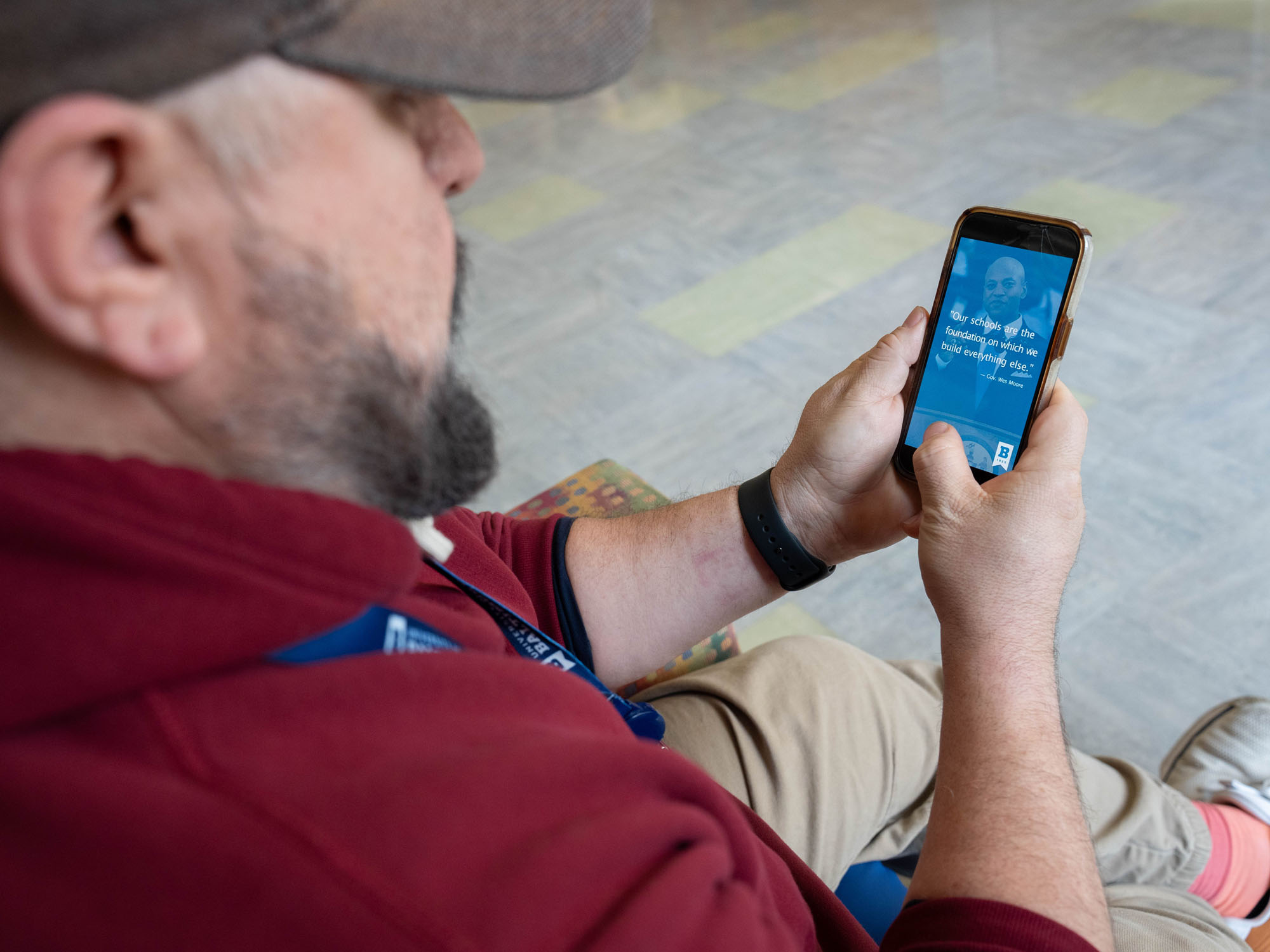
We’ve got your first assignment ready.
Maryland Gov. Wes Moore is coming to The University of Baltimore for a town hall (not really, but let’s pretend, OK?). The reason: a candid discussion about living in Maryland.
You’re going to have to pitch the plan to media. You should write some talking points for our staff, too. You’re also going to need to talk to a student to get their take on staying in Maryland after graduation.
Let’s get started...
Charting A New-ish Course
When UBalt professor Marion Winik started planning her fall public relations course, she wanted it to be memorable and dynamic. It was the first time the course was available after a brief hiatus and now had a waiting list.
She invited Chris Hart, UBalt’s communications director, to co-teach the class and they devised a plan. Students would face a semester-long project revolving around an imagined event. Then at some point, they would throw the students a curveball.
In this case, days after a successful event with Gov. Moore at UBalt, word spreads that he’s announcing a bid for president. Rumors are running rampant that the campus event was a distraction, a ploy, and the University might have even known.
Students in the class had to conduct real interviews about the mock event. They had to prepare a public response. They had to react like they might be in a real PR position facing a real crisis.
They learned by doing, Winik said, and they loved the challenge of it all.
“It was clear early on that this class was really catching fire,” she said. “People were all excited about it and saying it's their favorite class. And it was such a positive experience for me, an unexpected positive experience.”
Shakkearra Sykes, a B.A. in Digital Communication student, liked the experiential nature of the class. She wasn’t expecting it to be so hands on.
“It felt like a real-life simulation of what a day in the life of someone in PR would do,” she said.
When she enrolled in the class, Sykes looked forward to building on the skills she already has from a decade in the communications field.
“When I had seen PR writing, I'm like, this is going to strengthen my storytelling, this is going to help me with networking, and actually, the one thing I really enjoyed about the class was the fact that we had guest speakers,” she said.
Telling A Story, One Assignment At A Time
Amid the coursework, the students got to hear a variety of communications professionals offering insights from their own experiences. It helped to learn about the different degrees, demands and ethical challenges part of a public relations role, Sykes said.
She also appreciated the course’s continuity.
“I liked how the class told a story throughout,” Sykes said. “It wasn't that we're doing separate assignments; it was separate work, but it was one main issue throughout, one main event throughout the entire semester.”
Nicholas Salcido, a B.A. in Digital Communication student, also came into the course with extensive experience in related work. Between his time with the U.S. Army and work with a consulting group after, he has about 30 years of communications work on his resume.
Still, Salcido said, he took a lot away from the course. Despite his background, he is cognizant that there’s always something new to learn.
“I'm curious how this generation approaches design problems or crisis communications because I'm a digital immigrant—none of this stuff existed when I was coming up,” he said. “I'm just curious how somebody who's always lived in this environment approaches this because my brain doesn't work in that way, but it's important for me to understand that if I'm going to continue to do this.”
The course required a mix of individual work and group projects. The collaborative aspect helped Salcido because he could lend his own expertise while absorbing others’.
“I really enjoyed that, too, because it was an opportunity for me to collaborate with individuals and talk about how we approach these, and it's probably where I felt the least self-conscious allowing my experience to take the front seat,” Salcido said.
Sykes also enjoyed the collaborative nature of the class and noted it wasn’t reserved to the group projects.
“After each assignment, whether it was in groups or if it was a single, everyone had an opportunity to read what they had written, so we got to see how others broke it down. … I feel like we had one-on-one experience, but then in the same token, we were still within a group, and no one felt left out.”
Overcoming New Challenges
River Fox, a B.A. in English student, felt the class challenged them to work outside their comfort zone.
The class had to write a feature piece after a student interview, but they also had to write a press release, which was new to Fox. Learning new writing techniques gave them a chance to practice and understand the value behind different methods of writing and storytelling.
“This is one of the first classes I've taken that has asked me to write specifically not for a scientific purview or a supportive purview, … and instead, write for an audience I've never written for before—writing for people within your team with the talking points, writing for fellow students or the media with the student feature, and writing for specifically the press, and, journalists and reporters,” Fox said. “It really challenged me to think about these different audiences, what their needs are and how to appeal to them, like, what story can I tell that appeals to them enough to get them reading past that first line?”
Winik was thrilled with how the overall course turned out for the students. She noted she even learned new tricks in the course she can use when she’s promoting her published work.
“It was so interesting to think critically about what actually works in these pitch letters,” she said, noting she’s had to do some pitch work herself. “Now I can look more critically at the pitch letters that I receive, trying to think, what else?”