The accelerator was designed not simply to explore artificial intelligence as a trend, but to help founders combine strong entrepreneurial fundamentals with practical technology applications.
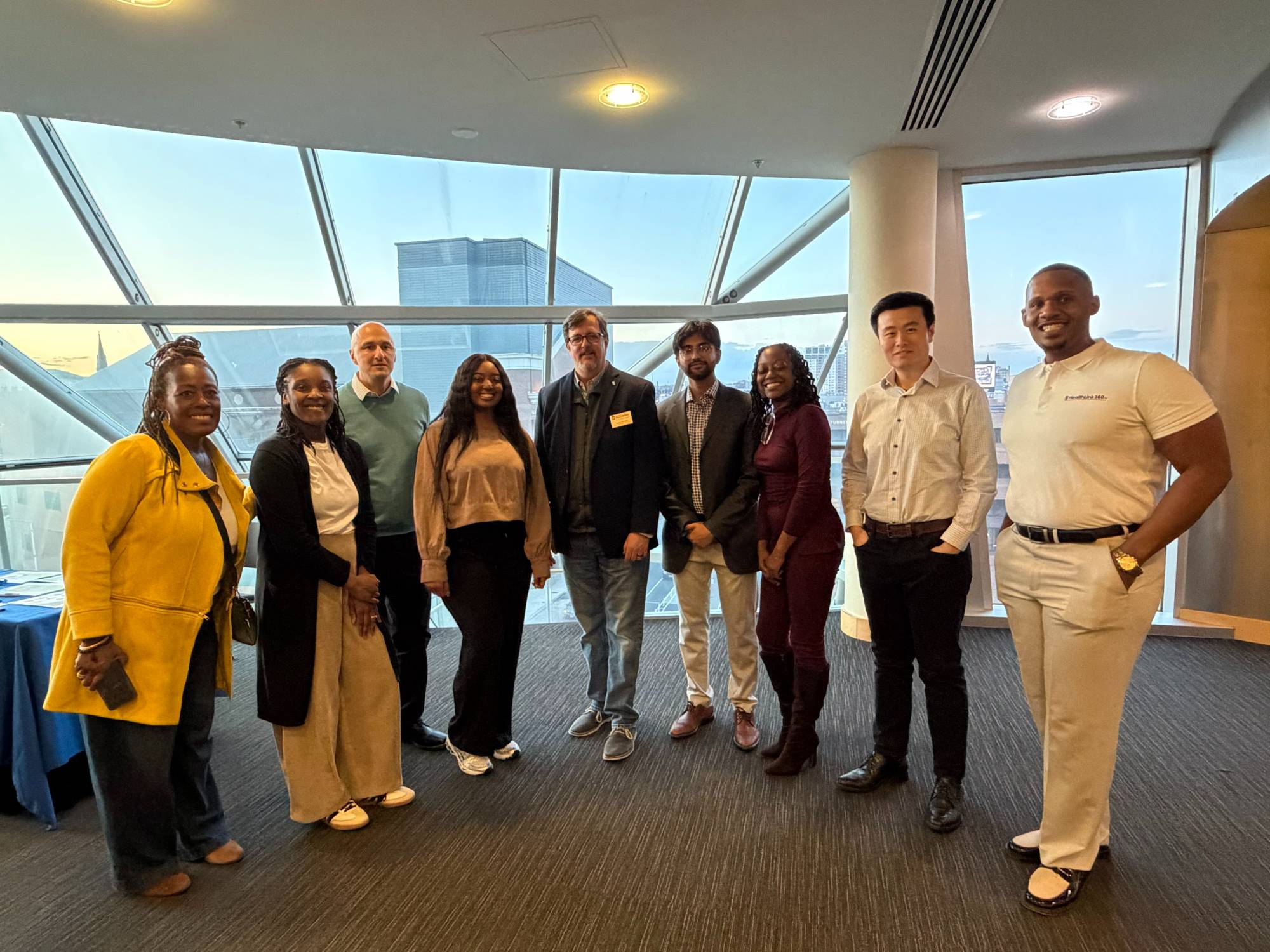
Artificial intelligence is already reshaping business, moving faster than most organizations can adapt. The question isn't whether to integrate AI—it's how to do it with purpose and precision. Eight Baltimore-area founders answered that question at The University of Baltimore's inaugural AI-Enabled Business Accelerator Demo Day, showcasing solutions built to solve real problems in healthcare, housing, energy, and education.
The UBalt AI-Enabled Business Accelerator Demo Day became more than a pitch event—it emerged as a public celebration of Baltimore founders, practical innovation, and the growing role of artificial intelligence in addressing real community and industry challenges.
Held at the Wright Theatre on the University of Baltimore campus, the event was organized
by the University’s Center for Entrepreneurship and Innovation (CEI) and supported by TEDCO’s Baltimore Innovation Initiative, bringing together founders, mentors, investors, students, and members of the regional
innovation ecosystem.
Henry Mortimer, director of the Center for Entrepreneurship and Innovation, welcomed attendees and reflected on the University’s long-standing mission to support builders, working professionals, and problem-solvers. He emphasized that the accelerator was designed not simply to explore artificial intelligence as a trend, but to help founders combine strong entrepreneurial fundamentals with practical technology applications.
For nine weeks, participating ventures worked through customer discovery, validation, pricing strategy, go-to-market planning, and storytelling while testing how AI could strengthen their business models. The result was a diverse showcase of startups using technology as a tool for solving real problems across industries.
Interest in the program highlighted growing momentum around AI entrepreneurship in Baltimore. Approximately 30 ventures applied to join the accelerator, with nine selected and eight completing the full experience. Their ideas spanned sectors including healthcare, housing, education, utilities, compliance systems, and small-business productivity.
Kenneth Watson, founder of HealthLink360, presented a preventive health platform designed to detect early metabolic risks through biometric analysis and AI-driven insights. Drawing from his own experience, Watson emphasized the importance of culturally responsive data and accessible wellness solutions for underserved communities.
Hamza Omar, founder of SphereHub, highlighted the challenges international students often face when searching for off-campus living arrangements. Drawing on his own journey, Omar explained how the platform uses AI-powered matching to help students find compatible roommates and safer housing options.
In the energy sector, Jiaqun Wang, founder of Alektra Inc., introduced a predictive analytics solution designed to help utilities manage market volatility through integrated forecasting and optimization tools. Wang noted that smarter energy decision-making is becoming increasingly important in today’s evolving power markets.
Education and workforce development were highlighted by Amber Johnson Avery, founder of NextGenEdu, who presented an AI-enabled platform designed to help students navigate career pathways with greater clarity and confidence. Avery said the goal is to provide direction in a rapidly changing workforce shaped by technological change.
Several founders also focused on structural gaps within innovation ecosystems. Bianca Jackson, founder of BrickRose Exchange, presented a framework aimed at helping incubators and accelerators measure whether startups are meaningfully integrating AI into daily operations. According to Jackson, tracking real productivity and operational outcomes is essential for long-term business resilience.
Entrepreneurial adaptability was underscored by Scott Kaufman, founder of Stacks Data, who described how his company pivoted after losing supplier engagement in its original compliance reporting model. Kaufman explained that the revised platform uses AI to streamline global compliance workflows and improve data efficiency.
In behavioral healthcare, Romane Sharp, founder of Pulse, delivered a powerful presentation on early signal detection for relapse risk. Sharp emphasized that identifying patterns across fragmented care systems can enable earlier intervention and potentially reduce overdose outcomes.
Closing the founder presentations, Nicole Foster, founder of Sommos, introduced an AI-native family storytelling platform designed to preserve intergenerational
memories. Foster highlighted how technology can help families capture meaningful
experiences while strengthening emotional connections.
TEDCO Baltimore Innovation Initiative Program Manager Jalaycia Lewis reinforced the broader regional significance of the accelerator, describing the program as an important step in strengthening Baltimore’s startup infrastructure.
Lewis also praised the leadership of the University of Baltimore and CEI Director Henry Mortimer for guiding founders at different stages of their entrepreneurial journeys and connecting them with mentors, investors, and industry partners within the local innovation ecosystem.
This program is about building community and creating the infrastructure that will support sustainable startup growth in our region. There was tremendous energy in the room, and we are excited to see how these founders continue to grow and contribute to economic development in Baltimore.
The program also recognized standout progress of individuals within the cohort. Supported by Pitch Creator Founder Jason Tagler, the accelerator presented an Acceleration Award to Amber Avery and Scott Kaufman in recognition of their determination, openness to feedback, and visible growth throughout the program.
The evening concluded with networking and informal conversations, Demo Day felt less like a final milestone and more like the beginning of a new phase for the participating ventures.
For the University of Baltimore, the inaugural accelerator signaled an expanding role in supporting innovation-driven economic development. For Baltimore, it was a reminder of what happens when determination meets opportunity. The founders who took the stage didn't just pitch ideas—they showed the city's capacity to build, adapt, and solve real problems with purpose and precision.
This is how Baltimore moves forward: one venture, one solution, one bold step at a time.