

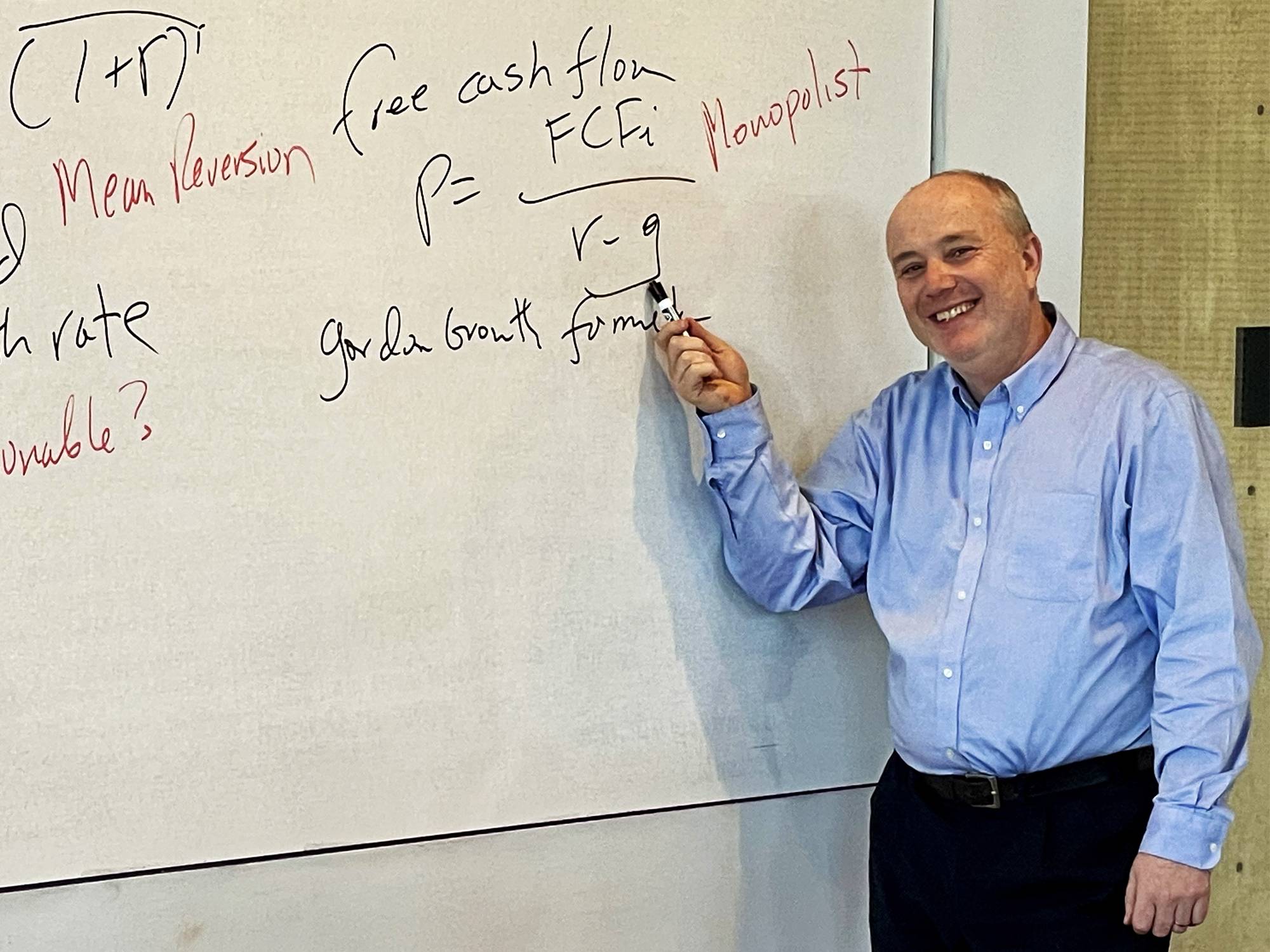
As new leadership takes the helm at a critical federal oversight agency, University of Baltimore accounting professor Mikhail Pevzner is offering an expert perspective on challenges facing the nation's audit watchdog.
Pevzner, who holds the Ernst & Young Chair in Accounting at UBalt's Merrick School of Business, was quoted in a Feb. 17 Bloomberg Tax article examining the Public Company Accounting Oversight Board's autonomy and effectiveness as it undergoes leadership changes.
The PCAOB, created in the wake of the Enron and WorldCom accounting scandals, oversees audits of public companies to protect investors. But the board has faced its own turbulence in recent years, raising questions about its stability and independence.
Pevzner brings unique insights to the discussion. Not only has he taught at the University since 2013, he spent some intervals on sabbatical serving as an economist in the Office of Chief Accountant and Division of Economic and Risk Analysis at the U.S. Securities and Exchange Commission and as a visiting financial economist at FINRA, where he contributed to economic analyses supporting rulemaking and corporate finance policy decisions. Most recently Pevzner served as a part-time economic expert at the SEC with primary responsibility of reviewing and commenting on the economic analyses of the proposed PCAOB rules.
His expertise on the PCAOB runs deep. For example, Pevzner co-authored "Deconstructing the PCAOB: Using Organizational Economics to Assess the State of a Regulator," a research paper that examines the quality of the board's organizational architecture through the lens of organizational economics. The work provides a rigorous framework for understanding the structural challenges facing the oversight body.
That regulatory experience informs his assessment of the PCAOB's deeper institutional challenges. In the Bloomberg Tax article, Pevzner argues that leadership turnover, while disruptive, isn't the board's fundamental problem.
"The board's members, however, are political appointees and the watchdog's politicization 'has been happening for a long time,' said Mikhail Pevzner, an accounting professor at the University of Baltimore.
Scandals and turnover, however, have destabilized the board, limiting its acceptance as the important institution that it is, Pevzner said.
'The deeper problem with PCAOB is not who runs it,' he said."
As graduate business program director for the Merrick School of Business, Pevzner teaches a graduate-level course in Advanced Financial Statement Analysis where he bridges his SEC regulatory experience with students’ learning. This course transforms financial statements from static reports into strategic intelligence—grounded not only in advanced analytical tools, but in real-world financial regulation experience. Drawing on insights from SEC-related financial reporting and enforcement work, students learn how regulators scrutinize earnings quality, disclosure choices, non-GAAP metrics, tax strategies, and ESG reporting—and how those judgments shape capital markets outcomes.
His academic credentials are equally impressive. Pevzner has published more than 40 peer-reviewed articles in leading journals including the Journal of Financial Economics, Journal of Accounting Research, Journal of Financial and Quantitative Analysis, Contemporary Accounting Research, and Journal of International Business Studies. His research examines how information, trust, incentives and institutional structures affect valuation and market outcomes—precisely the issues at stake in debates over audit oversight.
Pevzner's commentary in Bloomberg Tax exemplifies how UBalt faculty serve as thought leaders on issues affecting business, finance and public policy. His analysis connects academic research on institutional governance with practical concerns about audit quality and investor protection.
As a financial economist specializing in valuation, business damages and the economic analysis of regulatory rulemakings, Pevzner's work sits at the intersection of corporate finance, accounting and regulatory economics—making him an authoritative voice on PCAOB governance questions.
His perspective reminds us that effective oversight requires more than just appointing new leaders. It demands attention to institutional design, political independence and the incentive structures that shape organizational behavior.
Learn more about Dr. Pevzner's work: