

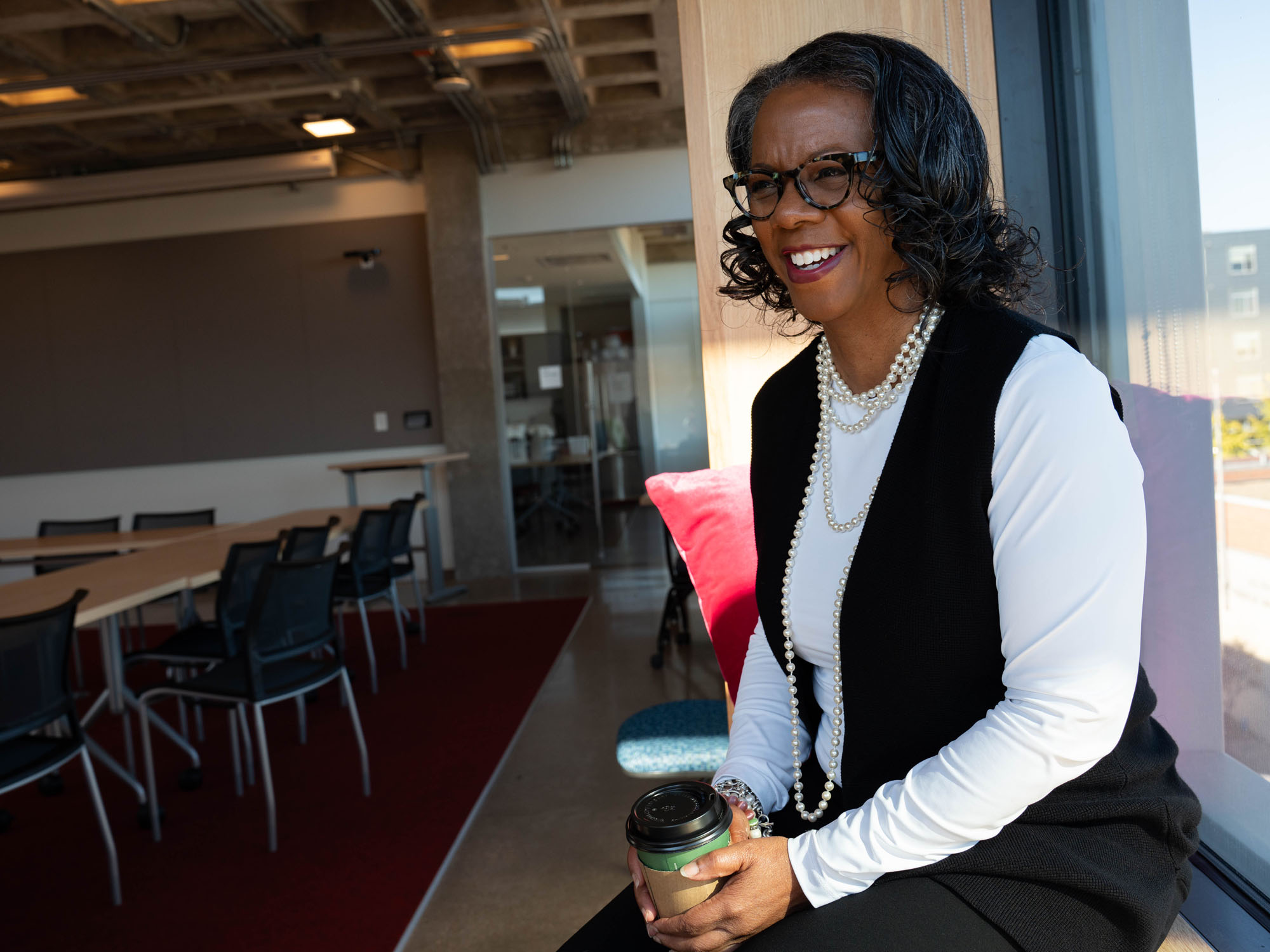
Dr. Jan Williams, CPA, has been an accounting professor at The University of Baltimore for 19 years. She brings her undergraduate and graduate students a wealth of expertise having spent time as an auditor and an accounting manager before becoming a professor in the field.
At UBalt, she gets to teach in some of the same classrooms where she was a M.S. in Taxation student. She roots her lessons in what she wanted to learn as a student and then builds on them to meet the ever-changing demands of the profession, including finding new ways to introduce AI into her accounting lessons. During a coffee break at Robert L. Bogomolny Library, Williams shared how she keeps adapting her lessons, what she’s still learning and why accounting has always been—and remains—a viable career option.
You have such a strong accounting history in work and research. How did you decide you wanted to teach accounting, particularly at the college level?
When I graduated with my undergraduate degree, I always knew I wanted to become a college professor. I had such a great experience in my undergraduate program; I graduated from Hampton University in Virginia. I had awesome professors, and I knew that somewhere down the road I wanted to go into academia. I thought it would be 30-40 years later when I was ready to retire, but God had another plan. It happened much sooner than I expected.
I started my career working at PriceWaterhouse, now PricewaterhouseCoopers, in auditing and then I moved to Kirschner Medical Corporation. I was the accounting manager there. I loved my job, loved the people I worked with, loved what I did, but we were acquired by another company. They gave me the opportunity to move to Indiana or New Jersey, but I decided to stay in the area. I love Baltimore.
While I was looking for a job, an opportunity to teach came up at Morgan State University. I said, OK, I’ll try it out and see if it’s something I want to do long term. I just fell in love with the classroom and the students, mentoring the students and helping to prepare them for their careers in accounting. I ended up staying in academia and then going back to school to get my PhD from Morgan.


Accounting is typically seen as a recession-proof or crisis-proof career. There are also now considerations of the impact of AI on particular positions. Where do you feel accounting stands as a viable career option? And what’s the most important lesson you want to impart on your students as they prepare for an accounting career?
Accounting is still a viable career and while no job is recession proof, we like to think of accounting as close to it. We will always need accountants and CPAs; the economy cannot survive without us. We have noticed that during recessions, our enrollment has actually increased in accounting. I think it is during those times that students realize how important accounting is and how stable it can be.
There’s talk about AI taking jobs, and I think AI will replace a lot of jobs, but in accounting, there is a significant amount of discretion that will still require human critical thinking and decision- making. As humans, we have additional knowledge that AI does not have and can do things that AI cannot do.
Also, you have to have the relationships. A lot of people think it’s just numbers, but you’re building relationships and you’re talking to clients, and that is still an important part. AI will be a good addition to help with routine tasks, but overall, you still need human involvement in accounting. I tell my students that’s why it’s so important for them to build analytical and critical thinking skills while they’re in college. The routine tasks might be eliminated, but there will still be a need for the higher-level, critical-thinking, problem-solving skills.
How have you adapted your coursework to reflect the changing demands of the workplace?
When I was in college, I remember always doing the work and wondering, how is this done in the real world? And that’s one of the things I try to expose my students to—hands-on experience, whether it’s with data analytics, whether it’s AI, or CPA Exam simulations.
Last semester, I integrated the Google AI Essentials course that the University System of Maryland made available to us in my Advanced Accounting course. In addition to completing that course, students earned a Google AI certification, which looks great on their resume and will help them stand out in interviews. Also, I developed a project in my Intermediate Accounting I class, where students used AI for research and to analyze financial statements.
One of the reasons I gave the students that project was because I wanted them to know that AI can assist you, but AI hallucinates also. You can’t totally depend on AI; it’s not going to always give you the right answer.
And it’s interesting, because with the project, they were more accurate in their answers than AI. I wanted them to know you just can’t ask AI something and expect it to give you the correct answer. You still have to do your research. You still have to know the information to know whether it’s accurate or not. Another reason for the project was to start a discussion about the ethics of using AI, which is a critical topic in academia, accounting and society.
Exposure is a strong driver of success for our students. So, I always look for opportunities to expose them to the profession. Some our students attend the Annual Maryland Association of CPAs Student Leadership Academy, where they meet accounting professionals and learn more about the accounting profession. It’s a great way to expose students to the profession and to motivate them to start thinking about their future careers now.
It’s my desire when students graduate that they graduate not just with a degree, but with a job, and then also a dream job in mind—where they would want to be maybe 10-20 years down the road. It’s important to talk to CPAs to learn about their career paths, because the profession is so diverse. Every organization needs an accountant, whether you’re in government, whether you’re in business, whether you’re in academia, in every industry, you have to have accountants. Accounting is the language of business.
As a long-time member of the Maryland Board of Public Accountancy (2019 to 2025), and particularly as education member, you were able to shape the ways accountants in Maryland are licensed and practice. What do you think are some aspects of accounting that make that work more challenging in today’s world?
It’s keeping up with a fast-paced and ever-changing environment in the business profession. The landscape of the accounting profession is changing quickly, so one of the things that is challenging is that we have to keep up with it. Sometimes in academia, things move a little slower than in corporate America, but as a professor and also as a past chair of the Maryland Board of Public accountancy, I always had to be aware of the changes and how they would impact accounting students, CPA Exam candidates and CPAs in the state. In particular, as the education member on the Board also, I focused on the changes that were occurring to make sure that our education requirements were up-to-date and sufficient to give students the best opportunity to pass the CPA Exam.
During COVID, it was very challenging because CPA exams are taken at Prometric testing centers. They were closed down, and we started looking at what we could do. Candidates had, at that time, 18 months to pass the CPA exam. Once you pass your first part, you had 18 months to pass the other four parts. Some people think that’s a lot of time, but when you start studying and you’re working, it’s a lot; so, we extended the time period to 30 months to give candidates opportune time to pass the exam. Also, we had an initiative during COVID where we extended exam credits if their time was about to expire. We extended them because we did not want candidates to lose those credits and then maybe become discouraged from taking the CPA exam.
Another challenge or gap that we’ve seen in the profession deals with communication skills and networking. Behavior changed tremendously during COVID, where people were siloed and they responded more on their computers and on their cell phones, as opposed to one on one and face to face. I think that’s one of the major challenges we’re seeing with students everywhere. This can be especially challenging for accounting students. Accountants tend to be introverted, aloof. In the school of business, we have events to help students to improve their networking skills. I tell my students, the more you practice, the more comfortable you’ll become doing it.
Please share about an experience you’ve had at UBalt outside the classroom that you cherish the most.
It would definitely be our Annual Back to UBalt Night event. It is our signature accounting event that I started in 2014 with the Beta Alpha Psi Honor Society and accounting honors program. We invite alumni back to campus to network with our accounting students and also to share their experiences in the accounting profession. It’s a student-favorite event. We have a networking reception, and we invite four of the alumni to participate in a panel discussion. The Beta Alpha Psi students develop the panel questions they want to ask the alumni. Students love hearing from alumni, and I think it resonates especially with them, because these are people who sat in the same classrooms that they sat in, the same seats that they sat in, and now they are successful in the profession.
I love it because we don’t have the traditional college homecoming; this is like our accounting homecoming. It gives the accounting faculty the opportunity to re-connect with former students and hear about their experiences in the profession; and it gives the alumni the opportunity to connect with other alumni and re-connect with some classmates.

We end all our Charles Street Chats with the same question: What do you love most about Baltimore? Here’s Jan’s answer.
There’s so much to love about Baltimore from the incredible restaurants to the vibrant arts and cultural communities, world-class museums and theaters. Put it all together and you get a great Baltimore outing, a meal at any restaurant with great crab cakes with family or friends, then heading off to a play at Baltimore Center Stage or wandering through an exhibit at Baltimore Museum of Art. Food, culture and community. Whatever you like, Baltimore has it. Baltimore is truly Charm City.