

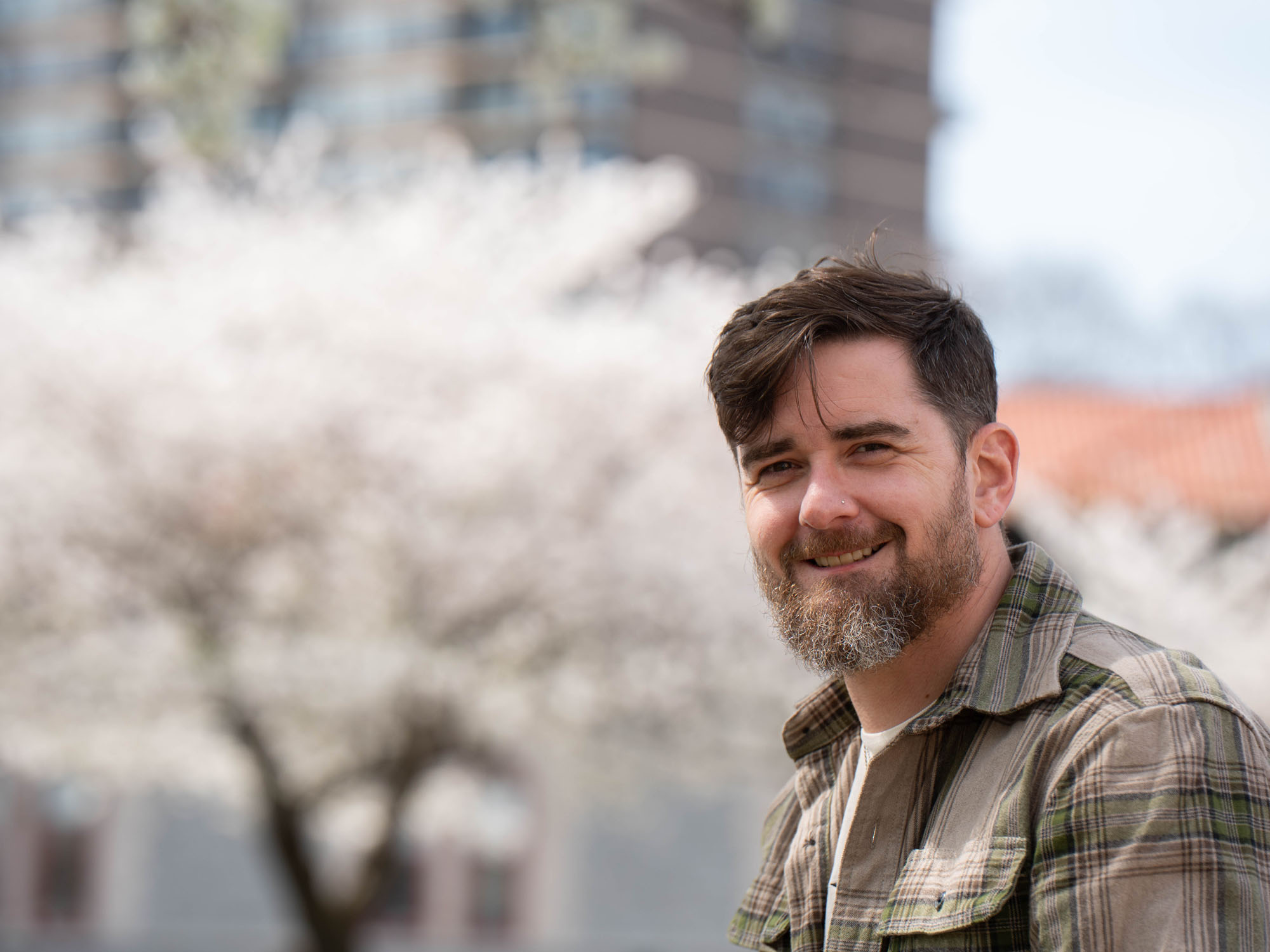
Bryant Lepic had a list of criteria for his future law school.
He wanted his university to have a veteran center and the law school to have a clinical program that focused on veterans. He needed a public institution that would accept his GI Bill.
He wanted a diverse community. And ideally, he wanted a location where the weather didn’t tip too heavily toward either extreme.
The University of Baltimore School of Law checked every box.
Bryant, a third-year law student and U.S. Air Force veteran, has found UBalt to be everything he hoped for, academically, professionally and personally.
Bryant was working in the veteran advocacy space when he decided to go to law school. He wanted to help people, and did, but too often, the only way to resolve an issue involved working with a lawyer.
“That’s one of the cool things about law. You can just take whatever you’re passionate about, and there’s something in law that intersects with that,” he said. “And I’d always wanted to go to law school, and I had the opportunity, so I thought, I’m going to take the jump.”
Lessons from deployment
Bryant’s future plans are deeply rooted in his past experiences.
A native of Appalachia looking for a different setting and life, he decided to enlist. In 2004, he joined the Air Force. He ended up at Air Assault School at Fort Campbell and deployed to Iraq with the Army. He would end up deploying to Iraq five times.
His work primarily included route clearance and convoy security. This job mandated the clearing out of roadside bombs.
“It’s not a fun job, but it’s also one of the most dangerous jobs,” Bryant said. “You’re just driving up and down the road just like frantically scanning the sides of the roads for bombs.”
He realized his nightmare on his third deployment.
“I was involved in an IED blast, right side,” he said. “I got a traumatic brain injury, and I kind of knew after that deployment, but I didn’t really pursue it, and I deployed two more times.”
Eventually, his pain overcame him and forced his medical retirement after 11 years of service.
Those last two years were particularly hard and his struggle getting the support he needed became his inspiration to help veterans get the help they needed.
“I started out joining some veteran clubs, like the Student Veterans of America; I got involved heavily with my VFW, and then I actually ended up working at a university for two years managing their veteran student program,” Bryant said. “I did some pretty fun events for some veterans, on Veterans Day and stuff like that, but I really wanted to make change, not just help out single veterans here and there who fell on a hard time. I wanted to really change the things that were causing veterans, as a community, issues.”
Bryant, who already had a bachelor’s degree in communications, focused his final project for his master’s degree in public administration on issues surrounding women veterans. What he learned about the plights of his military peers only fueled his passion to keep going.
Two hip surgeries and an unsatisfying advocacy post later, Bryant arrived at UBalt School of Law.
Bryant has kept his focus on veterans law since starting law school. He’s had opportunities through The Bob Parsons Veterans Advocacy Clinic helping veterans with disputes they have with Veterans Affairs. The experience was meaningful, but he felt a weight he wasn’t expecting.
“That’s why the veterans clinic was so important to me, because that’s really what I thought that I was going to be getting into, but I also have to sit back and say that working for veterans, when you are a veteran yourself, it can be really heavy. You can take it home, and it can really, really weigh on you and wear on you because I can empathize with them and it really, really started to affect me.”
Bryant decided to explore some of the other legal pathways he discovered since starting law school. He plans to remain a veteran advocate and hopes to support veterans through pro bono work in the future.
Bryant’s focus, however, is shifting toward cannabis law.
“It’s an interesting new sector, and it’s just kind of fascinating to me because it touches all aspects of the law,” he said.
Bryant also knows it’s another opportunity to support veterans. He first learned about medical cannabis through the veteran community and appreciates its value in physical and mental health.
He is also considering going the route of real estate law and public defense, keeping his options open as he moves through his final year of law school.
Meaningful Support and Services
Bryant credits his professors and the community within The Bob Parsons Veterans Center for helping him through his hardest moments at UBalt, both within and outside the classroom.
“I have a couple professors who, I probably wouldn’t be in law school right now if it wasn’t for them,” he said.
The veterans center lived up to Bryant’s expectations quickly. The center, located in UBalt Student Center, was the first place on campus he visited.
“This is a top-tier veteran center,” he said. “They have so many good events and services for veterans that you're not getting that anywhere else. It's just such a great space to come into. Law school can be stressful and fast-paced, and I come over here and go relax in the lounge or take a nap. It's great to have that.”
Once, he forgot his lunch and found food waiting for him in the center. The center offers events and services that Bryant is deeply grateful for, from massages during finals week and movie nights.
As president of UBalt’s Student Veterans of America chapter, Bryant gets to organize events, too. He is most proud of hosting a panel of veterans working in public service—an event that merged two of his foundational interests. He also organized a group of students to walk in the city’s Veterans Day parade.
“I was proud to get that up and going, and then I’m working on compiling a list of scholarships that veterans are eligible for,” he said. “We do a happy hour each semester, just to get together and hang out. We’re there to help. We’re limited here with the smaller population, but we still try to make that impact.”