

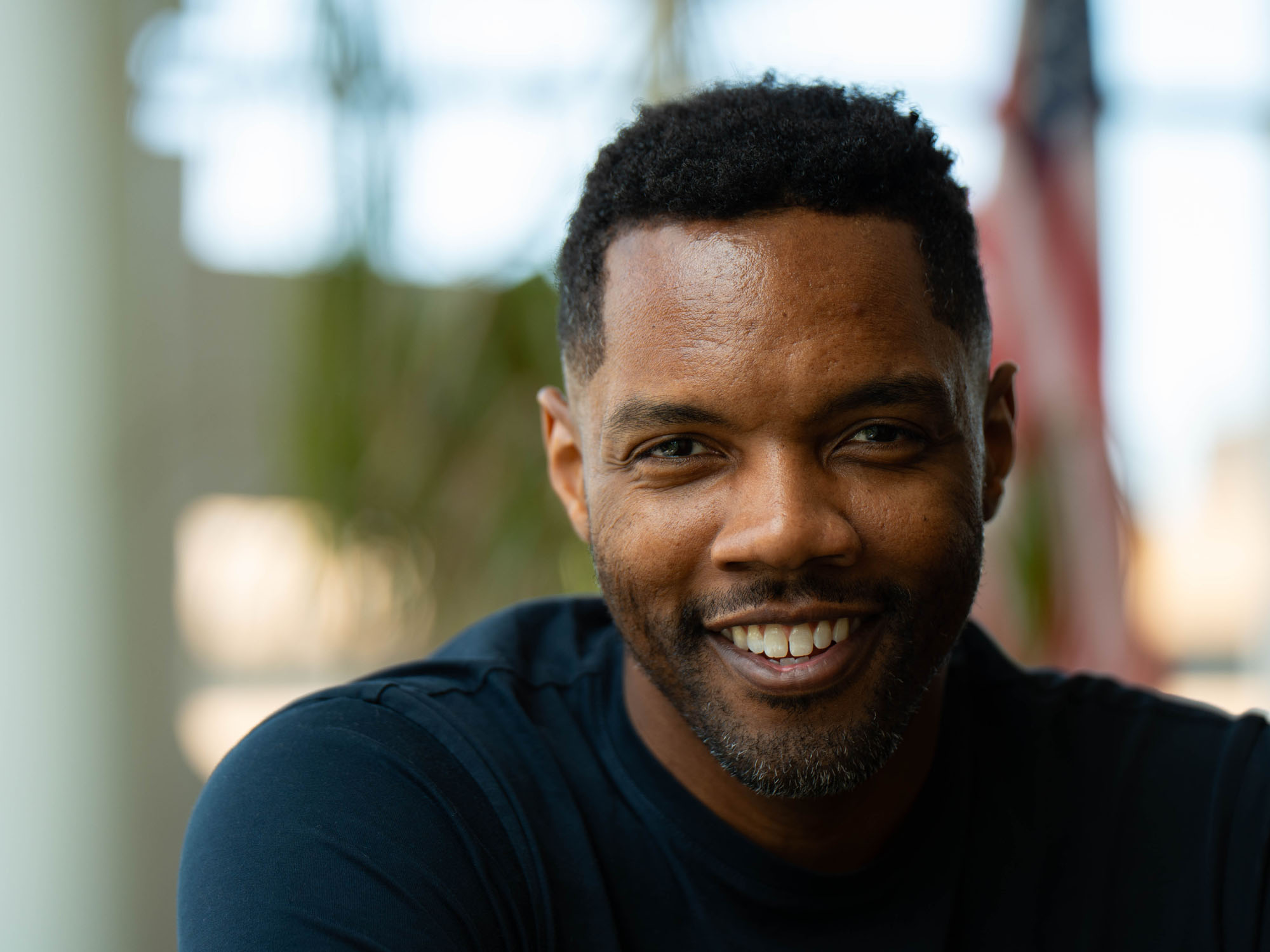
Javon Lamar Weaver got a taste for legal work while he was holding a job in a very different industry.
He was a federal agent with the U.S. Department of Justice, working with ATF on cases involving violent crime. From his view, the best part of the job was working with attorneys.
“One of the most intriguing parts about it was strategizing cases, procedures and how we move forward with investigations, investigation strategy, and then ultimately, end up with whatever angles can be provided toward possible pleas and so forth,” he said. “Going to trial also was pretty exciting.”
He retired from the job with his next step in mind: law school.
“I know justice can mean different things to different people, but ultimately, the judiciary branch is the character of America, how we look at criminal cases, how we effectuate criminal cases, and I really admire that about it,” Javon said. “My why is, how can I further that? I want to be able to help those who just need a fighting chance, a little bit more knowledge or legal resources because all these different types of things all matter very much.”
Javon spent 14 months in Iraq as a psychological operations specialist for the U.S. Army before taking his job with the Department of Justice. He also earned a bachelor’s degree in political science in 2010 and a master’s degree in integrated homeland security management in 2015.
Every milestone was another rung on a ladder pointing toward a legal career. The University of Baltimore School of Law was his next step.
What attracted Javon to the UBalt School of Law were the clinical opportunities and the faculty and staff that offer them.
Two years in, he knows he made the right choice. He spoke highly of the law school’s professors and staff, not only for their expertise, but also for their commitment to their students.
“They really are about seeking out the best opportunity for you and making sure that you are as academically successful as you can be,” he said.
On his first visit to the law center, Javon recalled Cordell Grant, J.D. ’18, assistant director of judicial clerkships and diversity initiatives, pulled him and a few other students aside just to get to know their interests and goals.
Javon credited Neha Lall, professor of the practice and director of externships, as a professor and mentor who helped him navigate two externships and maximize the learning opportunities before him.
Javon spent one summer with the Thurgood Marshall Clerkship Program, an initiative between the Maryland Office of the Attorney General and local law firms. He also had a judiciary internship where he worked directly with James L. Rhodes, an associate judge for the Baltimore County Circuit Court, “which was amazing.”
Every opportunity has helped Javon consider his long-term impact as he moves closer to his law degree. He was initially imagining himself as a prosecutor but wants to spend his final year exploring all the options available to him.
“I realized coming to law school that the civil side of the legal profession is much bigger than the criminal world,” Javon said. “I want to experience more, and I want to dance around. Most people in their life, they have one career. They go to school, they get in their career, and it may take them places, they do different things, but they just have one career. This is my third career, so I'm really excited to experience everything that has to offer.”
Javon feels he sees himself reflected in his classmates. Many are like him, they’re nontraditional students, they have real-world experience that they can feed into their learning experiences, and they want to make a positive impact on their world.
“There's definitely a huge benefit in having a diversity of people from different backgrounds, experiences, cultural experiences, economic backgrounds. You really see there's a different drive.”
The law school is where Javon has peers to count on for shaping his professional drive.
When it isn’t in class, Javon is likely in The Bob Parsons Veterans Center.
There, on the third floor of the UBalt Student Center, he found a community he recognizes and a safe haven in stressful times.
“This veteran center, with its staff and resources, provides a calm, tranquil environment, a place of peace and camaraderie,” he said. “They understand you need a place where you can ground yourself, your thoughts, and accomplish your educational objectives. It's such an advantage.”