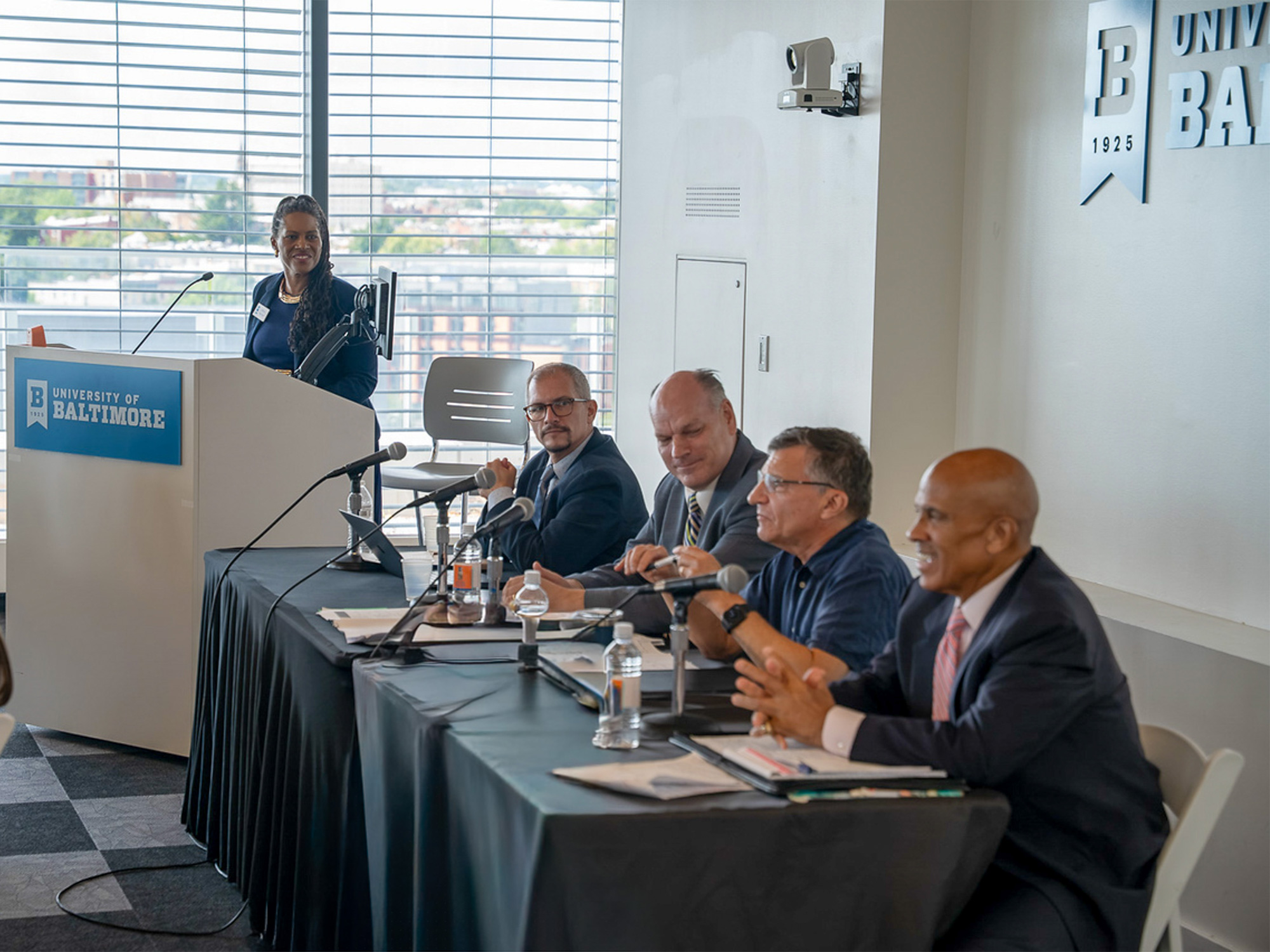
The University of Baltimore School of Law hosted its first-ever Supreme Court Briefing in honor of Constitution Day. The program drew a standing-room-only crowd of students, faculty, and community members to hear constitutional law experts and scholars analyze one of the most consequential terms in recent Supreme Court history.
Dean LaVonda Reed welcomed the audience: “There is no more fitting way to mark this
day than to gather as a community to take a close look at the document at the center
of it all, and the court charged with interpreting it,” she said, noting that the
term's rulings touched on the scope of presidential removal power, the boundaries
of executive authority over elections, and the meaning of citizenship itself under
the Fourteenth Amendment.
That is precisely the work of legal education. It's precisely the work that we do here at UBalt Law. Our faculty do not simply teach the law — they analyze it, they question it, and they help our students see where it's headed.
Moderator Chris Geidner, publisher of Law Dork, guided the discussion with UBalt Law professors John Bessler, Michael Higginbotham
and Michael Meyerson through the term's marquee cases.
Geidner opened the panel by pointing to real-time developments — including same-day
Supreme Court orders on a Missouri redistricting dispute and a Florida execution —
to illustrate how frequently and consequentially the Court now acts outside the traditional
briefing and argument process, often on its emergency “shadow docket.” The panel then
turned to the term's marquee rulings:
Trump v. Slaughter, which overturned the 91-year-old Humphrey's Executor precedent and reshaped presidential removal power over independent agencies, to Trump v. California and the National Park Service case, both of which turned on procedural questions
of standing and ripeness in disputes over election administration and the White House
East Wing demolition.
The panel's discussion of Trump v. Barbara, the birthright citizenship case, and Louisiana v. Callais, which narrowed the reach of the Voting Rights Act, brought a shared sense of concern
from the panelists, even as each brought a different lens to the analysis. Professor
Higginbotham argued the citizenship case "should have been a nine-zero decision" given
the plain language of the Fourteenth Amendment and long-standing precedent. Professor
Meyerson built on that point, noting how procedural doctrines like standing are increasingly
used to sidestep the substance of high-stakes disputes. Professor Bessler added historical
depth to the discussion, tracing the tension between executive power and congressional
checks back to the founding era.
The event closed with a lightning round previewing cases on the Court's upcoming docket,
touching on due process in immigration proceedings, excessive fines under the Eighth
Amendment, and religious liberty, followed by an audience Q&A. Panelists encouraged
students to stay engaged through both law and civic participation, with reminders
to register to vote and make a voting plan.
Dean Reed closed the program by thanking the panelists, moderator, and attendees,
and encouraging students to carry the discussion's themes- the rule of law, civic
responsibility, and the role of lawyers as leaders- into their own careers.
Missed the event? Watch the full recording of the inaugural UBalt Law Supreme Court Briefing.