

As digital tablets and communication technologies become standard tools behind bars, University of Baltimore School of Law Associate Professor Zina Makar is examining a pressing constitutional question: Do the legal standards governing prisons adequately protect the privacy in an era of expansive digital surveillance?
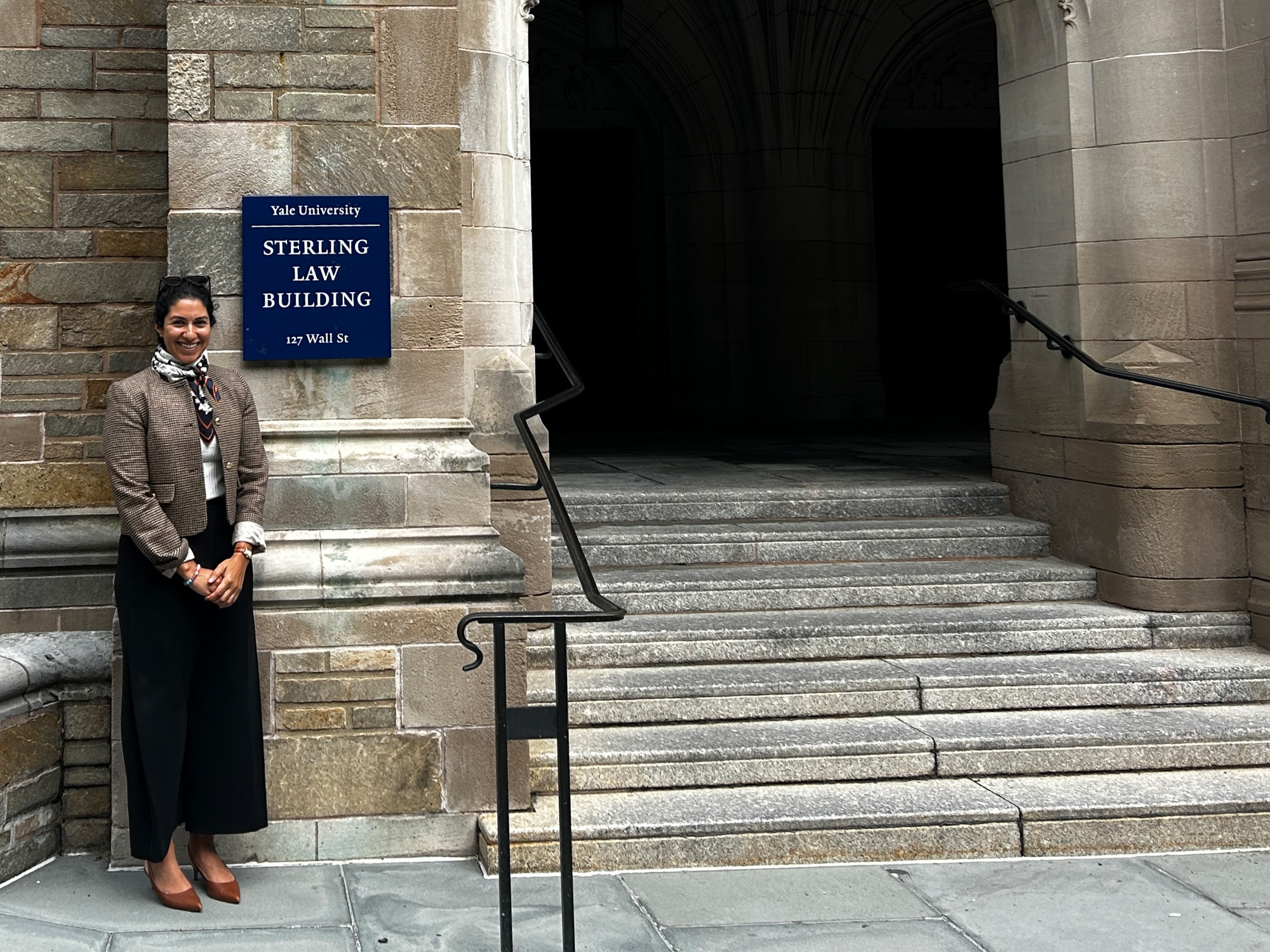
In her latest research, presented at the Yale Information Society Project (ISP), Professor
Makar examines how courts are grappling with the use of digital tablets and other
technologies to collect data and monitor communications involving incarcerated people
and those who interact with them.
Her article illustrates how courts continue to rely on longstanding prison-law precedents
that grant correctional institutions broad discretion in the name of security. But
digital surveillance, Professor Makar argues, differs significantly from traditional
prison searches in both its scale and reach. The resulting collection of personal
information can extend beyond prison walls, affecting family members, friends and
others connected to incarcerated individuals.
“The law has yet to establish limits on the prison’s ability to collect and surveil
prisoner and carceral-adjacent data,” Professor Makar writes in her article. She proposes
an alternative framework for courts to evaluate when government interference with
private information is justified, drawing on constitutional privacy principles under
the First and Fourth Amendments.
Her research also examines how lower courts assess privacy claims and whether they
adequately recognize the harms digital surveillance can impose on incarcerated and
nonincarcerated individuals alike. Ultimately, the work raises broader questions of
first impression about data privacy, individual liberty and the effects of increasingly
pervasive surveillance on society.
Professor Makar’s scholarship connects directly to her teaching at UBalt Law, where
she leads the seminar Incarceration and the Law. The course examines the legal rights
and liberties of individuals after conviction, an area of law that often receives
less attention in law school curriculums than criminal investigation, prosecution
and trial.
As Professor Makar explains to students, incarceration affects many people, whether
directly or through someone they know, yet few understand how constitutional rights
change behind bars. Her research brings contemporary questions about technology and
privacy into that conversation, helping students examine how legal doctrine responds
to emerging challenges.
By connecting prison law with broader information-privacy scholarship, Professor Makar’s
work challenges legal scholars, practitioners and policymakers to reconsider whether
established constitutional frameworks adequately protect individual rights in an increasingly
digital world.
Professor Makar's research on digital surveillance in prisons, titled The Datafication
of Incarceration, was published with the Yale Journal. Professor Makar's scholarship on prison law and policy has also appeared in the
Harvard Journal of Law and Technology and Southern California Law Review, among others.