

This post was written by Anthony Butler, MA ’02, director of UBalt’s Rosenberg Center for Student Engagement and Inclusion.
In 2014, Elizabeth Fowler noticed a student in her class arrived hungry.
Fowler, then an undergraduate history major at The University of Baltimore, was concerned that this student, and many more like her, might struggle academically if they were also experiencing hunger and financial need.
She shared portions of her lunch when she could but knew more action was needed to make a real impact. What she did next, with support from others across the campus equally concerned about the issue, would help establish the UBalt Campus Pantry.
Ten years later, the Campus Pantry is a living example of how a campus can demonstrate an ethic of care.
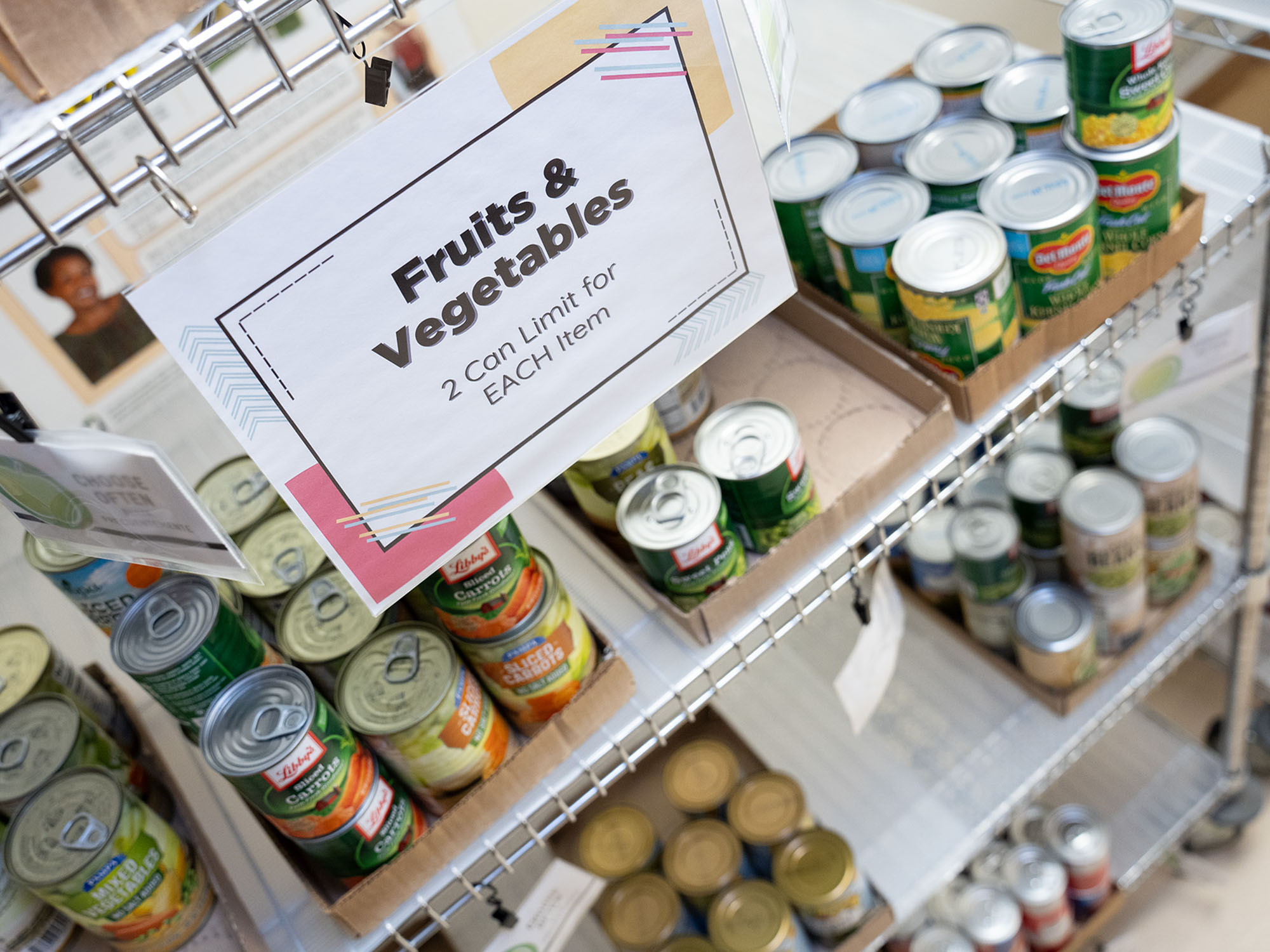
The Campus Pantry, located on the second floor of the UBalt Student Center, is one of multiple support services on campus that seek to address emergency needs so that students can focus on their academics.
“I'm so happy to see the pantry continue to thrive 10 years later!” said Fowler, B.A. '14, M.A. '17, J.D. '20. “Some of my fondest memories of UB, of which I have so many spanning nearly 10 years, involve the dreaming, planning and building of the pantry.”
The Campus Pantry effort began when Fowler brought her concerns to the Student Government Association (SGA). The SGA, under then-president Sydney Comitz Bowers, immediately organized an exploratory committee to investigate the idea of and need for a pantry on campus.
What Fowler noticed among her classmates wasn’t unique to UBalt. The Maryland Food Bank estimates that more than 116,000 Maryland college students struggle to obtain enough food for a healthy lifestyle.
Poised to make an impact for their peers, SGA passed a resolution in support of establishing a pantry, and approached the Rosenberg Center for Student Engagement and Inclusion (CSEI) with their proposal.
Looking back, Comitz Bowers, B.S. '15, J.D. '17, spoke on her pride of the SGA seeing this initiative through.
“We knew even 10 years ago the impact that food insecurity had on our campus family and we were relentlessly committed to leaving behind a legacy that would improve campus life for students, faculty, and staff long after we were gone,” she said. “I hope today’s students are inspired by our hard work and remember they hold the same power to make positive change for the next generation as we did.”
With the SGA’s resolution, CSEI created a planning team including students, staff and faculty. They set out to develop and open a pantry within two years.
Over that time, the team visited pantries at Carroll Community College and University of Maryland College Park. These other setups in mind, they imagined what UBalt’s pantry needed.
The planning team considered several important factors to decide how UBalt’s pantry could be most effective. They decided:
Dr. Tiffaney Parkman, a lecturer teaching Human Services Administration, has heard from her students about the value of a campus pantry. She was excited to be a faculty representative on the exploratory committee that could make it happen.
“From the earliest stages of the idea through its implementation, I knew I wanted to help ensure the UBalt family had access to such a vital resource,” she said. “I often point to the Campus Pantry as a tangible example of the values our students embody and the meaningful work they are committed to doing in their communities.”
The planning committee knew that hunger existed on campus but needed data to support their work. The Schaefer Center for Public Policy, embedded within UBalt’s College of Public Affairs, developed a campus-wide needs survey. Funded with support from the University of Baltimore Foundation, this survey further defined the problem of hunger on campus and established a rationale for support.
Bill Schnirel, executive director of student development, identified a space in the UBalt Student Center that balanced accessibility with privacy. The former campus café on the second floor offered secure storage and enough room to create a welcoming environment where visitors could shop comfortably.
Schnirel also helped secure facilities funding for renovations, including the installation of cabinets, shelving, and other furnishings.
“So much of the heavy lifting happened behind the scenes,” he said. “Finding the right location and making sure the space actually worked for day-to-day operations. Seeing a student-led idea grow into a permanent, thriving campus institution 10 years later is proof of what happens when student advocacy meets practical planning and University support.”
One of the greatest strengths of Maryland's response to food insecurity is the power of partnership.
The committee developed a plan to staff the pantry, requesting an AmeriCorps VISTA position from Transform Mid-Atlantic (then Maryland-DC Campus Compact). This partnership secured a position that would build capacity for the campus pantry effort and help secure funding, support, and strategy to sustain the pantry long-term. After the initial three-year grant, CSEI requested an additional three-year grant to build student financial capacity.
“Transform Mid-Atlantic is proud to have partnered with UB through our AmeriCorps VISTA grant to launch this pantry a decade ago,” said Madeline Yates, executive director of Transform Mid-Atlantic. “The pantry shows UBalt’s care for and investment in their students’ well-being, has clearly supported students’ retention and completion, and demonstrates how UBalt leans into their values around civic and community engagement and community development.”
Organizers knew a stable source of food and supplies would be needed to sustain the
pantry. To meet this need, UBalt formed a partnership with the Maryland Food Bank,
a statewide nonprofit that aims at reducing hunger by sourcing and distributing supplies
throughout its vast partner network.
“One of the greatest strengths of Maryland's response to food insecurity is the power
of partnership,” said Kristina Quein, manager of neighbor engagement for Maryland
Food Bank. “Community organizations, schools, faith communities, businesses, volunteers,
local governments and residents all play an important role. When these groups come
together, they create something much bigger than the sum of their individual efforts.”
According to Quein, Maryland Food Bank has distributed 303,747 pounds of food through
19 higher education partners throughout Maryland.
On Oct. 16, 2016, the Campus Pantry opened with a ribbon cutting and celebration. The first-year impact was modest. Awareness was a challenge, and the resource was brand new. In its first year, the pantry distributed more than 1,600 pounds of food and supplies.
The following year, everything changed. The pantry’s visibility increased as it gained trust on campus. In its second year, the pantry distributed over 15,000 pounds of food and supplies. The pantry effort continued to grow and became a visible, permanent part of the campus fabric.
In March 2020, the pantry closed its doors for 18 months as UBalt operated fully virtually in response to the COVID-19 pandemic. CSEI donated its goods to a local nonprofit organization to ensure nothing went to waste.
The pantry reopened in August 2021, ramping up its services to ensure it met the campus’ evolving needs.
That year, CSEI joined with the Office of Student Support and a host of other campus members to launch the Basic Needs Initiative, including a committee to network and share available resources across the campus. This effort also included a Basic Needs Virtual Resource Center developed and managed by the Office of Student Support.
Student needs are increasing and diverse, and this concerted effort that engages a variety of departments on campus to ensure these needs are met, head-on.
As the pantry has grown, new initiatives and support have been established. Generous donor contributions over the last 10 years have provided more than $38,000 in support of the ongoing pantry effort, from 160 donors
SGA has provided significant financial support over the years to continue to supply the pantry. And in the last three years, a student-driven effort called “Pack the Pantry” has engaged organizations and offices from across campus in collecting supplies and goods for the pantry. Last year, donations from Pack the Pantry exceeded 1,400 pounds.
Ten years after its founding, the Campus Pantry has distributed over 62,000 pounds of food and supplies to over 1,800 recipients across the campus community.
The data is clear, but we cannot adequately capture what the pantry has meant to the campus over the years. Every student should have the opportunity to learn without hunger, and as long as hunger exists on campus, the pantry will be there to meet that need.