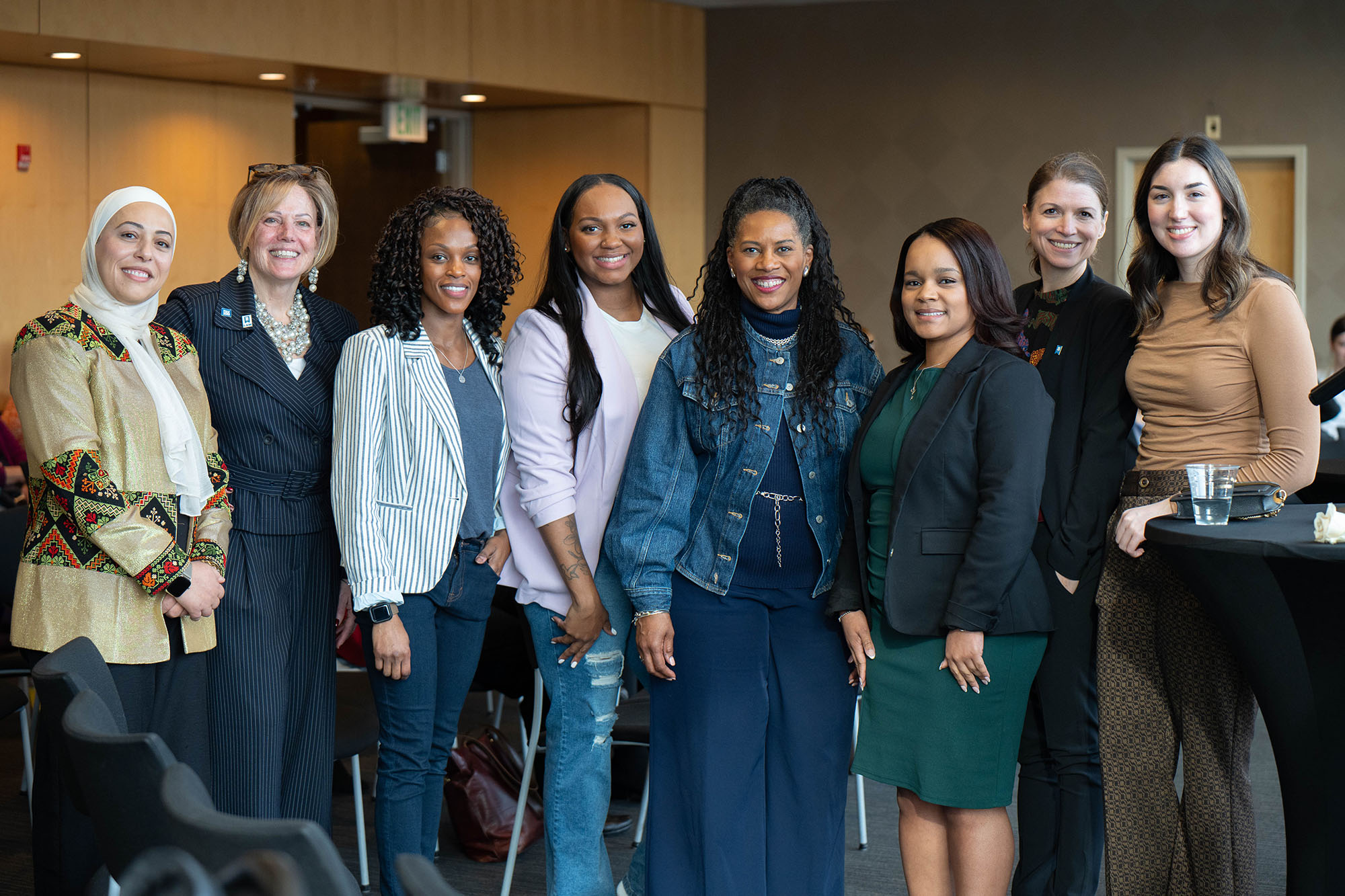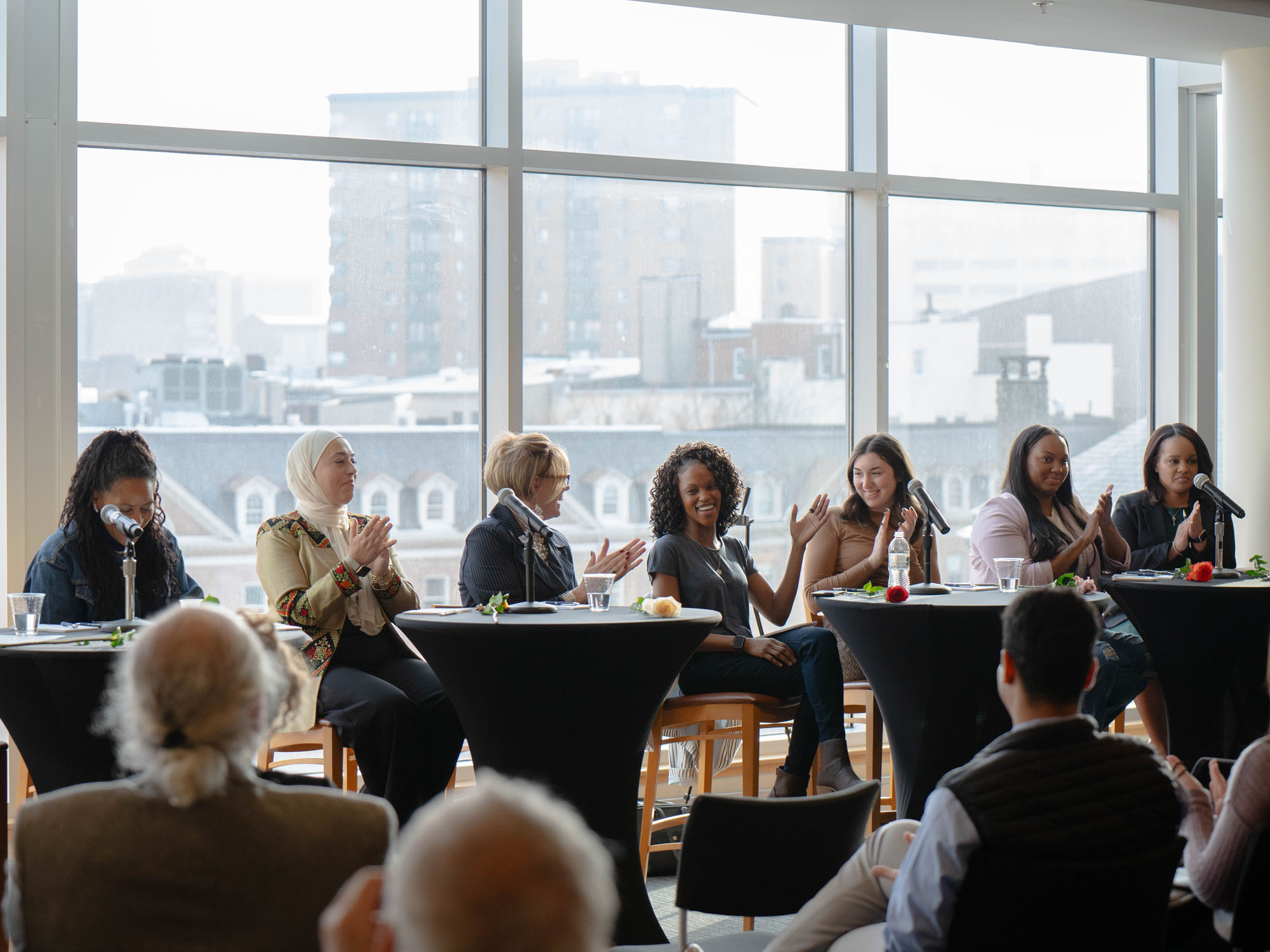
A panel of women inspired a packed room with their stories in a celebration of International Women’s Day and its annual theme of Give to Gain.
The Office of Diversity and International Services hosts the event each March, showcasing women across The University of Baltimore community.
LaVonda Reed, dean of UBalt’s School of Law, moderated the panel that included current students and alumni: Ayanna Davis, B.A. ’24, M.A. in Integrated Design student; Ruba Abukhdeir, DPA candidate; Christian Ritchie, B.A. ’18, J.D. candidate; Odi Odian, J.D. candidate; Joan Worthington, B.S. ’84, MBA ’91; and Meka Harding, M.S. in Negotiations and Conflict Management student.
Led by Reed, the panelists shared a piece of their own stories that shaped who they are and who they want to be to future generations.
“Women’s stories matter because they shape institutions,” said Reed, who is shaping the law school herself as its first female dean. “They reshape expectations. They challenge silence. And they remind us that thriving is built through resilience, reinvention and courage.”
HISTORY OF WOMEN'S DAY
The event combined personal reflections from women across the UBalt community with a broader look at the history and ongoing global struggle for gender equality.
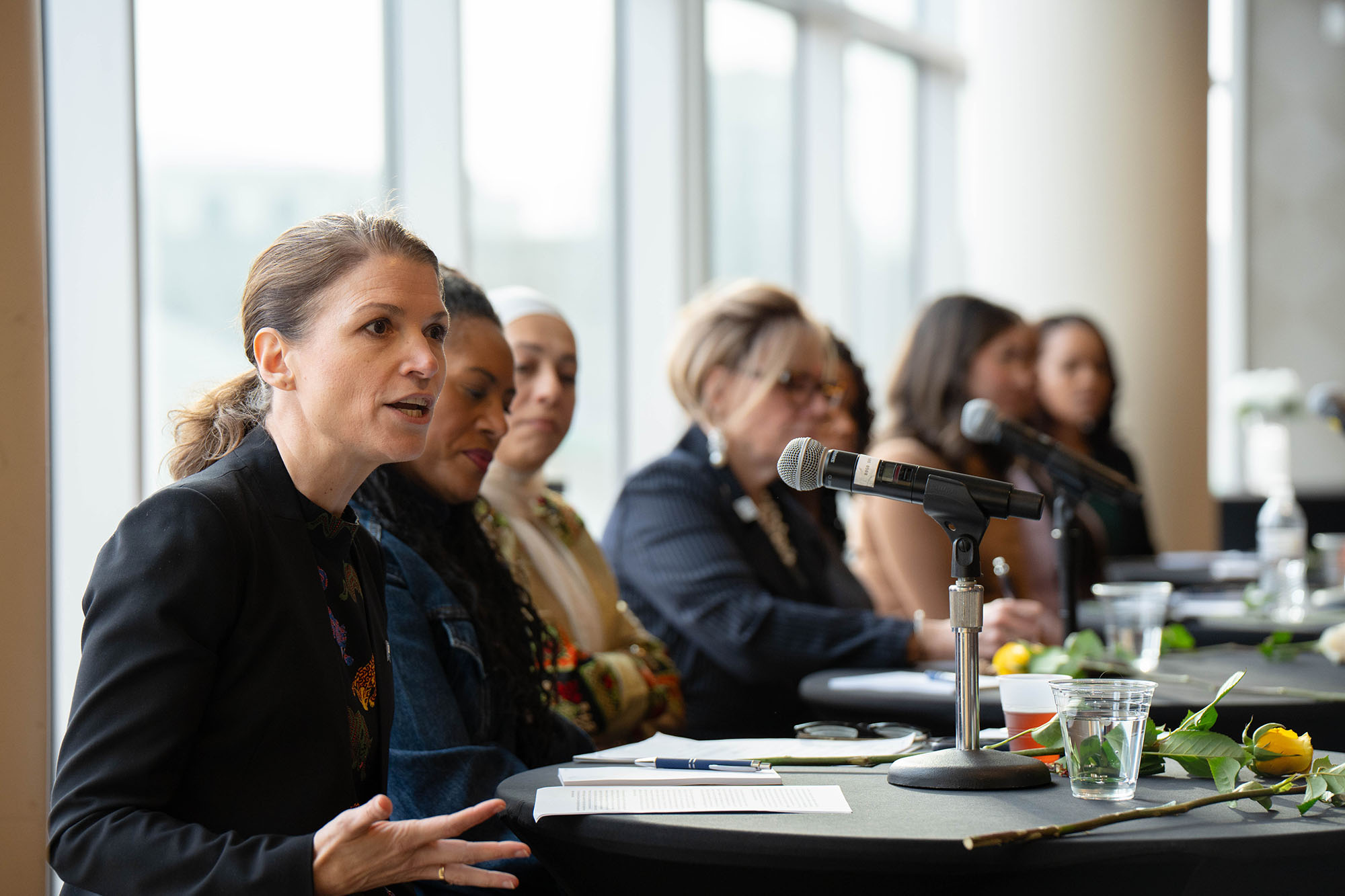
Jennica Larrison, executive director of the School of Public and International Affairs and an associate professor, shared that International Women’s Day wasn’t set as a global holiday until 1975.
The movement that led to its recognition traces to the 1848 Seneca Falls Convention in New York, where Elizabeth Cady Stanton and Lucretia Mott called for civil, social and political rights for women, “radically declaring that men and women are created equal,” Larrison stressed.
Sixty years after the convention, in 1908, 15,000 women marched through New York City demanding shorter hours, better pay and the right to vote.
The first National Women’s Day came on Feb. 28, 1909, and following that in 1911 was the first International Women’s Day, a celebration with more than a million people in Austria, Denmark, Germany and Switzerland.
Despite the marches forward, Larrison said, “the finish line is still over a century away.”
According to the World Economic Forum’s 2025 Global Gender Gap Report the global gender gap is only 68.8 percent closed and at our current pace, it will take 123 years to reach full global parity.
Additionally, representation remains a challenge, she said. As of 2025, women held less than one-third of parliamentary seats globally. Economically, women still earn approximately 77 cents for every dollar earned by men, and according to UN Women, 1 in 10 women globally live in extreme poverty, a figure exacerbated by climate change and conflict.
“International Women’s Day is a commemoration, but it is also a diagnostic tool for the health of our global society,” Larrison said. “Gender equity is not a ‘women’s issue,’ but a fundamental requirement for stability, economic prosperity and human rights here in Baltimore and across the world.”
These data show the significance of the Give to Gain theme.
“Give to Gain focuses on the power of generosity, collaboration and investment in women to accelerate gender equality,” Larrison said. “This is precisely what our panelists are doing today—giving of their time and resources to share with all of us. We all have ancestral stories, stories of how we became who we are today, and how we want to continue to grow in the future.”
TAKING UP SPACE
During the panel discussion, Harding said the idea of thriving as women in today’s world means taking up space.
“I think, as women, we make ourselves small for the comfort of other people,” she said. “Sometimes people have beaten it out of us and told us to be small.”
In a difficult moment that urged the nearby Abukhdeir to reach out for her fellow panelist’s hand, Harding shared about sexual harassment she faced during her time in military service.
“It did teach me resilience,” she concluded. “I learned that I could stand on my own two feet, but I shouldn’t have had to.”
Harding served in the U.S. Army and now aspires to be a civil rights attorney dedicated to advancing justice and systemic equity.
Abukhdeir spoke about how her experience with bullying inspired her current doctoral research on workplace bullying, organizational culture and leadership.
“I get emotional talking about because, it's been years and I've been healing. I've been recovering, but when I mention it, I kind of go back to that experience,” she said. “But I decided I don't want anybody to go through what I went through. I look at my loved ones, I look at my daughters, and I'm like, no way, I'm going to let this happen to them. … Sometimes those hard experiences, they teach you a lot. They taught me to redirect myself into a more meaningful work.”
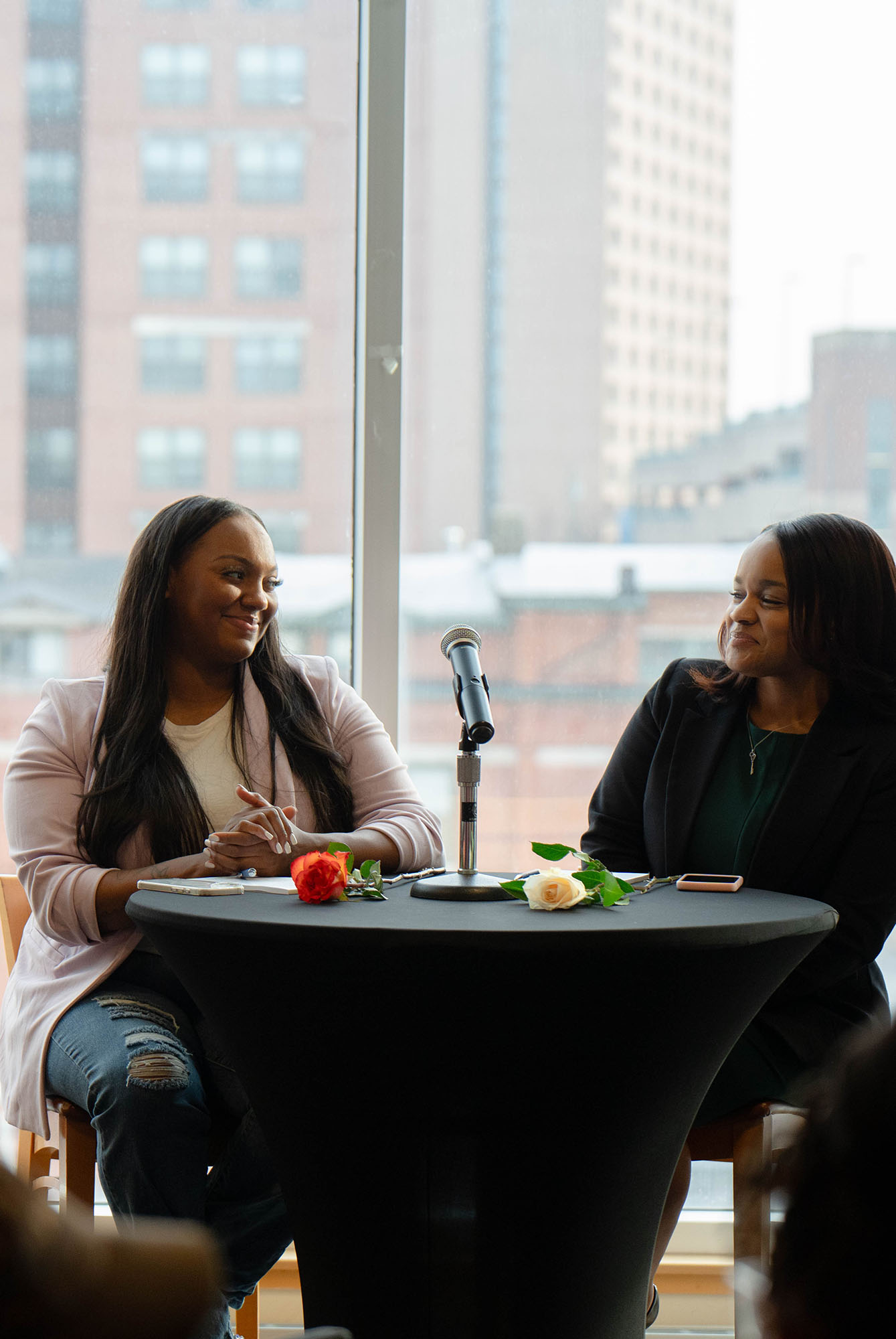
Ritchie said she realized she wasn’t casting herself correctly when she was telling people her story. She called herself a high school dropout without giving the context behind the label. She left of her own accord after too many absences pushed her behind and she didn’t want to repeat a year. Instead, she decided to manifest her own destiny—sign herself out, study for and take the GED, go to college and not stop there until she finished law school.
“I chose UBalt because I knew I was going to be across the street. I have a picture from 2017 where I was manifesting being in the law school, and now I'm a year away from graduating,” she said. … “I just knew that I was there was something else that I needed to be doing.”
LESSONS IN LEADERSHIP
Reed guided the panelists to talk about their experiences in leadership. She praised Odian for becoming editor in chief for the Law Forum, one of two student-run scholarly publications at the law school.
Odian admitted she was hesitant initially to add the journal to her heavy workload. But she came to love it, seeing its value paralleled the reason she chose law school to begin with—to help people.
“We're a Maryland specific journal, and I saw the impact we could have on our community, from the people who are up at the top of the big law firms down the street to the people who are going into our low-income clinics who have no legal background whatsoever, how words could give them resources and give them knowledge, and knowledge is so powerful for people,” she said.
Leading a team of mostly women, Odian said she wants them to discover their purpose, too.
“I always try to just encourage people, what do you want to do? What's the impact you want to have, the legacy you want to leave behind? And I really lean on the people who have always supported me since Day 1 of my 1L year. I'm so excited for who's going to step in after me and take over and make the journal even better.”
Working in the male-dominated IT word, Worthington said she had to learn to push back against sexual harassment and find her own voice to be a better leader. Worthington, board chair for the University of Baltimore Foundation, led major technology initiatives at the SEC and HireVue and now heads Worthington Power, LLC.
“It's a lot of mental attitude and manifesting along the way about this is how I want to be when I go at my leadership. I want to bring everybody along. I want to hear the voices, and I also want to be sincere yet decisive in my decision making,” she said. … “You've got to keep putting yourself out there—that will take you to the next level. And that is a big piece of my leadership.”
Davis said her story is rooted in race: “I was always the only brown girl in rooms, and I had to learn that I was just as important and that I deserved the right and the space to be in the room, no matter who was in there.”
As an entrepreneur who runs her own body wax studio, she feels emboldened to give her clients the safe space they’re looking for.
Reed echoed Davis in the value of lifting one another up, as the panelists did during the event.
“In law, in business, in public service, in motherhood, in nontraditional careers, women continue to lead while carrying stories that are often unseen. Today, we make space for those stories.”