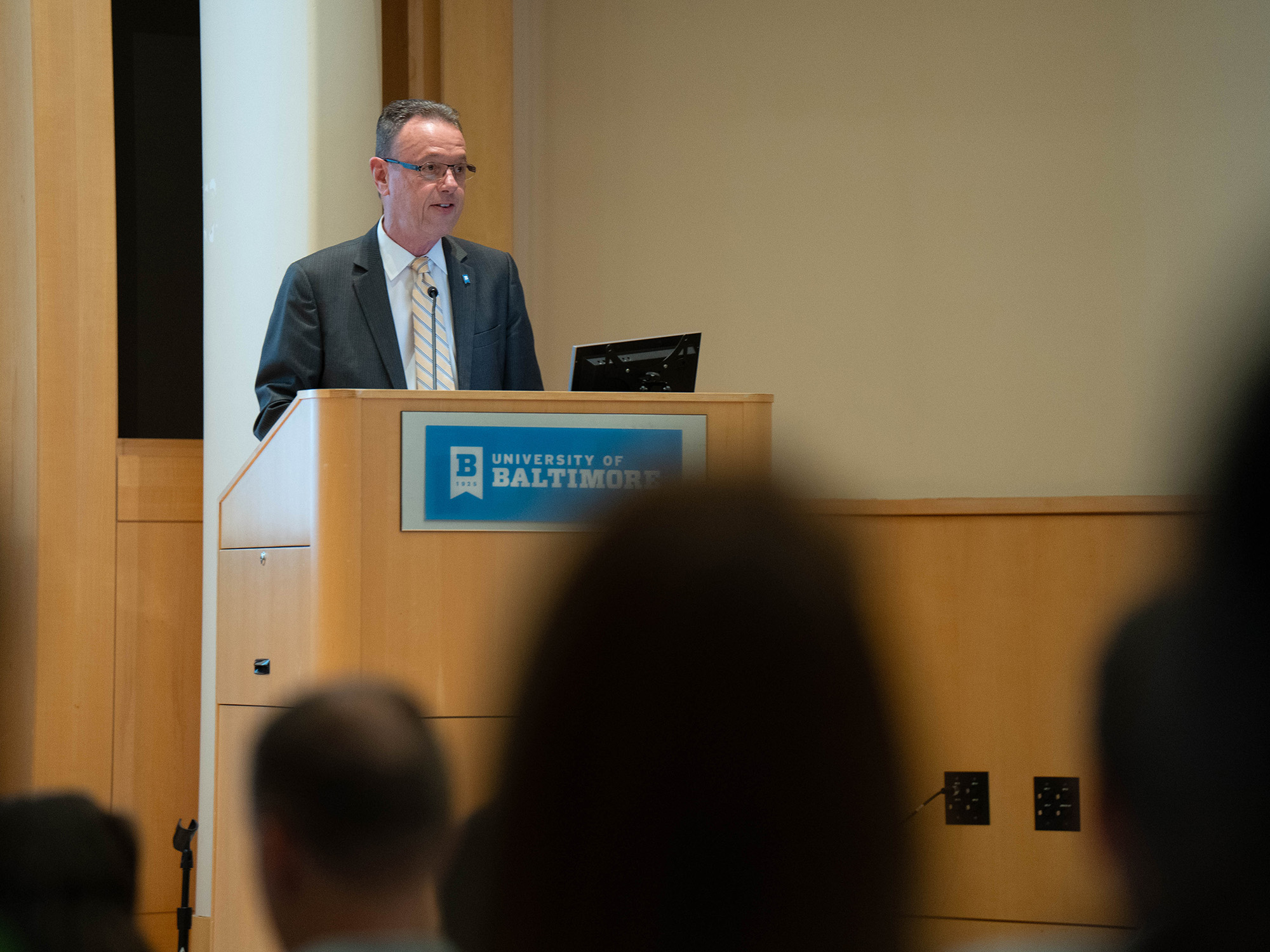
The University of Baltimore's 2026 Convocation
Wednesday, Sept. 2
Wright Theater
Remarks by Dr. Ralph O. Mueller
Good afternoon.
It is so good to see everyone this afternoon at the beginning of the new academic
year. Before I formally begin my remarks, allow me to set a bit of context for this
year's Convocation.
- Last September at this event, John Brenner, director of Early College Initiatives
and Staff Senate Chair, welcomed everyone and introduced our new staff members. Today,
we mark two weeks after celebrating John's life. He passed away in July after a brief
but tough battle with cancer. I worked with John directly and miss him immensely,
as do those of you who knew him, I know.
- Each year at Convocation, we gather to highlight and celebrate some of the previous
year's academic accomplishments as well as to foreshadow the new year's opportunities,
challenges, and academic initiatives ahead.
- In January, the Carnegie Foundation for the Advancement of Teaching formally notified
us that our application for the Community Engagement classification was accepted.
- In March, we welcomed a Middle States re-accreditation team to campus, followed by
a Commission notification in June that the University of Baltimore was fully re-accredited.
- And finally, in July, President Kurt Schmoke let us know of his intent to retire at
the end of this academic year, after a very successful and impactful 13-year tenure
as president.
While we currently face several challenges, there are many hopeful opportunities for
growth and reasons for optimism at the dawn of our second century.
From within this context of gratitude, accomplishment, and anticipation of a bright
future, I join President Schmoke, Staff Senate Chair Kathea Smith, and Faculty Senate
President Al Gourrier in welcoming you to the 2026-27 academic year.
Let me begin today's comments with a few updates–on digital accessibility, AI usage
on campus, not-for-credit instruction, online program offerings, institutional sustainability,
and the new strategic plan.
- No doubt, everyone is aware of the April 2027 deadline to comply with the federal
digital accessibility standards. Based on last year's data, across the four schools
and colleges, 76 percent of courses met our initial threshold of accessibility. But,
more work remains. Again this year, we will offer several training sessions, and I
strongly encourage you to sign up and participate.
- Collectively, we are responsible for ensuring that our students, faculty and staff
members, and visitors have a digitally accessible experience at UBalt. Thus, we will
announce soon that UBalt promises that all future LMS content, documents, media, and
websites will be "born accessible."
- Our Center for AI Learning and Community-Engaged Innovation, CAILI, has had considerable
impact across campus as well as the broader community: Overall, it generated more
than $77,000 in institutional support and served 489 UBalt learners and 653 individuals
from industry and other area organizations.
- Internally, CAILI's director, Jessica Stansbury, is helping to move AI use in the
classroom from a hidden to a transparent, faculty-guided, and assignment-aligned practice.
BoodleBox, our free-access AI platform was only introduced last year but has already
reached a 62 percent adoption rate. And, more broadly, with 21 active community partnerships
and 51 regional engagements, CAILI is positioning the University as a hub for ethical
and collaborative AI education, connecting campus initiatives with community needs.
- Related, perhaps some of you noted last week's MIT report on "AI and Education: A
Watershed moment for MIT." … It's a worthy read because, irrespective of institutional
affiliation, it will influence how many of us think about teaching, learning, and
socialization in the age of AI. To start, the report calls upon us to present our
students with "clear, explicit policies about why, when, and how you must, may, or
must not use AI in a given subject or field."
- But the report goes way beyond that: it challenges basic assumptions underlying higher
education, from A to Z. And it urges us to foster more in-person relationships and
experiences, through experiential learning and other career-related engagement–a topic
I will take up in a few minutes.
- Last year, we created the Office of Continuing Studies to house our emerging not-for-credit
offerings, thereby opening an anticipated new revenue stream. We have purchased and
are currently integrating Canvas Catalog into our existing systems. The integration
should be complete by mid fall so that non-credit courses and certificates can be
offered in the spring. Our overall goal is to develop a portfolio of fee based as
well as free offerings that will complement our degree programs, facilitate career
advancement, provide access to professional skills development, and also will orient
new students to UBalt. Associate Provost Aaron Wachhaus will be speaking to faculty
and staff senates about the course proposal process as well as the LMS and the completion
badging platform.
- A second possible source of new revenue is to expand our asynchronous online program
offerings. This past spring, an outside consultant assessed UBalt's strengths and
challenges in online education. He noted our strong market position in the DMV, our
deep knowledge in supporting working adults, and experience with both synchronous
and asynchronous course offerings.
- However, he also pointed to inconsistent and confusing language when describing course
modality, a lack of university-wide online quality standards, and our very limited
number of asynchronous program offerings, namely, only the MBA and the M.S. in Accounting.
This fall, we will be rolling out four definitions that standardize the meanings of
"on campus," "virtual campus," "online," and "hybrid," across the University and its
publications. Furthermore, we will propose to adopt the Quality Matters or similar
standards to assure students of consistently high-quality online courses.
Also, the College of Public Affairs will explore developing an asynchronous online
version of the M.A. in Global Affairs and Human Security. Similarly, the Merrick School
of Business will consider asynchronous versions of the M.S. in Finance and M.S. in
AI in Business.
We hope that these and similar developments will open a new market of students who
seek maximal flexibility in when to engage with program materials.
- Given UBalt's sizable structural deficit and continuing enrollment challenges, this
year's annual Provost's Council retreat was entirely devoted to brainstorming forward-looking
ideas to help ensure our long-term sustainability. The four collegiate deans, the
vice president for student success, and the two associate provosts and I used the
recent Middle States reaccreditation report and the new strategic plan to guide our
discussions. Over a two-day period, we jointly developed a list of initial ideas that
are now under further study by the Budget office and Enrollment Management.
Our tentative recommendations include
- To become a more affordable institution;
- To invest in our strongest academic programs;
- To capitalize on external partnerships and engagement;
- To consider alternative academic calendars; and
- To explore ways to shorten the time-to-degree: For example, some states now offer
three-year, 90 credit hour "applied" or "professional" baccalaureate degrees, including
Georgia and Massachusetts, but not yet Maryland.
This fall, you will hear more from your deans about these ideas, all of which are
intended to address our competitiveness, hone UBalt's identity, and increase financial
stability.
- Soon, we will introduce UBalt’s Differentiation Strategy, our new three-year strategic
plan. At its core are five Differentiating Strategic Objectives:
- Create an exceptional, forward-thinking learning environment that integrates an on-site
professional hub with a high-quality virtual experience;
- Deliver high-demand, career-focused academic programs and credentials designed specifically
for adult students;
- Provide flexible programs and services tailored for the unique needs of UBalt students;
- Strengthen community engagement through structured partnerships with regional employers,
alumni, and Baltimore-area educational institutions; and
- Enhance support that drives positive student and career outcomes.
As you can glean, academic and student affairs are at the core of the plan: modern
learning environments, relevant academic programming, strengthened engagement, and
enhanced student supports. While I spoke about learning environments and academic
programing during last year's Convocation–namely the University's plans for the replacement
of the Academic Center and our newly consolidated majors–today, I will focus on another
strategic goal, strengthened engagement. Specifically, I'd like to highlight some
recent examples of activities that illustrate our mantra, "Knowledge That Works,"
through external collaborations that promote (1) public well-being, (2) democratic
participation, and (3) career connection.
The first type of engagement I'd like to talk about is community engagement. As mentioned
earlier, this past January, we were informed by the Carnegie Foundation that our application
to attain the elective classification was successful. To wit, in their feedback letter,
Carnegie remarked–and I quote: [UBalt's] "academic programs are intentionally designed
to address local priorities, and student survey data [that indicate] high levels of
participation, further demonstrate the tangible impact of these efforts. Overall,
UBalt presents a strong and integrated model of community engagement, characterized
by leadership support, policy alignment, academic integration, and a vibrant civic
culture."
Here are a few examples of community engagement that show how UBalt imparts Knowledge
That Works in and for Baltimore.
- The School of Law's Civil Advocacy Clinic is entering a partnership with the Johns
Hopkins Medicine-Pediatrics Urban Health Residency program. It involves UBalt students
educating medical residents on the law and referring patients to the Clinic for free
legal representation.
- The College of Public Affairs is building a new partnership with the Baltimore Police
Academy that creates clear pathways for law enforcement professionals to pursue criminal
justice degrees, connecting workforce development directly to higher education.
- The Merrick School of Business teamed up with the School of Law to participate in
the "Volunteers in Tax Assistance" program, a national program that allows trained
students at higher education institutions to help underprivileged families with their
tax preparation. Our students prepared and filed about 200 tax returns for underprivileged
families.
- Faculty members and students from the Yale Gordon College of Arts and Sciences continued
to advance the University's public mission through community-engaging events such
as the Ethics Bowl, Mock Trial, and Ethics Week.
- And CAILI convened state and local leaders during its third annual AI Summit—including
Lt. Gov. Aruna Miller, Maryland's Secretaries of Higher Education and Labor, and the
Baltimore City Council President—to advance dialogue around AI's impact on communities,
education, and workforce.
These are just a handful of examples of our impactful community engagement. But we
can't rest on our laurels. In its letter, Carnegie also suggested that we–and I quote
again:
- "More explicitly connect community engagement priorities to broader goals of social
justice and opportunity;
- "Ensure that engagement is not just activity-based but intentionally designed to produce
measurable outcomes for students and communities;
- "Create a standing Community Partner Advisory Board; and
- "Strengthen and expand community engagement branding; that is, extend community engagement
messaging beyond the website into philanthropic campaigns, student recruitment, and
social media platforms."
In the past, our long-standing Task Force to Advance University Engagement was ably
led by Vice President Nicole Marano and former Dean Roger Hartley, and we thank them
both for their exemplary leadership. Starting this year, the Task Force will be chaired
by Anthony Butler, director of the Center for Student Engagement and Inclusion. With
active faculty, staff, student, and community participation, Anthony and his group
will ensure that we resist interpreting Carnegie's decision as having reached our
goal, but that the new classification will serve as a mere springboard toward strengthening
our commitments as an anchor institution for Baltimore and the region.
Second, there is another form of engagement that is closely related to the first and
that I introduced last year: Civic Engagement. The "All-In Campus Democracy Challenge"
organization again recognized The University of Baltimore, this time with the 2026
Highly Established Action Plan Seal in recognition of our efforts to increase nonpartisan
democratic engagement on campus.
And, again, quoting from Carnegie's decision letter: "UBalt should be commended for
holding post-election dialogues on campus and fostering skills for structured, rational
dialogue and deliberation through partnerships with organizations such as the National
Center for Free Speech and Civic Engagement and Braver Angels."
So, here then are a few examples of recent civic engagement that intentionally conveyed
knowledge and skills to shape our democratic society. It demonstrated that Knowledge
That Works indeed addresses public concerns and improves community life.
- During the 2026 Maryland legislative session, the Law School's Center for Criminal
Justice Reform provided testimony on over two dozen bills. In fact, the Center has
become a go-to source of knowledge and partnership on criminal justice reform and
has partnered with the Moore administration and many others in the passage of multiple
landmark bills concerning public safety.
- The Law School's Sayra and Neil Meyerhoff Center for Families, Children, and the Courts
worked with middle school students from Baltimore's most underserved neighborhoods
to tackle chronic absenteeism from school. Approximately 90 students in the program
made significant gains toward achieving the City's school attendance goal of 92 percent.
- Multiple events offered by CAS's Hoffberger Center for Ethical Engagement provided
opportunities for students to engage with contemporary legal, ethical, and public
policy challenges while strengthening connections between the University and the broader
community.
- The Bogomolny Library hosted four "Braver Angels" debates that were organized by a
student organization and provided a campus venue for civic discourse and constructive
dialogue across political, cultural, or educational differences.
- And CAILI partnered with Baltimore's Office of Information and Technology to deliver
community-based AI literacy workshops at senior centers, building practical understanding,
confidence, and responsible AI use.
Last year, I introduced the nationally recognized Civic Learning and Democracy Engagement
(CLDE) framework that proposes four components of how students best develop purposeful
civic engagement. I further mentioned that both community and civic engagement have
risen to be priorities for the USM Board of Regents. In fact, Chancellor Jay Perman
has asked each institution to submit a plan on how it intends to implement the CLDE
framework by the end of this academic year.
In response, we formed a CLDE Working Group under the leadership of Mike Kiel, our
Bogomolny Library director of reference and instruction. Since the group's inception
last spring, it has met thrice and participated in an introductory USM retreat. Expect
regular updates from the Working Group during University Faculty Senate and school
senate meetings, as you did just today.
And finally, there is a third kind of engagement that involves how our students engage
with their chosen careers while they are studying at The University of Baltimore.
Here is a sample of a few experiential learning activities that let our students engage
with their actual careers, current or future. As such, these are types of career engagement
through internships, coops, apprenticeships, or similar experiences. They enrich,
complement, and complete our curricula and make them more career relevant: again,
Knowledge That Works.
- A CAS-sponsored Global Field Study program in England allowed students to engage directly
with employees of overseas historical, cultural, and other professional organizations.
- CAS's Klein Family Center for Communications Design sponsored several events to connect
students with working professionals in the design, media, and publishing fields.
- MSB hosted several Real Estate and Economic Development events where students toured
development projects in Baltimore.
- Through its NextGen Leaders for Public Service program, the Schaefer Center for Public
Policy has surpassed a significant milestone—delivering more than 100,000 paid, public
service internship hours. This past academic year, the NextGen Leaders program placed
203 students who completed a total of 34,000 internship hours in state, county, and
municipal agencies, nonprofits, and community development organizations.
- The Schaefer Center also continued to grow its nationally accredited Maryland Certified
Public Manager program: During the past academic year, 100 individuals completed the
program, while to date, the program graduated a total of 343 serving supervisors and
managers across the government and nonprofit sectors statewide.
- And, in UBalt's School of Law, every student must complete at least six credits of
experiential coursework. This requisite may be satisfied in one of our 12 law clinics,
which are ranked #4 nationally and span a wide range of legal topics.
Given these multifaceted engagement initiatives across all schools and colleges, we
will complement the two existing engagement committees with a third, the Career Engagement
Committee to be led by Lakeisha Mathews, director of our Career and Internship Center.
The heads of the three committees will then be joined by Vice President Nicole Marano
and Associate Provost Aaron Wachhaus to form what we are calling the Engagement Council.
So, what does all of this add up to? For a couple of years now, I have spoken about
how intentional engagement will help define and differentiate The University of Baltimore.
Perhaps, engagement–be that community, civic, or now career-related–should not just
be optional at The University of Baltimore. Each of our curricula could have a core
engagement component build around purposeful community engagement, intentional civic
engagement, or relevant career engagement. Already, the law school and about 30 percent
of our non-law programs have an experiential learning stipulation, while an additional
55 percent of programs have an experiential learning option.
That is, how about a University of Baltimore where every student receives core credit
for completed community, civic, or career engagement activities? … We would be the
system's first and only institution with such a commitment.
Certainly, much of how to incorporate engagement into our curricula remains to be
articulated, discussed, decided, and acted upon. I hope, however, we can come to consensus
quickly on the centrality of engagement in UBalt's identity and promise. According
to the National Association of Colleges and Employers, intentional engagement leads
to workplace readiness, which is precisely what we need to assure our students of.
To incentivize the necessary development of curricular and co-curricular components
that cover engagement, I am again happy to announce that, in the next few days, we
will distribute the call for proposals for the Provost's Grant for Collaboration and
Innovation. As before, projects will be funded at either the $15,000 or $30,000 level.
Let me give you an idea what last year’s winning proposals entailed:
- Kahlil King from CAS and Henry Mortimer from MSB's Center for Entrepreneurship and
Innovation have launched the Baltimore Organization and Workforce Development Lab.
It is a consulting and training hub that pairs social and organizational psychology
students with Baltimore organizations to address workforce and organizational issues.
Incidentally, the master's program in Social and Organizational Psychology was developed
with funds from the first round of the Collaboration and Innovation grants.
- In another CAS and CEI collaboration, Jacob DeGeal, Megan Rhee, and Henry Mortimer
paired up to plan the UBalt Create-a-Thon. During a day this coming spring, Integrated
Design students, faculty members, community leaders, and entrepreneurs will gather
to deliver real-world design and branding solutions for emerging Baltimore businesses.
- And Rachael Zeleny from CAS, Jessica Wherry from Law, and Jessica Stansbury from CAILI
are collaborating to provide professional development for a cohort of faculty members
who teach professional writing in the age of AI.
- Finally, we just learned that Frank Xu from the College of Public Affairs received
not one, but two National Science Foundation grants resulting from work initially
funded by the Collaboration and Innovation grants. Over the last year, Frank worked
in collaboration with Ting Zhang from MSB to design SmartTutor, an online tutoring
platform intended as a 24/7 learning assistant for cyber forensics students. That
work led to the submission of multiple NSF proposals to advance the use of AI in digital
forensics and cybersecurity education, two of which were funded: one at $120,000 in
collaboration with Bowie State University, and the second at $170,000 in collaboration
with Florida A&M.
Proud and encouraged by these inspiring projects and successes, we are confident that
continuing to incentivize collaboration and innovation in areas that strengthen institutional
identity will lead to a clearer value proposition.
You have done much this past academic year–and we congratulate you! Yet, institutionally,
we remain at a critical inflection point. To assure financial sustainability, we must
eliminate, or at least significantly shrink, the structural deficit–either by eliminating
budgeted expenses or increasing revenue. Enrollments grow when students see personal
value. And knowledge becomes valuable to me, when it works, when I engage with my
community, civics, or my career.
Please continue to reach out, bring your ideas to our attention, during upcoming Provost's
Office Hours, other gatherings, or by just sending an email.
We wish you a very productive academic year, a great Labor Day weekend, and we will
see you shortly at the Bee-BQ!