

This article was written by Sheik Akij, MBA student and graduate assistant for Center for Entrepreneurship and Innovation at University of Baltimore.
The University of Baltimore’s Center for Entrepreneurship and Innovation (CEI) launched its AI-Enabled Business Accelerator with a clear emphasis on listening—encouraging founders to engage with customers,
mentors and one another before pitching their ideas.
Designed as a nine-week, hands-on working studio, the accelerator focuses on storytelling,
customer discovery and real-world execution as the foundation for building sustainable,
AI-enabled ventures. The program is supported by funding from TEDCO’s Baltimore Innovation Initiative and brings together Baltimore-based founders working across healthcare, education,
energy, housing, and business services.
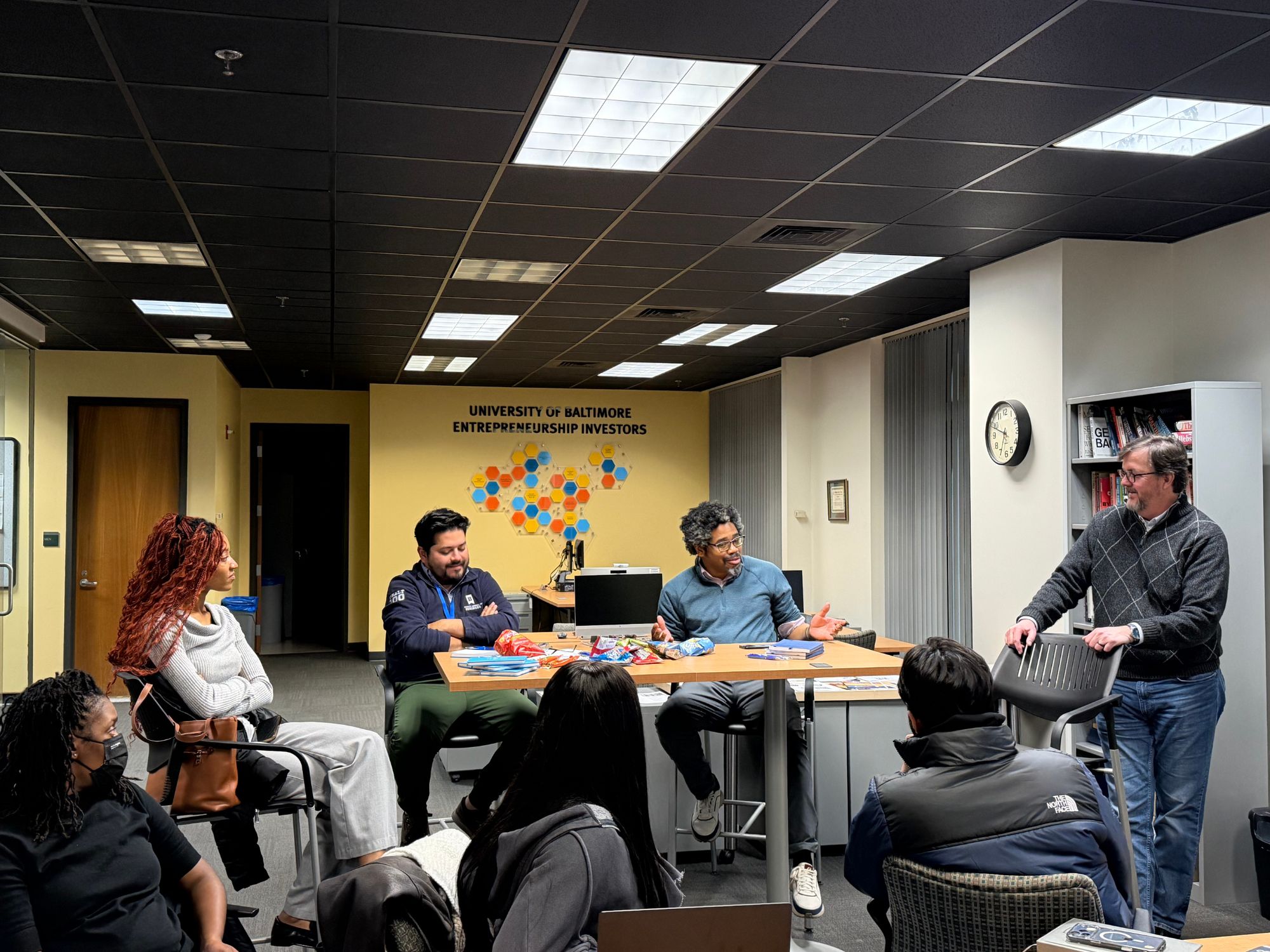
Instead of opening with slide decks or technical lectures, the inaugural session centered
on human connection. Founders were invited to share why they started their ventures;
the problems keep them up at night and what unanswered questions they hope to resolve
over the coming weeks.
“This is a working studio, not a lecture hall,” said Henry Mortimer, director of the Center for Entrepreneurship and Innovation. “The goal here is progress, not perception. We want founders to feel safe thinking aloud, asking hard questions and learning together faster than they could on their own.”
From the start, the accelerator made it clear that this program isn’t about memorizing
scripts or polishing slides. Founders were encouraged to replace formal pitches with
real conversations, especially when talking to customers.
Customer discovery, Mortimer explained, is not an interview designed to confirm what founders already believe. It requires listening closely, asking better follow‑up questions and being comfortable with uncertainty.
“It’s okay not to have the answers yet,” he said. “This space is for thinking out
loud, testing assumptions and learning faster together than you could on your own.”
That listening‑first approach shapes the early weeks of the accelerator, which prioritize understanding the problem before building or scaling a solution.
The program is co‑led by Sunny Sanwar, assistant professor of entrepreneurship at the University of Baltimore, who outlined a clear yet flexible roadmap for the weeks ahead. He spoke candidly about a common mistake among early‑stage founders: moving too quickly from idea to execution without understanding the market.
“Product–market fit isn’t something you assume,” Sunny told the group. “It’s something
you earn.”
Over nine weeks, founders will move step by step through customer discovery, validation,
go‑to‑market strategy, product‑market fit, pricing, financing and storytelling. Each
phase builds on the previous one, helping founders slow down just enough to replace
intuition with evidence—without losing momentum.
Supporting founders on the technical side is Jason Michael Perry, founder and chief AI officer of PerryLabs and entrepreneur‑in‑residence at CEI. With more than 20 years of experience building
software and AI‑enabled systems, his role is not to teach founders what AI is, but
to help them understand what’s realistic, feasible and worth building.
“We’re still very early in this AI moment,” Perry said. “The real opportunity isn’t
just using AI—it’s using it intentionally and responsibly, in service of real problems.”
His guidance focuses on helping founders move beyond surface‑level AI adoption and
into practical workflows that support decision‑making, execution and scale.
The accelerator is supported by TEDCO’s Baltimore Innovation Initiative, and Jalaycia Lewis, the program’s manager, emphasized that the work happening in the room matters beyond
the individual startups.
This program, she noted, is part of a larger effort to strengthen Baltimore’s innovation
ecosystem—helping founders validate ideas, move toward commercialization, and prepare
for long-term growth. What founders build here contributes not just to their own companies,
but to a broader pipeline of innovation across the city and the state.
In the weeks ahead, founders will meet with mentors, conduct customer discovery interviews,
challenge their assumptions and document how their thinking evolves on the way to
Demo Day. CEI will continue to highlight founder journeys and lessons learned throughout
the program.
If Day One made anything clear, it’s this: the accelerator isn’t about perfect pitches
or quick wins. It’s about doing the hard, often uncomfortable work of listening—before
building, scaling or selling.
And for this cohort, that work has already begun.