

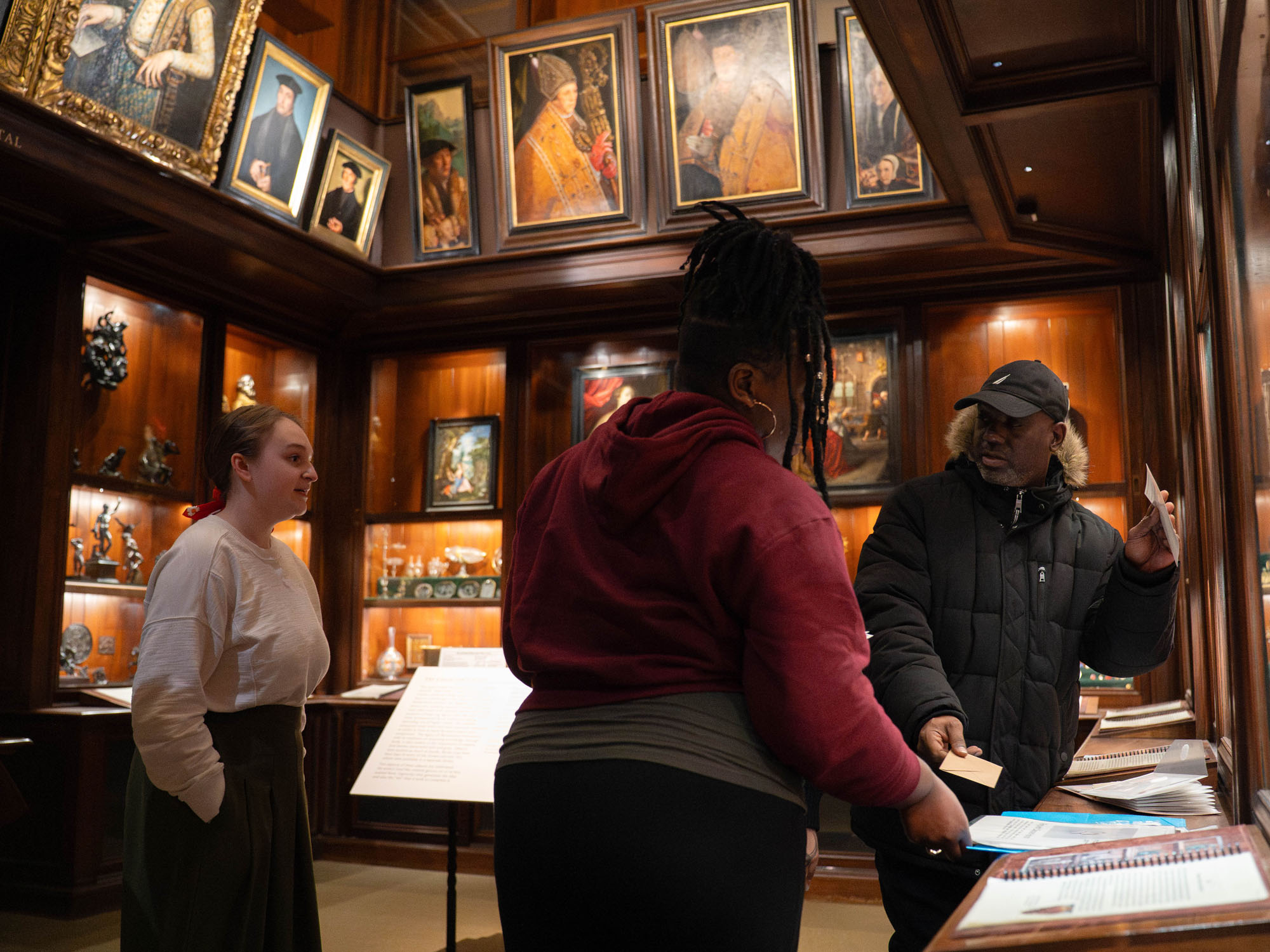
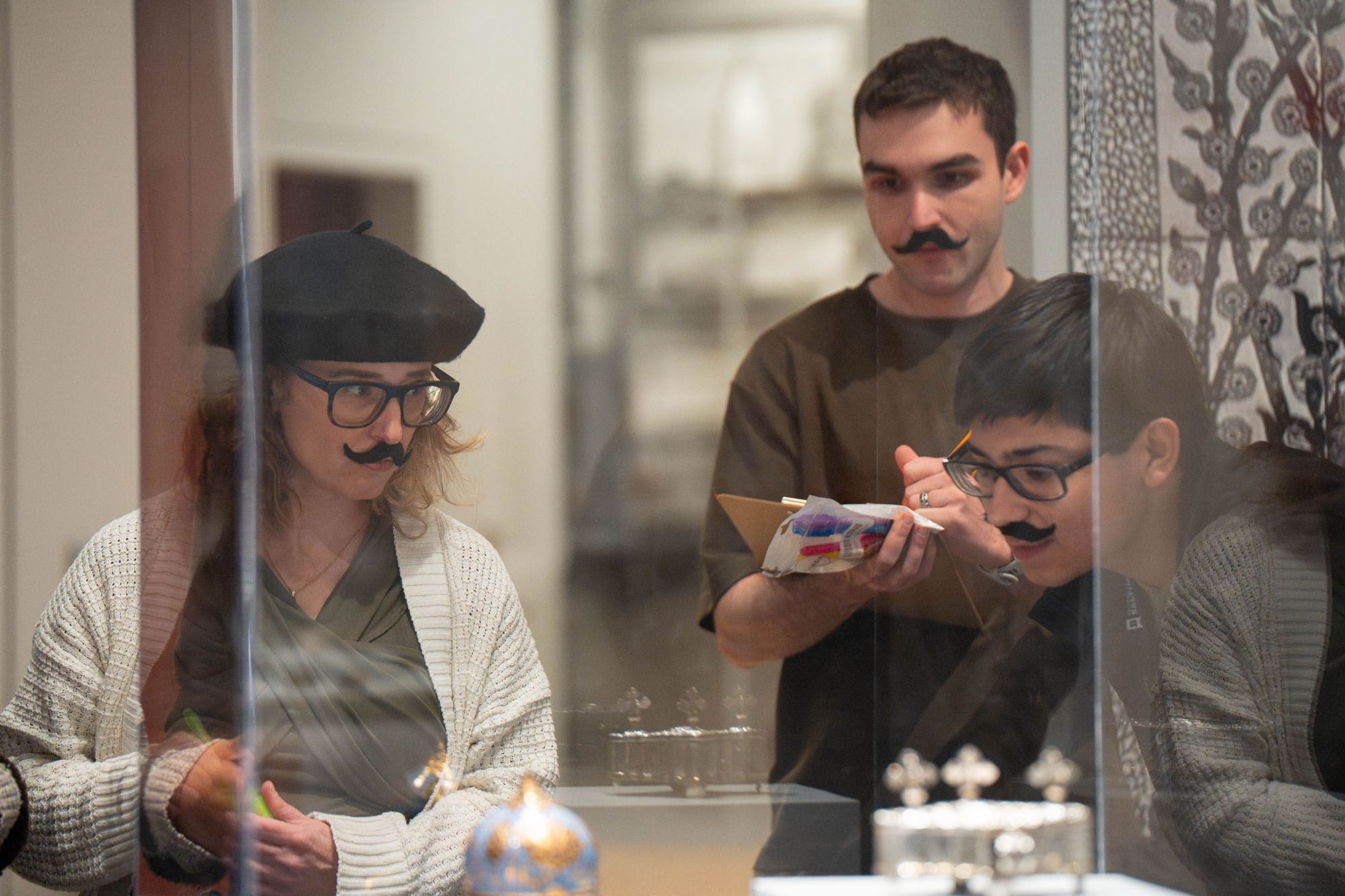
Some students positioned curly mustaches on their face while others donned their artist berets. They caught some attention from fellow guests of the Walters Art Museum but didn’t notice. These University of Baltimore students had a mission to complete.
They spent most of their semester in Dr. Rachael Zeleny’s Arts in Society course building elaborate scrapbooks that could serve as portable escape rooms. These books would live at the free Baltimore museum for visiting high school students to play. The college students had to test-run their creations: Did their narratives make sense? Were their escape rooms solvable?
“It's definitely a different type of class,” said Heintz Delany, a B.A. in English major. “It's a big process but it's cool to design something like beginning to end.”
The class itself was its own challenge for Zeleny.
She received a grant from the Office of the Provost and earned a service-learning designation from the University around her idea of gamifying public spaces to create a field trip alternative for local high schools. The Walters is already free to visit, Zeleny noted, and the escape rooms could rejuvenate the experience with an immersive, playful element.
“What we are doing is we are figuring out how we can use storytelling strategies in order to make places like museums more engaging for the public it serves,” Zeleny said.
More than once, Zeleny has reimagined what the Arts in Society course could be for her students—typically a mix of majors from across the Yale Gordon College of Arts and Sciences. This latest iteration allowed her to mix her longtime passion of helping students gain appreciation for museums and art with the University’s renewed commitment to community partnerships and engagement.
UBalt recently received a 2026 Carnegie Elective Classification for Community Engagement. Zeleny's course is just one example of how UBalt faculty are finding ways to fulfill the greater community’s needs through their students’ coursework.
With the Walters’ blessing, Zeleny held many of her classes at the Mt. Vernon museum so her students could get to know the collections and pieces that made this space unique.
Zeleny found support from her fellow UBalt professors throughout the project. Shelly Clay-Robison, an assistant professor for UBalt’s College of Public Affairs, came to the Walters to talk with Zeleny’s students about some of the stories and conflicts behind the art. Dr. Greg Walsh, associate professor and Parsons Professor of Digital Communication, Commerce, and Culture, gave a lesson about the concept of game flow, and Jacob DeGeal, assistant professor, spoke to the students about color theory and how it could advance their designed puzzles.
Even the books her students used to house each escape room were a collaboration; students in the MFA in Integrated Design program made them specially for Zeleny’s project.
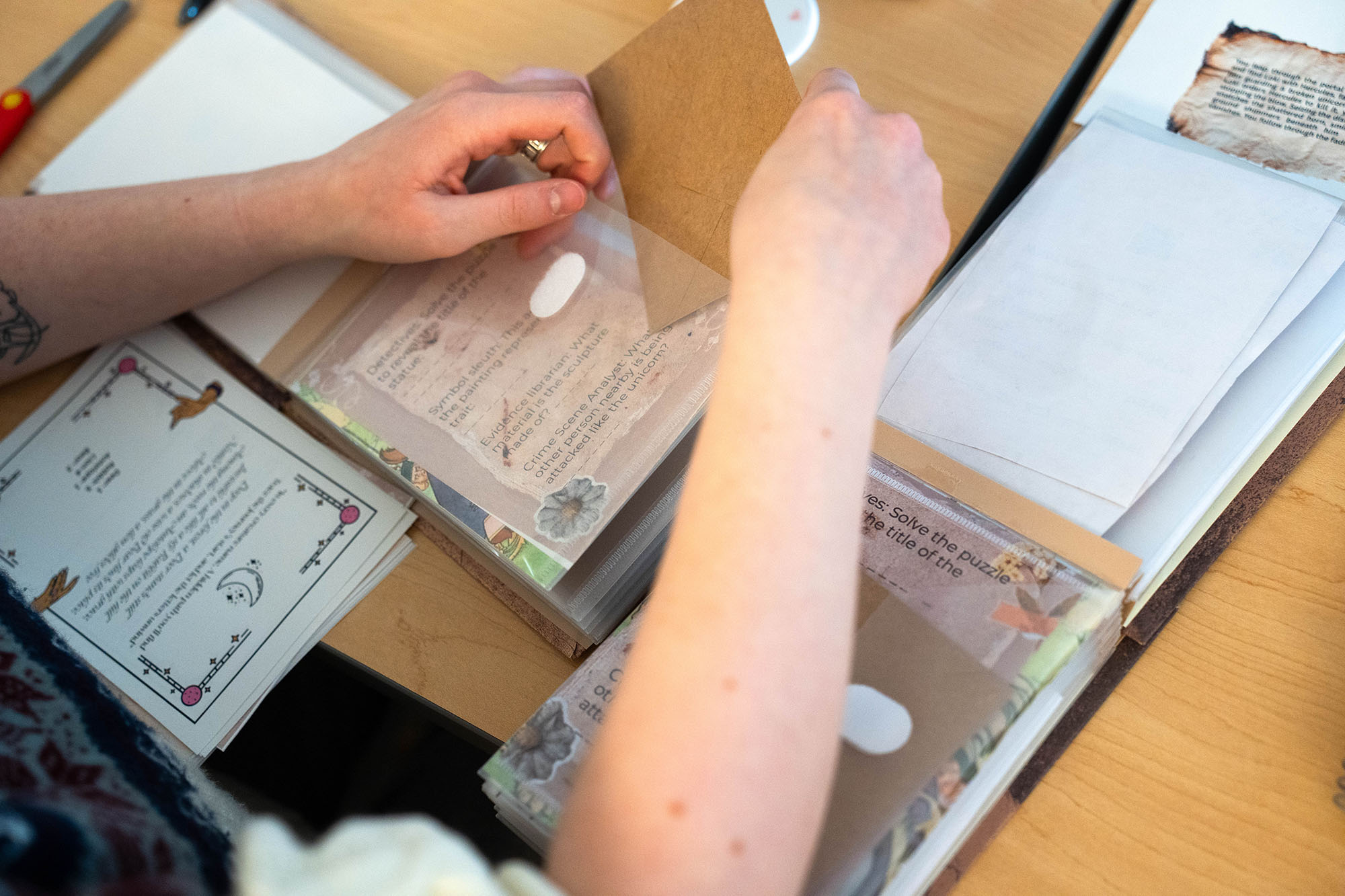
At the start of the semester, Zeleny gave her students the plan and they had to build everything from nothing. The guest lectures and museum tours helped them get to know the Walters’ galleries and pieces within each. They had to pick where they wanted to focus their project, which pieces would be central in their stories, and then work backward to write the story around those pieces. Once they had the story, then they could create the puzzles and write the questions that would help the player solve their quest.
The students divided into four groups and picked from one of three themes to design their escape rooms: murder mystery, time travel and art heist. Their stories would be imagined based on the artifacts and collections within the Collector’s Study, the Chamber of Wonders and the John and Berthe Ford Gallery of Indian, Nepalese and Tibetan Art.
For Zeleny’s students, the project carried more significance knowing it will become part of the community and used by others.
Markayla Merchant, a B.A. in Digital Communication student, welcomed the idea that gave schools more options for field trips.
“There are many students who might enjoy art but don’t get the chance to explore it because it can feel confusing or inaccessible if no one introduces it to them,” she said.
Benjamin White, a B.A. in History student developing a murder mystery with his group, agreed. He hopes their projects make the museum more inviting for those that might otherwise miss out on their value.
“Art museums aren't as engaging for a lot of people, but they tell so much about our culture and our history, and I think that's very important for us to know about those types of things,” he said.
For his group, a fork and knife, a necklace and a ring, and a statue of a head helped develop a story of forbidden love, jealousy, power and murder.
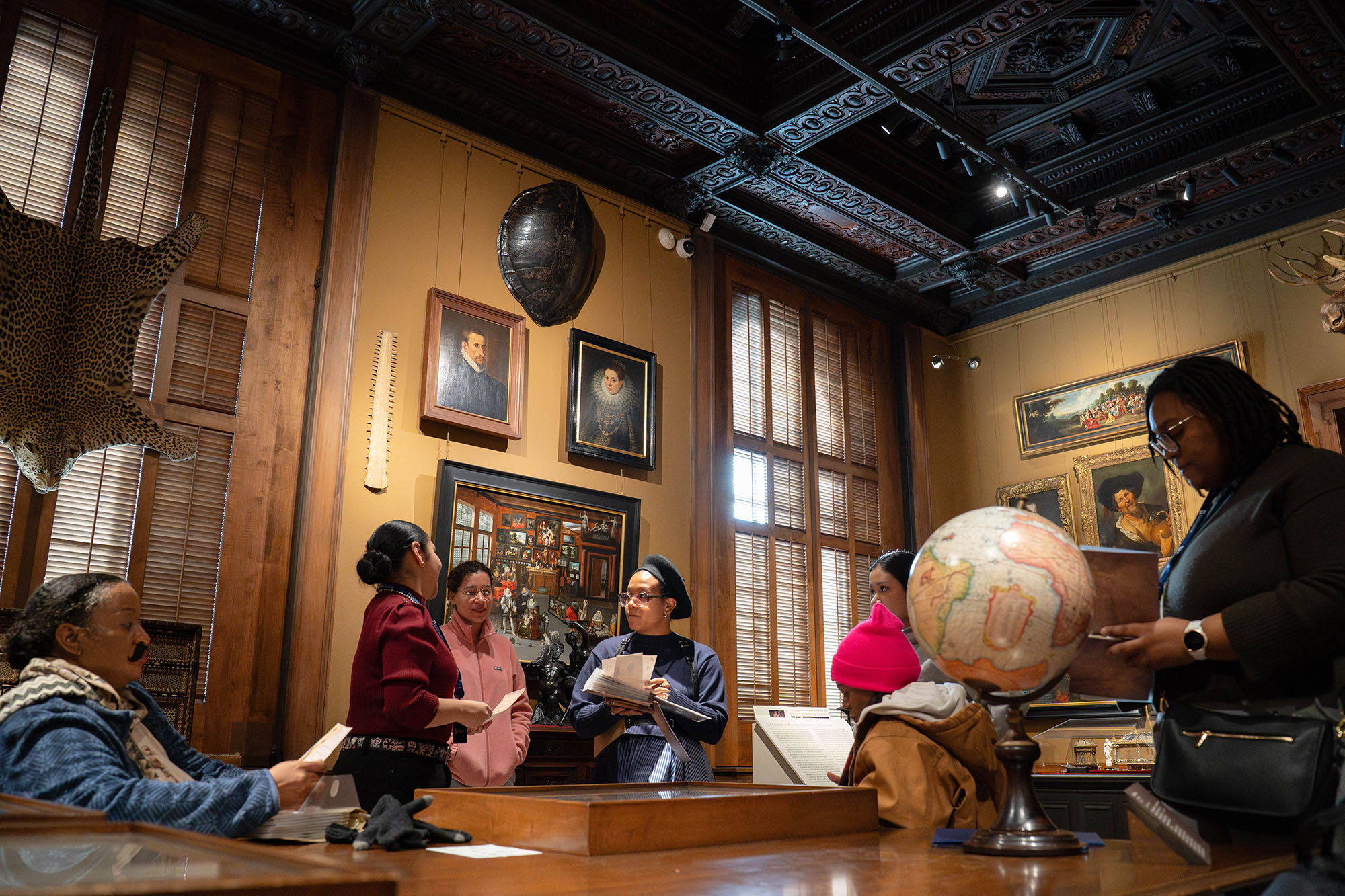
Kimberly Flores’ group cast their story around Loki, Greek god of chaos, who needs to be stopped from wreaking havoc with our timeline. In the busy Chamber of Wonders, some puzzles require a keen eye and patience.
“We had a lot of fun with it,” said Flores, a B.A. in Business Administration student. “We used our own creative outlets with different things to make it more interactive and took feedback from our classmates.”
Once the students had their narratives, they could start to consider what pieces their escape room books required to play out that narrative. Zeleny ordered a variety of game pieces including small silk purses and blacklight pens that her students could add to the book sets to deepen the user’s experience.
“Our goal is to keep everyone off of their phone as much as possible, and to make sure each student feels like they have a responsibility in terms of completing the puzzles,” Zeleny said. “We have the detective who's in charge of solving the puzzles. We have the evidence librarian who's in charge of reading the catalog. We have the symbol sleuth who is given the task of understanding common symbols in art. We have the crime scene analyst, who's in charge of actually finding the object in the gallery. And then finally, we have the sketch artist who is in charge of rendering a quick copy of the piece of art that we found.”
As the semester was ending, Zeleny invited some of her other students to the Walters to test what her Arts in Society students created. The students had to make sure the escape rooms worked as planned or note necessary adjustments.
Once the students’ books were complete, Zeleny coordinated with local high schools to come try them, too. Mere months after her students finished their work, high school students were coming to the Walters to take up their challenges—finally fulfilling Zeleny’s nearly year-long goal.
“It has been absolutely amazing to watch students play these,” she said.
The first group, students from Western High School, carefully reviewed every word as they navigated their way through the museum rooms and shared positive feedback about the project, Zeleny said. Students from another group, a high school in Catonsville, shared that they had never been in a museum before their visit, and were so thrilled at not only the escape room addition, but just the opportunity to visit more of the Walters with Zeleny acting as an impromptu guide.
“That was a really cool experience. That really did work exactly the way I wanted it to: This was a gateway to a space that those students would have never come into,” she said.
Zeleny’s Arts in Society students were grateful to have been part of the project, both for the community and for how it opened their own perspectives to what a museum can be.
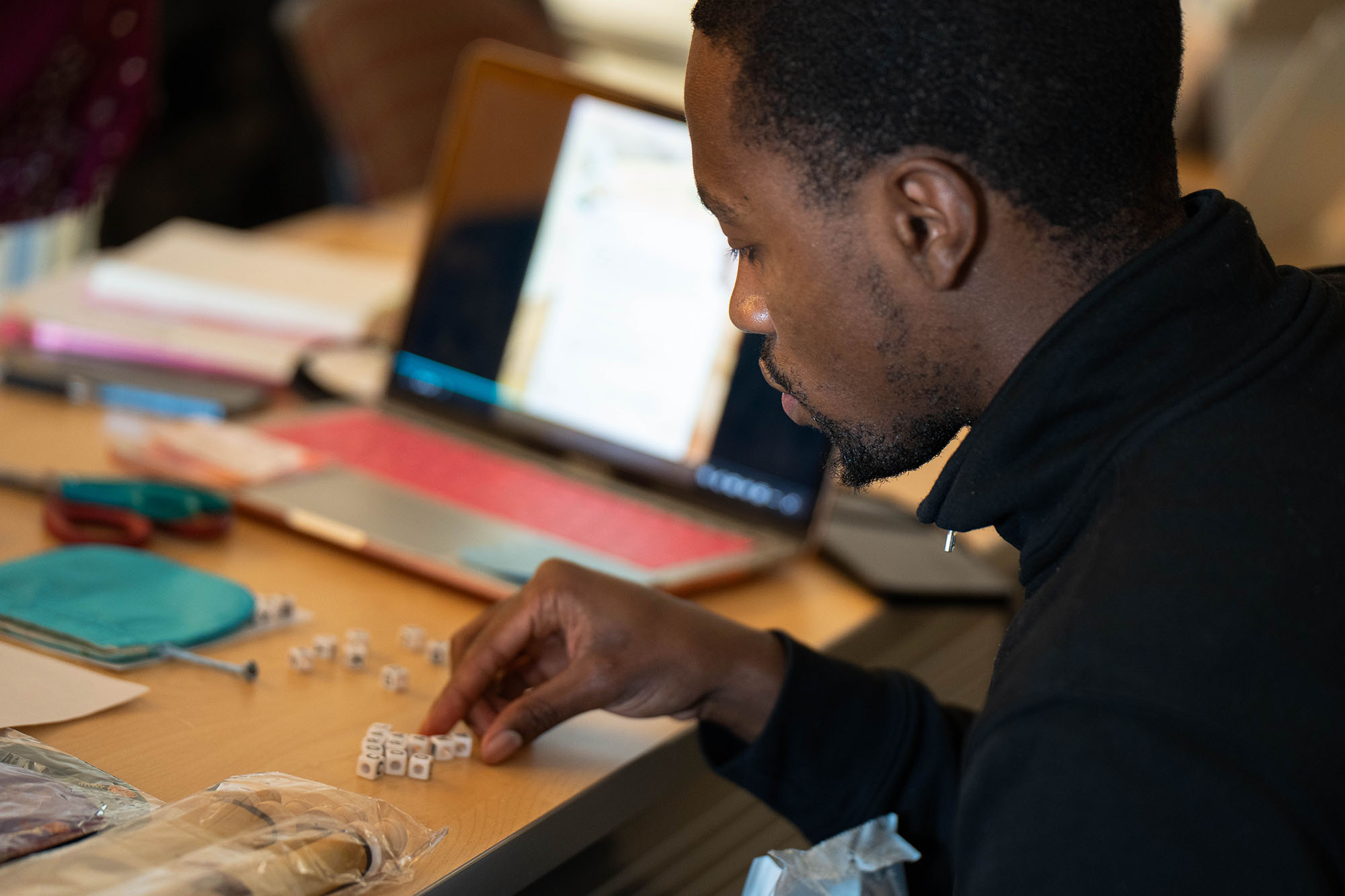
“Working through puzzles required communication, trust and shared problem-solving, which helped me get to know my classmates better than in more traditional classes where interaction is limited,” said Erika Young, a B.A. in Arts Production and Management student. “Because the games demanded focus and teamwork, I found myself more present in the moment, paying closer attention to my surroundings and the people around me. The physical spaces themselves became active parts of the experience rather than just backgrounds, encouraging close observation, movement and engagement.”
Gamar Hayles, a B.S. in Information Systems and Technology Management student, said this class changed his relationship with art and museums.
“Art doesn’t just show us objects, it tells stories about power, class and identity, often in ways words can’t capture,” he said. “When we combine those stories with our own experiences, the meaning becomes even richer.”