

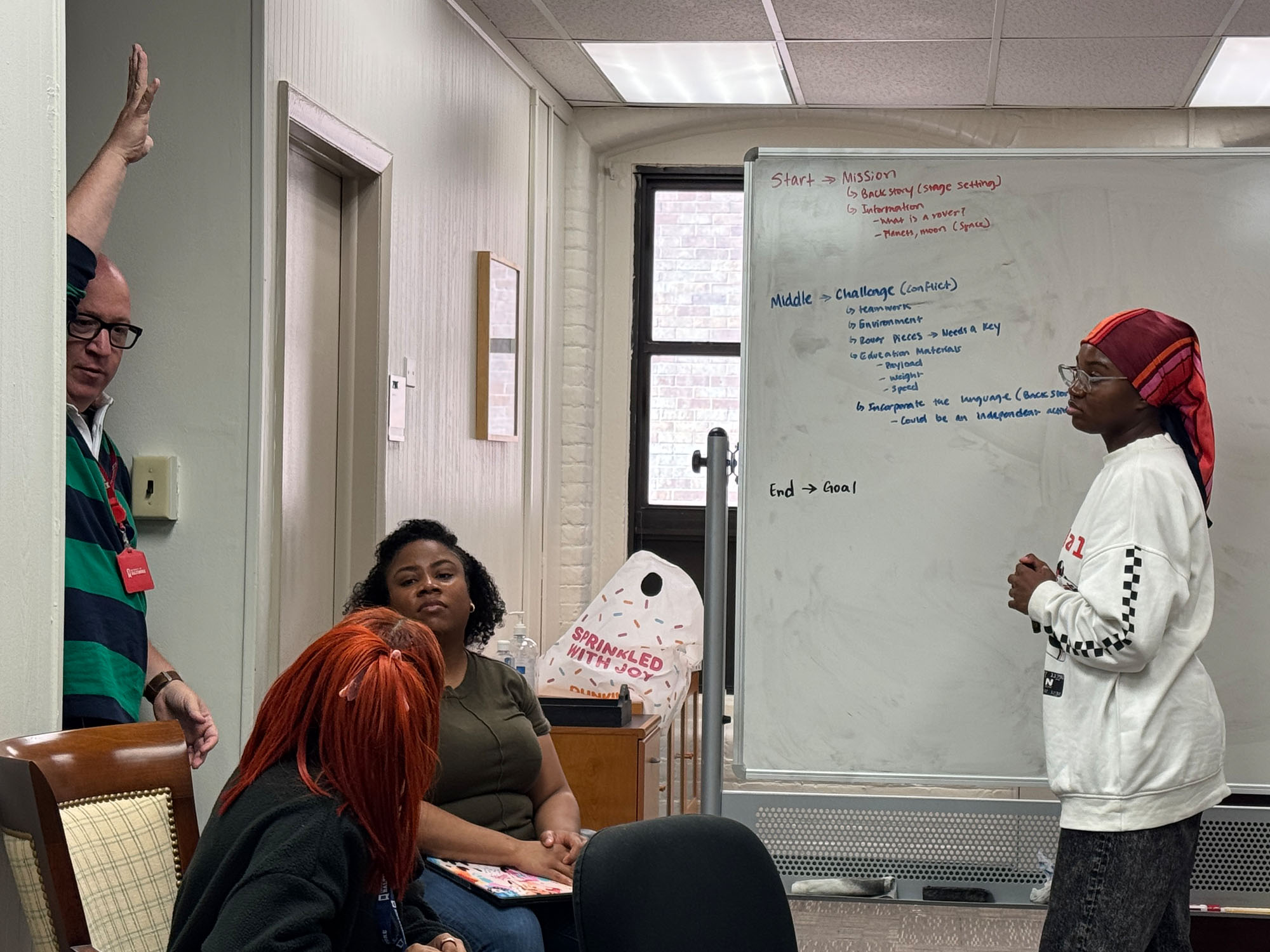
Students in the in-person and fully online programs at The University of Baltimore had a rare opportunity to get together for a behind-the-exhibit look at Port Discovery Children’s Museum.
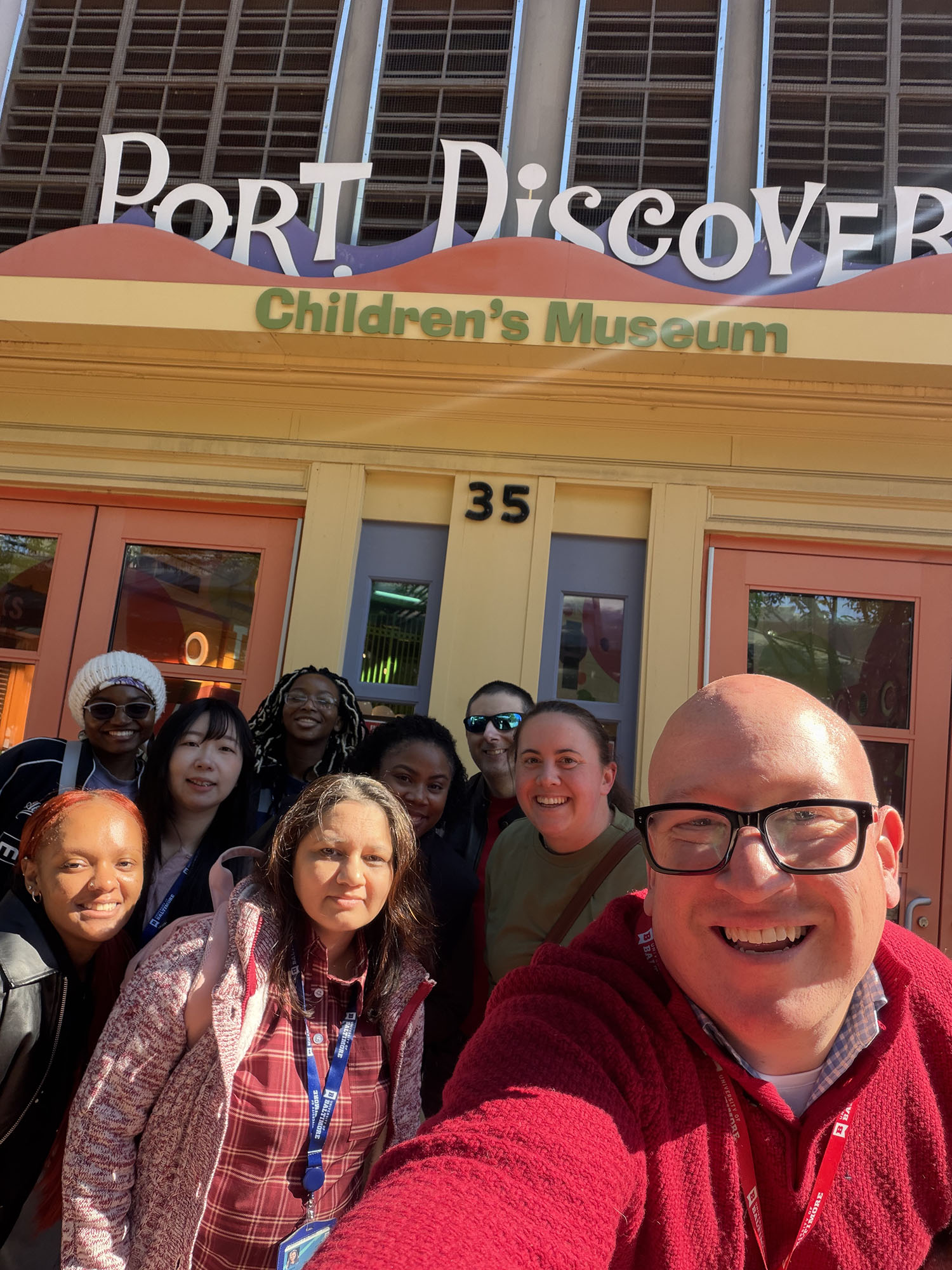
Students in Dr. Greg Walsh’s Topics in User Research course took up a challenge: re-imagine an exhibit so it’s more engaging to older and younger kids alike.
Within 48 hours, they were back at the Baltimore museum presenting the results of their co-design work to a staff interested in implementing those ideas.
It was a key learning opportunity for the M.S. in Interaction Design and Information Architecture students excited to design collaboratively while supporting a city museum.
“This research has been awesome,” Manisha Gurung, B.S. ‘23, one of the IDIA students, said. “We went to the museum; we were able to talk to people who have a background in a similar field, and they were explaining how they come up with ideas. It’s been wonderful.”
For Walsh, the Bob “PXG” Parsons Professor of Digital Communication, Commerce, and Culture, the class is a valuable experience in co-design. The students collaborated with peers and community partners, evaluate diverse perspectives and integrate feedback into a cohesive plan.
This fall, the students’ on-campus project started with the field trip to Port Discovery. There, they met with design personnel who imagine and create the exhibits. Then they were given a puzzle to resolve: A space-themed exhibit wasn’t seeing the engagement that staff anticipated, especially given the potential for older kids visiting with younger family members.
When Sowmya Nath enrolled in UBalt’s IDIA program, she was looking for opportunities like this so she could build on what she learned in the User Experience (UX) Design Certificate program. She hopes the master’s degree will provide new skills that set her apart in the rapidly evolving marketing field.
“Marketing jobs are changing so much. I’m with the team that works for the website, so I definitely use information architecture principles in my daily work as well as design,” Nath said. “But, at the moment, with AI changing design and what it can do, our focus has to change.
“So, we’re moving away from actually doing web design so much as making it more strategic, and that’s where I think the advanced degree in IDIA would come in handy.”
Nath picked UBalt’s program because it was available fully online. She lived in the city for 13 years but moved with her family to Atlanta for work. The IDIA program format allowed her to pursue the degree she wanted from her new home—and around her full-time job there—while keeping a connection to her former city.
Having the in-person project was worth the travel and time for Nath. She found value in the back-and-forth dialogue with her classmates and tour with museum staff.
Nath also appreciated brainstorming with students from The Community School, a high school in Remington, who visited the class to learn about the design process.
Some used past visits to Port Discovery for inspiration, while others used their imagination to devise new ideas. Proposals included slides, climbing walls and trampolines, Nath recalled.
“When we were online, we learned about the ethics, we learned about what exactly research is, what constitutes research, but when we are here in person, we actually get to interact and work with each other, and having the materials to watch the children build a prototype was just priceless,” Nath said. “You can’t do that online.”
Gurung felt similarly. She is interested in working in UX design after she finishes the program and is looking for ways to build her portfolio in the meantime. This project proved a perfect opportunity in hands-on work and collaborative research.
“To meet everyone and to get this project done together as a team, this is giving me a good idea of what the real research looks like,” Gurung said.
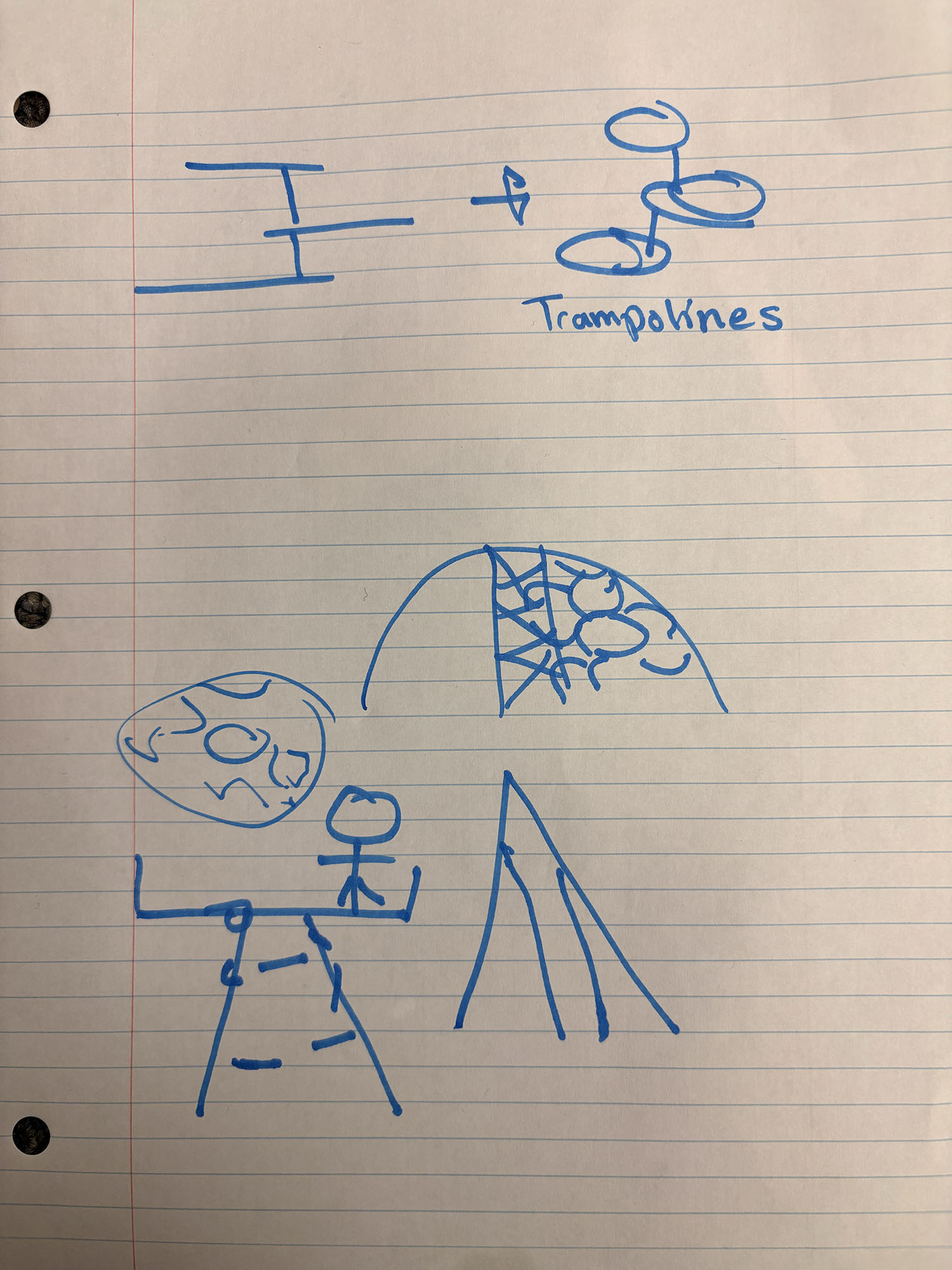
As part of their co-design work, Walsh’s students synthesized the high school students’ concepts into several scenarios, drawing lines between interaction, immersion and opportunities for independent play. Then they created a series of storyboards to gather feedback from members of the UBalt community.
They considered several possibilities: What if the exhibit wasn’t just about building a rover vehicle, but re-tinkering it so it could manage different terrains and challenges? What if the participants had a lasting piece of the exhibit, like a photo with their rover? And what if mission cards encouraged groups to solve tasks together, deepening engagement?
“It’s not just STEM, it’s more about when you have a good idea or when you do something creative, you should just keep iterating on it. It’s not just a one and done kind of thing,” Walsh said.
Walsh was impressed with his students’ ability to create ideas that could not only address some of the initial problem they were working to solve, but also enhance the exhibit, pull from different skill sets, and make it an inviting and interactive place of play.
The project culminated in a formal presentation for Port Discovery staff, which valued the UBalt students’ ideas, too.
Hope Myers, vice president of exhibits, said the museum’s education team had planned time to discuss the presentation and consider steps in implementing some of the ideas. She said the museum is always looking to work with and gain feedback from members of the Baltimore community.
“Part of Port Discovery’s mission is to create playful experiences that are accessible to every child, family, educator and members of our community,” Myers said. “We view partnerships with higher educational institutions as opportunities for students to playfully learn and for our museum to get outside perspectives on how to continually improve the experiences we provide.”
Deborah Greengold, director of marketing and communications at Port Discovery and a UBalt alum, said inviting community feedback brings fresh perspectives and the museum actively seeks partnerships with students and emerging talent.
“Partnerships like this are great ways to build stronger connections within the city and only elevate the experience at the museum for the next generation of children and families,” she said.
This partnership was particularly meaningful for Greengold, who noted that she and the museum’s digital content specialist, Ashanti Smith, are both 2025 graduates of UBalt’s M.A. in Integrated Design program.
“It’s extra rewarding to have the chance to have current students in our museum and connect with members of our team,” Greengold said.