

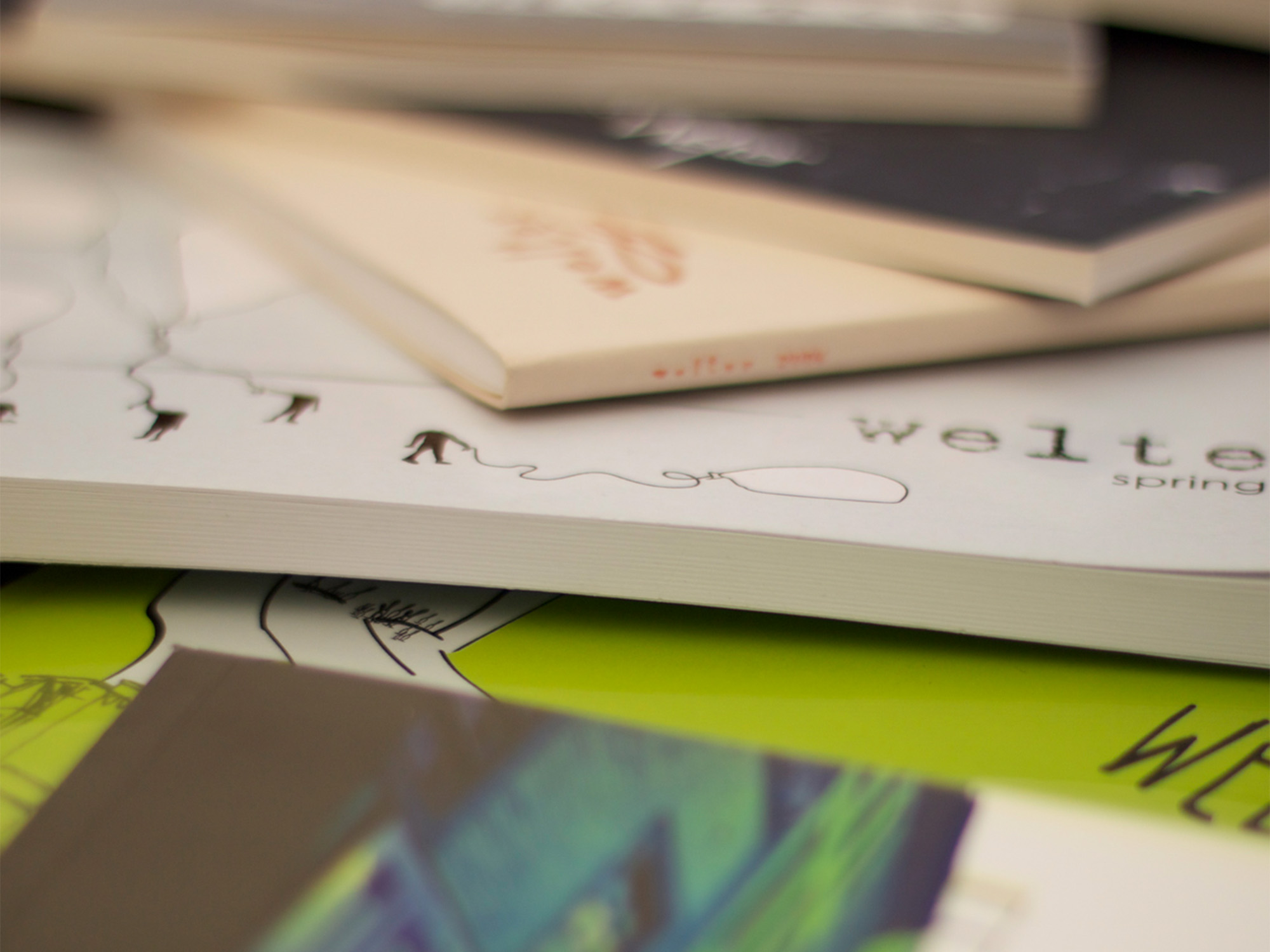
Welter, the longtime literary magazine of The University of Baltimore, will publish its 2026 edition on May 5. All of the accepted submissions, including short fiction, nonfiction, essays and poetry, are presented as a form of flash writing―concise, to the point, and intended to deliver an emotional punch that is made more powerful by the brevity of the form. The new edition will be celebrated with an online reading on Thursday, May 7 at 6 p.m. The event, held on Zoom, is free and open to the public. Registration information is listed below.
UBalt undergraduate and graduate students in the University's writing and communication disciplines, guided by the faculty, received hundreds of submissions to the publication from across the United States and the UK. For visual art submissions, including drawings, photography, paintings and more, the edition's prompt called for artists to send work inspired by the concept of flash.
Welter is one of several publications at the University, and serves as an essential part of the learning process in both creative writing and publishing.
Loosely described, flash writing is as short as possible, but also expansive beyond its word count― usually 800 words or less for narrative pieces. In poetry, flash can encompass haikus, sonnets, tankas, and free verse. Flash writing requires a measure of discipline that represents something new and challenging for many writers. It's an increasingly popular form that, according to the University's MFA in Creative Writing and Publishing Arts Director Betsy Boyd, has attained mainstream acceptance.
"Having any constraint as a writer can help us get going," says Boyd, who serves as Welter’s editor and supervisor of the student-led editorial team. "When I am moved to write a flash, I can do it quickly and submit it quickly, and that is such a nice feeling. It creates a great contrast with the kind of methodical work that it takes to create a novel. The best flash leaves you with a shiver at the end. All of the pieces we've accepted sure do. It's not easy to write, but when it comes together, the brevity—of setting the scene, making the music, removing the nonessential—is a kind of magic."
Prof. Boyd says the popularity of flash is a natural outcome of a time of "digital, national, and global chaos."
"We're reading a lot less, all of us. Why? It's hard to find quiet, sacred focus in this age, and that's proven," she says. "We rely on our devices for some kind of connection, but they become an addiction. We're active on an endless number of text threads and everything else, but it takes a toll and takes us from our inner selves. Reading can bring us back, and flash is something you can read with ease. I consider it an invitation back into reading―a way back to finding meaning. And meaning can't be hacked. It can't be faked."
Kim Wernsing, a senior graduating in May with an English degree and a concentration in creative writing, said that serving as Welter's editor for flash fiction submissions gave her a new appreciation of the ability to tell a story within the confines of a page or so.
"Flash writing may look brief, but it holds tremendous depth," Wernsing says. "Each piece felt like a well-traveled path worn deep into the woods. Whether written in a single day or over many years, each work carries the weight of a lifetime—its joys, its grief, its quiet truths. Reading them, I felt their stories linger in my body long after the last words left the page."
Boyd cites three Welter flash pieces—Lauren Mirzakhalili's story "Little Hatcher"; Karen McGee's memoir piece "Golden Joinery"; and Nat Raum's poem "Sonnet for Shorter Days"—as exceptional examples of the form.
"These are all answers to the question of why we write," she says.
The 2026 flash fiction edition of Welter will be celebrated on Zoom. Readings by artists whose works were selected for inclusion in the new edition will highlight the event. To receive the login code for the May 7 Zoom event, send an email to Prof. Boyd at bboyd@ubalt.edu.
Learn more about Welter and its 60-year publishing history.
Learn more about UBalt's MFA in Creative Writing and Publishing Arts and the Digital Communications major.