School of Law
School of Law
The Center for Criminal Justice Reform supports community-driven efforts to address the harm and inequity caused by the criminal legal system and improve public safety. It brings together diverse voices and decision-makers to examine how the criminal legal system currently functions and collaborates on strategies that promote justice throughout the country and in Baltimore.
The University of Baltimore School of Law established the Center for Criminal Justice Reform (CCJR) in 2022 to address numerous challenges facing the nation, including mass incarceration and rising gun violence.
The Center and a companion Criminal Defense and Advocacy Clinic launched in Spring 2023 and were made possible through a $3 million donation from Baltimore Law alumnus Samuel G. Rose, LL.B. '62. A retired commercial real estate developer who obtained his law degree while attending night classes, Rose had a highly successful career in commercial real estate, largely in metropolitan Washington, D.C., and worked for corporations including the Rouse Co. and the American Trading & Production Corp.
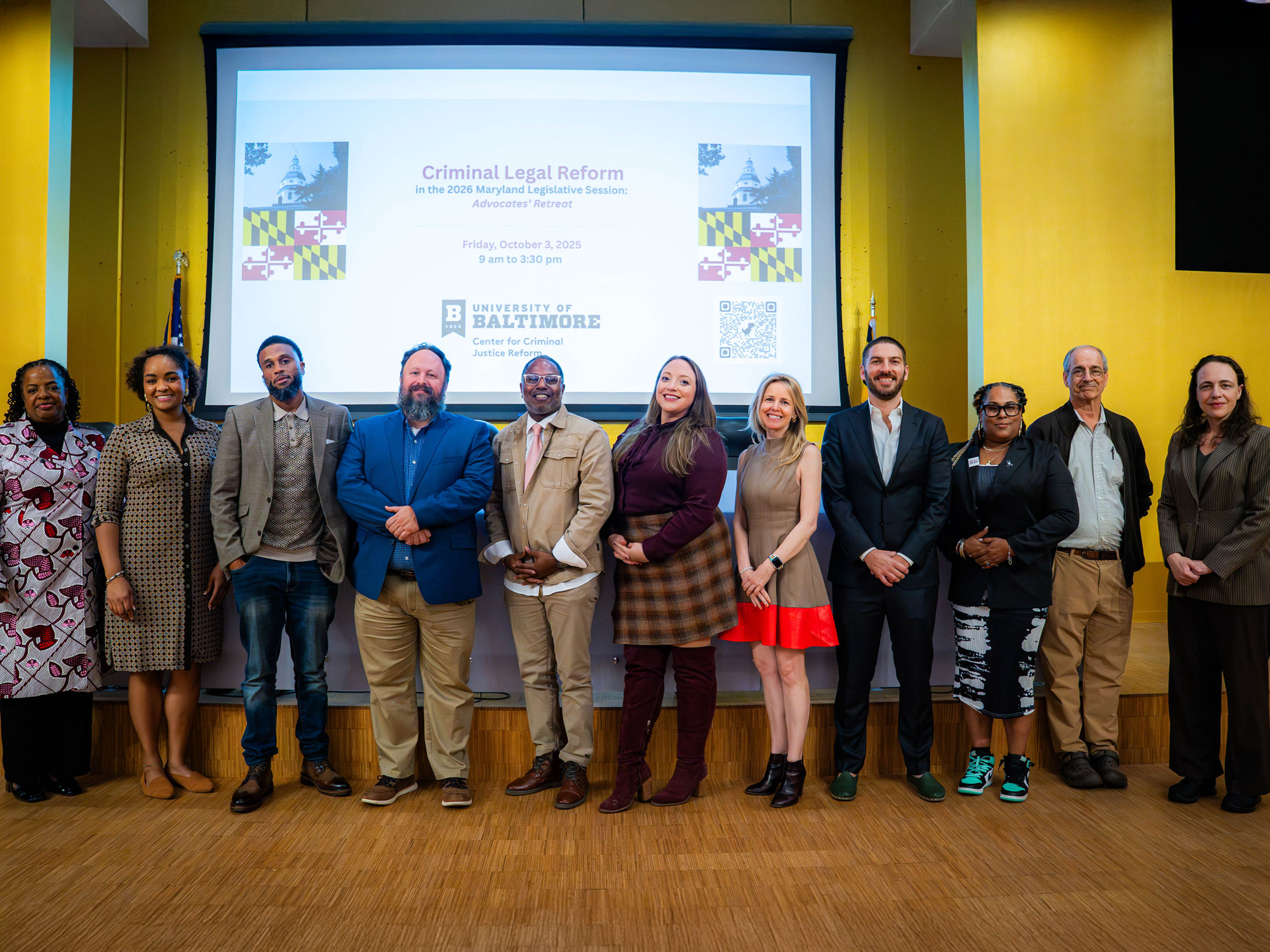
Through its initiatives and partnerships, the Center brings together community and government stakeholders to identify challenges and suggest solutions to the deeply rooted inequities in our criminal legal system. Public events play a vital role in fostering and maintaining these important conversations.
The Center also supports UBalt faculty and students in direct service initiatives, including the exoneration of wrongfully convicted individuals and efforts to release persons convicted as juveniles serving lengthy sentences. It affords UBalt students with additional experiential learning opportunities that foster tangible change across various criminal justice reform issues, and offers the opportunity to collaborate with grassroots organizations, policymakers, and those directly affected by these issues.
The Center serves as a statewide hub bringing together diverse voices across advocacy, research, policy, and lived experience to foster collaboration and strengthen justice and community safety.
The Center advances community rooted, evidence based reforms by bridging lived experience, research, and policymaking to help ensure change takes hold in practice.
The Center supports research that connects data, policy, and practice to advance evidence based, community driven safety strategies and reforms.
The Center prepares future lawyers, advocates, and policymakers through hands on experiences that support transformative justice and systems change.
The Center informs and shapes public understanding of safety and justice by elevating community perspectives and reframing conversations around equity, harm, and reform.
The Center connects government, community, practitioners, and academia to strengthen collaboration and advance intersectional, cross disciplinary justice strategies.