

Assessment of academic programs is undertaken on a continuous basis at UBalt. Student Learning Outcomes and educational effectiveness of each program are assessed regularly. This work builds towards more encompassing Periodic Program Reviews. In addition, selected programs are accredited through professional bodies.
Below are helpful tips to help with the program assessment process
In accordance with the standards for conducting and documenting assessments by the Middle States Commission on Higher Education, the University of Baltimore ensures that assessment processes, findings and interventions are housed centrally within SharePoint sites under appropirate security. Sharepoint is used to collect and manage data in the following areas for each academic program and various administrative units:
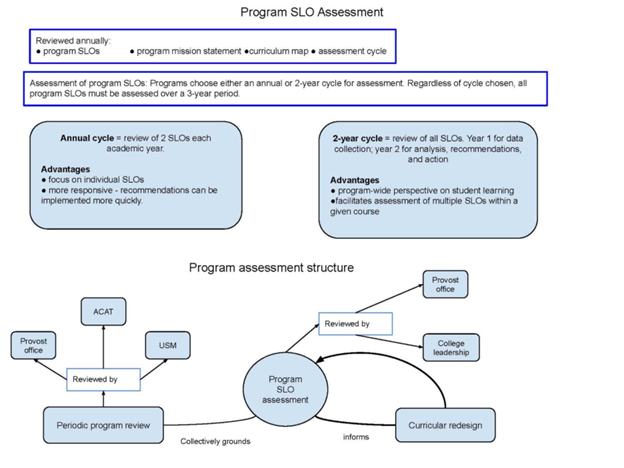
Students perform best when they have a clear understanding of what is expected of them and how they can best meet those expectations. Learning outcomes are formal statements that articulate what students should know and be able to do at the end of the course or as a result of instruction. Each academic program at UBalt has a guiding set of student learning outcomes (SLOs). These should be periodically reviewed and updated by faculty. Program-level SLOs inform learning outcomes for each course. These should be communicated clearly to students in the syllabus. Here is an effective format for including learning outcomes on a syllabus:
By the end of this course, successful students should be able to:
Regular assessment of the degree to which our students are attaining learning outcomes provides us with evidence of the strengths and weaknesses of our curriculum and our methods of delivering it. Of course, the regional agency that accredits the University of Baltimore, Middle States Commission on Higher Education (MSCHE), requires its member institutions to assess student learning outcomes. However, the ultimate reasons for the assessment of student learning outcomes must be to make our curriculum stronger, to make us more effective teachers, and to help our students learn more effectively.
The assessment cycle is a process for continuously inquiring about how students, staff and faculty are doing. What are students learning? How are students learning? How is a particular service assisting our students? Is student learning supported or supplemented outside the classroom? Are current pedagogical strategies used by faculty effectively? Although all faculty and staff may use some components of the assessment cycle, use of all steps in this cycle results in continuous focus on the use of evidence to create better teaching and learning.
Whether one is assessing learning outcomes for an academic or co-curricular program or for a single course, it is important to remember that assessment is an iterative process, intended to provide useful feedback about what and how well students are learning. When developing an assessment plan, it is essential to think through all four steps of the cycle. Assessment is an ongoing process of planning, doing, checking, and acting.